No products in the cart.: $0.00
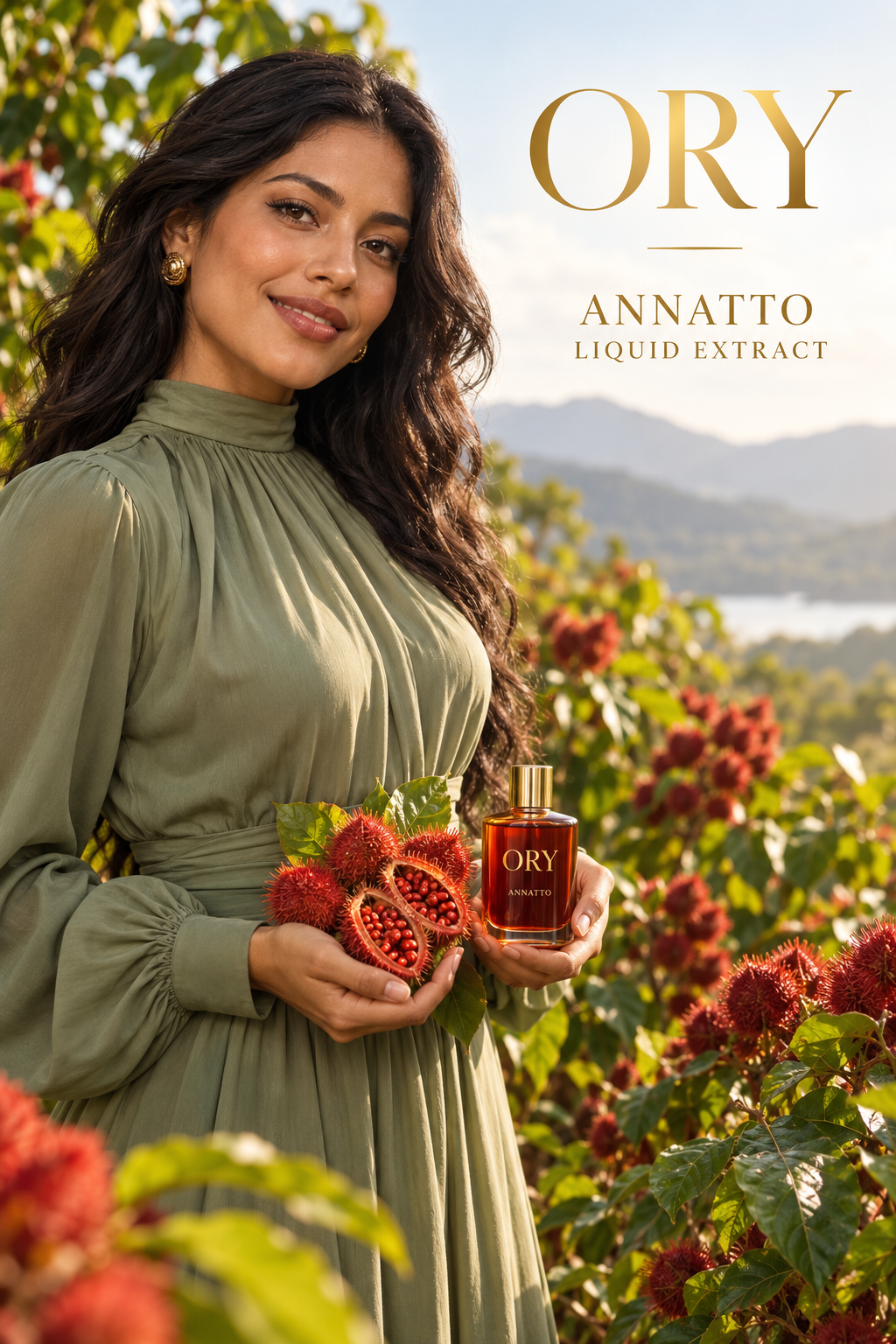
Annatto Liquid Extract

ORY® product lines:
☑ Skincare
☑ Haircare (limited: antioxidant, warm tint)
☑ Handmade Soap (classic natural orange colorant)
☑ Cosmetics (natural orange-red pigment; tocotrienol antioxidant) — full dual-use ingredient
Annatto liquid extract is made from the red-orange waxy coating of the seeds of Bixa orellana (achiote), a tropical American tree whose seeds have been used as body paint, sun protection, and skin medicine by Amazonian and Central American peoples for millennia. The extract carries two valuable families of actives: the carotenoid pigments bixin (oil-soluble) and norbixin (water-soluble), which give annatto its color and antioxidant activity [1, 2], and one of nature’s richest sources of tocotrienols — the potent vitamin E fraction that penetrates skin more readily than tocopherol and shows superior antioxidant and photoprotective activity in laboratory studies [3]. Annatto is an approved natural colorant (CI 75120) and a handmade-soap classic for stable, dye-free orange. Its warm color and antioxidant profile make it a four-line ORY® ingredient, with cost and color governing its use in haircare and cosmetics.
What is Annatto Liquid Extract made of?
Annatto liquid extract is prepared by extracting the seed coat with oil (bixin-rich, oil-soluble), alkaline water (norbixin-rich, water-soluble), or alcohol; the seed oil is a separate cold-pressed product. Constituents [1, 2]:
ORY® specifies the form by product: bixin/oil extract for soap, oils, and balms; norbixin/water extract for water-based products.
- Bixin (apocarotenoid, ~80% of pigment): Oil-soluble orange-red antioxidant; UV-absorbing.
- Norbixin: Water-soluble hydrolysis product of bixin; yellow-orange.
- Delta- and gamma-tocotrienols: Annatto is the only known tocopherol-free tocotrienol source; potent antioxidants [3].
- Geranylgeraniol: Precursor terpene with antimicrobial and anti-inflammatory activity.
- Flavonoids (apigenin, luteolin) and phenolic acids (in seed extracts): Supporting antioxidants.
- Sesquiterpenes (ishwarane) and fatty acids (in seed oil): Emollient minor components.
What skin type is best suited for Annatto Liquid Extract?
Annatto suits most ORY® skin types as an antioxidant and warm-tone colorant:
- Mature: Tocotrienol antioxidants and carotenoids support photoprotection and collagen defense [3].
- Normal: Antioxidant daily defense; natural sun-kissed tint.
- Dry: Annatto-infused oils and balms nourish.
- Combination: Low-level antioxidant in serums.
- Sensitive: Anti-inflammatory geranylgeraniol and tocotrienols; patch test (rare allergy).
- Oily: Water-soluble norbixin in light formulas.
- Acne-prone: Antimicrobial and anti-inflammatory support; use extract rather than heavy oil.
What hair type is best suited for Annatto Liquid Extract?
Annatto’s haircare role is antioxidant protection and warm tone enhancement:
- Color-treated: Tocotrienol antioxidants protect color; warm orange tint enhances copper and auburn shades (avoid on blonde).
- Dry or damaged: Annatto-infused oil conditions and protects.
- Mature or thinning: Antioxidant scalp support (traditional South American hair-strength use; cosmetic claims only).
- Sensitive scalp: Anti-inflammatory support at low levels.
- Straight, wavy, curly, coily, oily scalp, dandruff-prone: Optional antioxidant addition; scalp-only, low level.
What are the benefits of Annatto Liquid Extract?
Annatto’s benefits are supported by pharmacological reviews and vitamin E research [1–3]:
- Antioxidant: Bixin, norbixin, and tocotrienols scavenge free radicals and protect skin lipids [1, 3].
- Photoprotection support: Carotenoids absorb UV; tocotrienols reduce UV-induced oxidative damage in laboratory studies [3]; traditional use as sun paint.
- Anti-inflammatory: Geranylgeraniol and tocotrienols reduce inflammatory mediators [2].
- Antimicrobial: Seed extracts inhibit skin bacteria and fungi [1].
- Wound-healing support: Traditional and preclinical use for burns and wounds [1].
- Skin-penetrating vitamin E: Tocotrienols distribute into skin more readily than tocopherols [3].
- Natural colorant: Stable orange-yellow for soap; orange-red for cosmetics without synthetic dyes.
- Formula antioxidant: Tocotrienol-rich extract slows rancidity of oils.
Dual use across ORY® product lines
Annatto’s oil- and water-soluble forms and stable pigment fit all four ORY® lines; it is one of the few natural colorants that holds in cold-process soap.
Pros and cons of Annatto Liquid Extract
Pros
Cons
- Richest natural tocotrienol source: Premium vitamin E fraction [3].
- Stable natural colorant: Holds in soap where most botanical colors fade.
- Antioxidant and anti-inflammatory: [1, 2].
- Approved food and cosmetic colorant: CI 75120; long safety history.
- Sustainable, traditional: Tropical agroforestry crop.
- Staining: Strong orange stains skin, fabric, and light hair at high levels.
- Limited controlled skin trials: Evidence for topical annatto is largely preclinical; tocotrienol data are the strongest.
- Rare allergy: Documented annatto sensitivity (mostly food-related); patch test.
- Light fading in cosmetics: Bixin fades in prolonged light; package opaque.
- Color limits placement: Not suited to white or clear products.
What is the best application of Annatto Liquid Extract?
Annatto is an antioxidant, a colorant, and a soap classic:
- Antioxidant serum: Norbixin/tocotrienol extract AM under SPF.
- Sun-kissed body oil: Annatto-infused oil for a warm glow (not a sunscreen).
- Balm: Tocotrienol-rich annatto oil for dry, chapped skin.
- Hair oil: Color-protective, warm-tone-enhancing treatment.
- Soap: Steep seeds in olive or sunflower oil, strain, use in the recipe for orange bars.
- Cosmetics: Lip tint, cream blush, bronzer.
- Formulation: Tocotrienol extract as antioxidant in oil products.
Peer-reviewed references
- Vilar DA, Vilar MSA, de Lima e Moura TFA, et al. Traditional uses, chemical constituents, and biological activities of Bixa orellana L.: a review. The Scientific World Journal. 2014;2014:857292.
- Raddatz-Mota D, Pérez-Flores LJ, Carrari F, et al. Achiote (Bixa orellana L.): a natural source of pigment and vitamin E. Journal of Food Science and Technology. 2017;54(6):1729–1741.
- Sen CK, Khanna S, Roy S. Tocotrienols: vitamin E beyond tocopherols. Life Sciences. 2006;78(18):2088–2098.
Disclaimer:
The information on this page is provided by ORY International, LC for educational purposes only. It summarizes published research about annatto as an ingredient, including laboratory and animal studies and clinical studies of formulas that may differ from ORY® products. Results from these studies may not apply to every person or to ORY® products. This page is not medical advice and does not replace advice from a dermatologist, physician, or other qualified healthcare provider.
ORY® Skincare, Haircare, Handmade Soap, and Cosmetics products are cosmetics. They are not intended to diagnose, treat, cure, mitigate, or prevent any disease or condition, including sunburn, sun damage, wounds, burns, infections, inflammation, or hair loss. References to FDA or Cosmetic Ingredient Review (CIR) findings describe the ingredient, not ORY® products, and do not mean FDA has reviewed or approved any ORY® product.
Results vary by skin and scalp type, formulation, and use. Annatto can stain skin, fabric, and light hair, allergy is rare but documented, and any cosmetic can cause irritation, sometimes from other ingredients. Always patch test, follow label directions, and stop use if irritation occurs. If you are pregnant, nursing, have a medical condition, or are buying for a child, consult a healthcare provider before use.
ORY International, LC works to keep this page accurate and current but makes no warranty as to its completeness. To the fullest extent permitted by law, ORY International, LC is not liable for any loss or injury arising from reliance on this information or from use of any product contrary to its label directions. To report a reaction, contact us at [insert contact email / phone].