No products in the cart.: $0.00
Beeswax

ORY® product lines:
☑ Skincare
☑ Haircare (styling, pomades, ends balms)
☑ Handmade Soap (hardener, 1–3%)
☑ Cosmetics (structural wax in lipsticks, mascaras, balms) — full dual-use ingredient
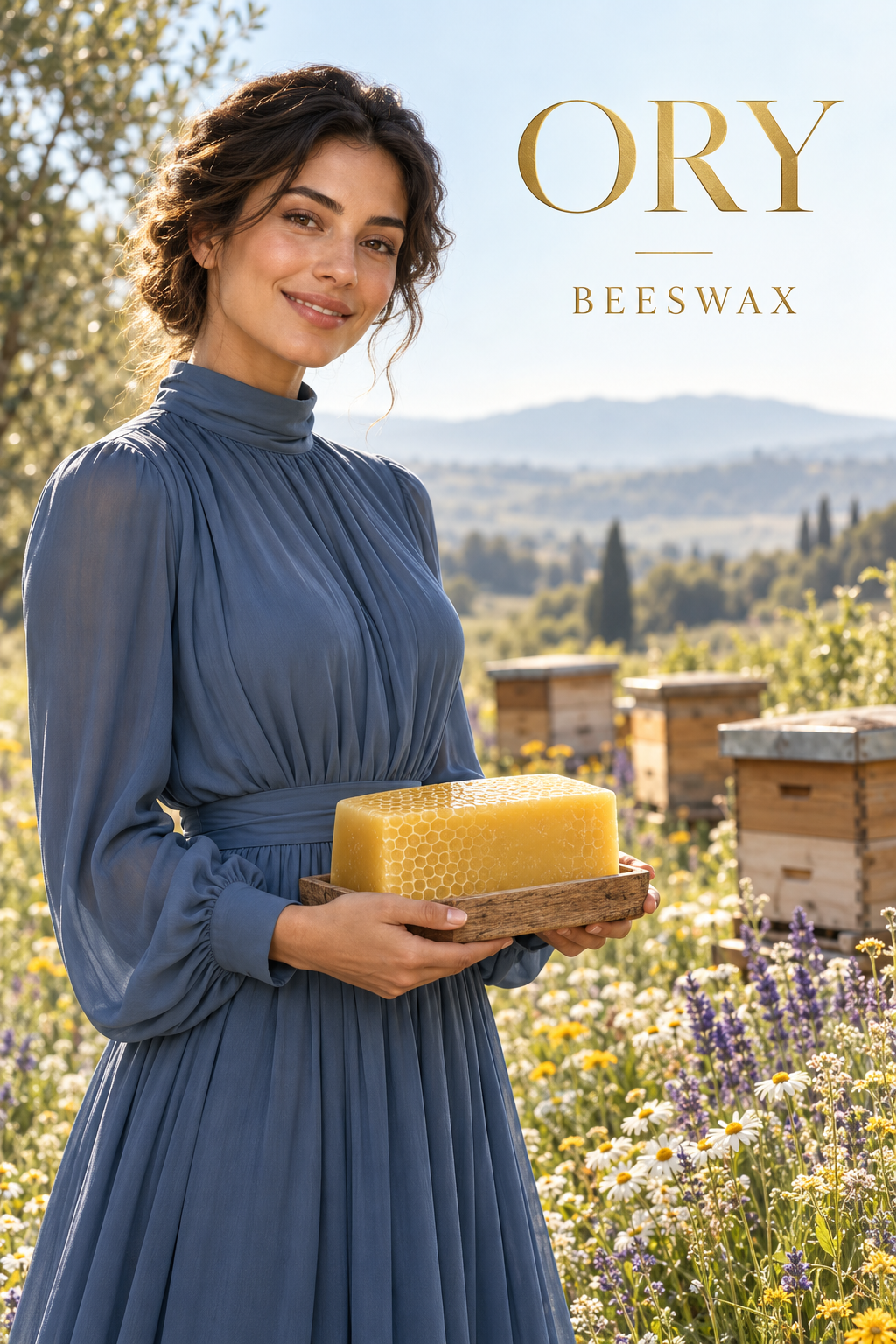
Beeswax is the natural wax secreted by worker honeybees (Apis mellifera) to build honeycomb, harvested as a by-product of honey production and refined by melting and filtering. Chemically it is a complex blend of long-chain esters, free fatty acids, hydrocarbons, and alcohols that melts at 62–65 °C, which makes it the classic structural ingredient for balms, salves, and lip products. Beeswax forms a breathable, semi-occlusive film that reduces water loss without fully sealing the skin, and it carries mild antimicrobial activity [1]. A partially controlled clinical study found a honey–beeswax–olive oil mixture improved atopic dermatitis and psoriasis symptoms [3], and reviews of bee products document beeswax’s emollient, protective, and wound-supporting roles in dermatology [2]. Beeswax is also a traditional hardener in handmade soap and a base for hair pomades. Because it is an animal product, ORY® offers candelilla or carnauba wax as vegan alternatives.
What is Beeswax made of?
Beeswax is produced by bees from honey sugars, harvested from cappings and comb, then rendered, filtered, and optionally bleached (white beeswax) or left natural (yellow beeswax). Constituents [1, 2]:
ORY® uses cosmetic-grade, filtered beeswax (yellow for natural positioning, white for color-sensitive products) and offers vegan candelilla/carnauba alternatives.
- Wax esters (myricyl palmitate and related long-chain esters, ~70%): Structural film-formers; give beeswax its plasticity and gloss.
- Free fatty acids (cerotic, melissic acids, ~14%): Emollient; contribute to emulsification.
- Hydrocarbons (hentriacontane and other alkanes, ~14%): Water-repellent protective film.
- Free fatty alcohols and hydroxy esters: Emollient, thickening.
- Propolis and pollen traces, flavonoids (chrysin), vitamin A: Antimicrobial and antioxidant minor components (higher in yellow beeswax).
What skin type is best suited for Beeswax?
Beeswax suits dry, chapped, and barrier-compromised skin best; lighter skin types use it sparingly:
- Dry: The primary use — semi-occlusive film locks in moisture and protects cracked, chapped skin.
- Sensitive: Protective balm base for eczema-prone, wind-burned, and irritated skin [3]; hypoallergenic for most.
- Mature: Protective, nourishing balms for thinning, dry skin.
- Normal: Lip balms, hand salves, cuticle care.
- Combination: Targeted balms on dry areas only.
- Oily: Avoid heavy beeswax balms on the face; fine in lip and body products.
- Acne-prone: Generally low comedogenicity but occlusive; use in lip and body products rather than facial balms.
What hair type is best suited for Beeswax?
Beeswax is the traditional base of pomades, waxes, and ends balms:
- Curly and coily: Defines curls and coils, seals moisture, and smooths edges; classic edge-control and loc-styling wax.
- Dry or damaged: Ends balms seal split ends and reduce moisture loss.
- Straight and wavy: Light hold pomades and flyaway tamers (use sparingly).
- Color-treated: Protective ends balm.
- Oily scalp, dandruff-prone, sensitive scalp, mature or thinning: Keep off the scalp; use on lengths and ends only (buildup can clog follicles).
What are the benefits of Beeswax?
Beeswax’s benefits are supported by dermatological reviews and clinical observation [1–3]:
- Protective barrier: Semi-occlusive film reduces transepidermal water loss while allowing skin to breathe.
- Emollient: Softens and smooths chapped, rough skin.
- Antimicrobial: Inhibits bacteria and fungi, supporting wound and chapped-skin care [1].
- Anti-inflammatory support: Improved atopic dermatitis and psoriasis in a mixture study [3].
- Structure and stability: Thickens and stabilizes balms, emulsions, and sticks; raises melting point for warm-climate products.
- Hair hold and seal: Provides natural hold, definition, and moisture sealing.
- Soap hardening: Increases bar hardness and longevity at 1–3%.
- Gloss: Adds shine to lip products and balms.
Dual use across ORY® product lines
Beeswax is a true four-line structural ingredient — with vegan wax substitutions available for every use.
Pros and cons of Beeswax
Pros
Cons
- Natural, multifunctional structurant: Thickens, protects, and stabilizes.
- Breathable occlusion: Protects without suffocating skin.
- Antimicrobial and long shelf life: Does not go rancid [1].
- Four-line utility: Balms, hair, soap, and color cosmetics.
- Consumer trust: Familiar, traditional ingredient.
- Not vegan: Animal-derived; candelilla or carnauba substitutes needed for vegan lines.
- Rare allergy: Propolis/beeswax contact allergy is documented; patch test.
- Heaviness: Can feel waxy or greasy; buildup on hair.
- Formulation heat: Requires heating to ~65 °C; accelerates trace in soap.
- Lather reduction in soap: Above 3%.
- Limited clinical trials: Evidence is largely traditional and observational.
What is the best application of Beeswax?
Beeswax is the base of protective and styling products:
- Healing balm: 20% beeswax with calendula-infused oil and shea for chapped hands, elbows, heels.
- Lip balm: 15–25% for structure and gloss.
- Cuticle and nail salve: Nightly.
- Cleansing balm: 5–10% with oils for makeup removal.
- Ends balm: Pea-sized amount on dry ends.
- Pomade or edge control: Warm between palms; apply to lengths.
- Soap: 1–3% for harder, longer-lasting bars.
- Cosmetics: Lipstick, mascara, and cream-stick bases.
Peer-reviewed references
- Fratini F, Cilia G, Turchi B, Felicioli A. Beeswax: a minireview of its antimicrobial activity and its application in medicine. Asian Pacific Journal of Tropical Medicine. 2016;9(9):839–843.
- Kurek-Górecka A, Górecki M, Rzepecka-Stojko A, Balwierz R, Stojko J. Bee products in dermatology and skin care. Molecules. 2020;25(3):556.
- Al-Waili NS. Topical application of natural honey, beeswax and olive oil mixture for atopic dermatitis or psoriasis: partially controlled, single-blinded study. Complementary Therapies in Medicine. 2003;11(4):226–234.
Disclaimer:
The information on this page is provided by ORY International, LC for educational purposes only. It summarizes published research about beeswax as an ingredient, including laboratory and animal studies and clinical studies of formulas that may differ from ORY® products. Results from these studies may not apply to every person or to ORY® products. This page is not medical advice and does not replace advice from a dermatologist, physician, or other qualified healthcare provider.
ORY® Skincare, Haircare, Handmade Soap, and Cosmetics products are cosmetics. They are not intended to diagnose, treat, cure, mitigate, or prevent any disease or condition, including atopic dermatitis (eczema), psoriasis, wounds, infections, or chapped skin caused by medical conditions. References to FDA or Cosmetic Ingredient Review (CIR) findings describe the ingredient, not ORY® products, and do not mean FDA has reviewed or approved any ORY® product.
Results vary by skin and scalp type, formulation, and use. Beeswax allergy is uncommon but documented, especially in people allergic to propolis, and any cosmetic can cause irritation, sometimes from other ingredients. Always patch test, follow label directions, and stop use if irritation occurs. If you are pregnant, nursing, have a medical condition, or are buying for a child, consult a healthcare provider before use.
ORY International, LC works to keep this page accurate and current but makes no warranty as to its completeness. To the fullest extent permitted by law, ORY International, LC is not liable for any loss or injury arising from reliance on this information or from use of any product contrary to its label directions. To report a reaction, contact us at [insert contact email / phone].