No products in the cart.: $0.00

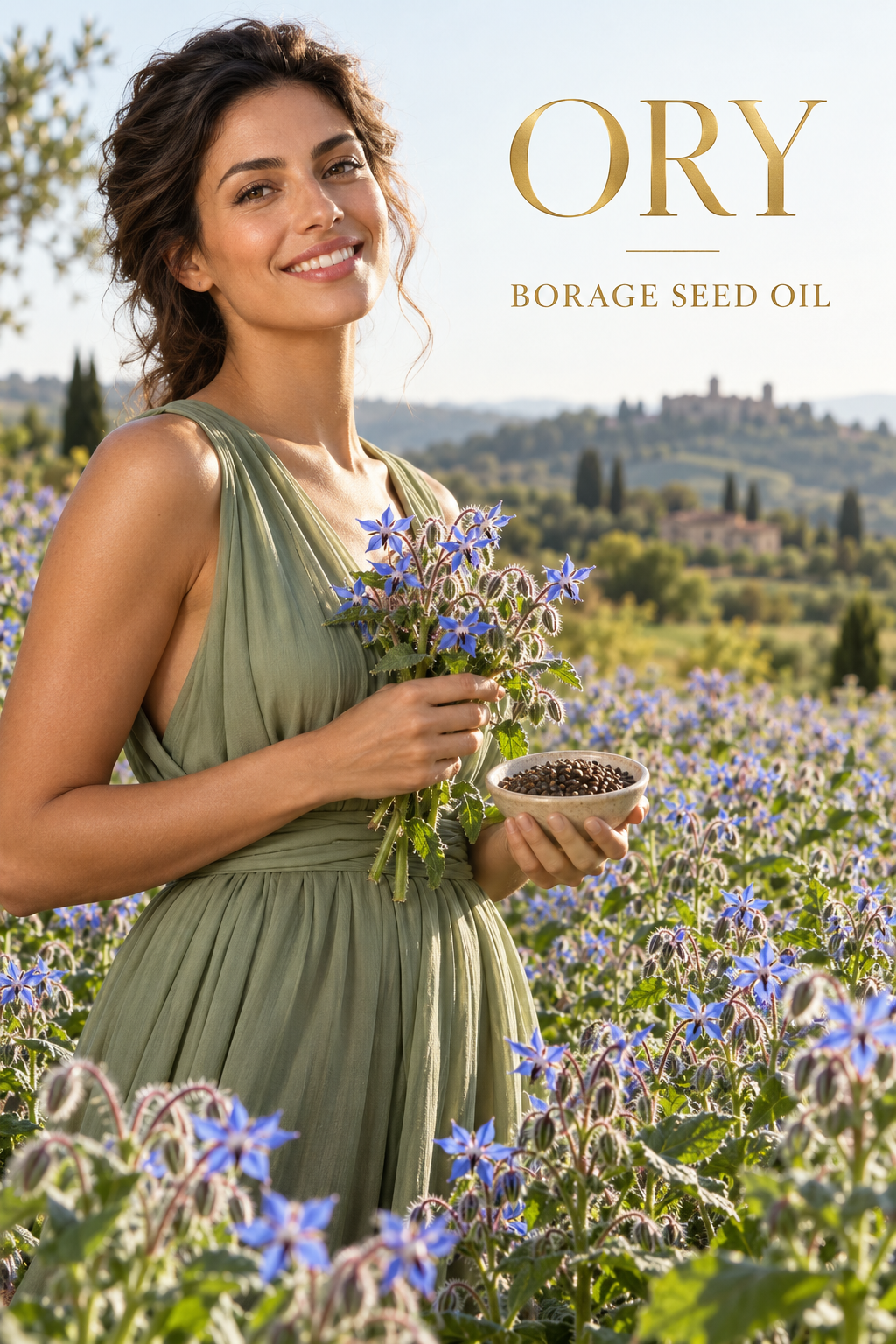
Borage Seed Oil

ORY® product lines:
☑ Skincare
☑ Haircare
☑ Handmade Soap (superfat/small percentage)
☑ Cosmetics (lip and balm products) — full dual-use ingredient
Borage seed oil, pressed from the seeds of the starflower (Borago officinalis), is the richest natural source of gamma-linolenic acid (GLA), an omega-6 fatty acid the skin converts into anti-inflammatory prostaglandins and barrier-building ceramide precursors [5]. Low GLA is characteristic of dry, atopic skin, and both topical and dietary borage oil have improved dryness, roughness, and itch in atopic and seborrheic dermatitis: borage oil resolved infantile seborrheic dermatitis in a clinical report [3], undershirts coated with borage oil reduced eczema symptoms in children [4], and oral GLA improved skin barrier parameters in adults with dry skin [1]. Reviews of its use in atopic dermatitis are cautiously positive, with topical delivery considered promising [2]. Its light, fast-absorbing texture and stability in small amounts make it suitable for every ORY® line.
What is Borage Seed Oil made of?
Borage seed oil is cold-pressed (or CO₂-extracted) from borage seeds and refined to remove pyrrolizidine alkaloids, which are found in the plant but not in properly processed oil. Fatty-acid profile:
Because of its polyunsaturation, borage oil oxidizes quickly; ORY® stores it refrigerated and formulates with tocopherol and rosemary extract.
- Gamma-linolenic acid (GLA, 18–25%): The highest of any common plant oil (evening primrose ≈9%, black currant ≈15%).
- Linoleic acid (35–40%): Barrier-essential omega-6; ceramide precursor.
- Oleic acid (15–20%): Emollient monounsaturated fat.
- Palmitic and stearic acids: Structural saturated fats.
- Vitamin E and phytosterols: Antioxidant and anti-inflammatory minor components.
What skin type is best suited for Borage Seed Oil?
Borage seed oil is a lipid-repair specialist for dry and inflamed skin:
- Dry: The ideal candidate — replenishes GLA and linoleic acid, reducing roughness and water loss [1].
- Sensitive: Anti-inflammatory fatty acids calm eczema-prone and reactive skin [2, 4].
- Mature: Supports elasticity and hydration in lipid-depleted aging skin.
- Combination: Use in light serums for dry zones.
- Normal: Barrier maintenance in face oils and creams.
- Acne-prone: Linoleic-rich oils are generally acne-friendly; use at low levels in light emulsions.
- Oily: Small amounts only; not a primary choice.
What hair type is best suited for Borage Seed Oil?
Borage oil nourishes dry scalps and adds softness to the fiber:
- Dry or damaged: Fatty acids soften and condition brittle hair.
- Dandruff-prone scalp: Improved infantile seborrheic dermatitis in a clinical report [3]; supportive for flaky, dry scalps.
- Sensitive scalp: Anti-inflammatory scalp oil.
- Curly and coily: Light, penetrating oil for sealing moisture.
- Color-treated or chemically processed: Replenishes lipids stripped by chemical services.
- Mature or thinning: Scalp nourishment.
- Straight, wavy: Use sparingly on ends.
- Oily scalp: Avoid on the scalp; ends only.
What are the benefits of Borage Seed Oil?
Borage seed oil’s benefits stem from its unique fatty-acid profile [1–5]:
- Barrier repair: GLA and linoleic acid are converted into ceramides and barrier lipids, reducing water loss [1, 5].
- Anti-inflammatory: GLA metabolites (DGLA, PGE1) counter inflammatory prostaglandins, calming eczema and dermatitis [2].
- Deep moisturization: Emollient fatty acids soften rough, flaky skin.
- Seborrheic and atopic dermatitis support: Clinical reports of improvement with topical borage oil [3, 4].
- Anti-itch: Reduces pruritus associated with dry skin.
- Antioxidant: Vitamin E and phytosterols.
- Hair and scalp: Conditions dry hair and calms flaky scalps.
- Soap: Adds a conditioning, skin-loving superfat to bars.
Dual use across ORY® product lines
Borage seed oil is an oil-phase emollient that works in every ORY® line; in soap it is added as a small superfat to preserve its fragile fatty acids.
Pros and cons of Borage Seed Oil
Pros
Cons
- Highest natural GLA: Unique barrier and anti-inflammatory profile [5].
- Clinical support for dermatitis: Reports in infants, children, and adults [1, 3, 4].
- Light texture: Absorbs quickly; non-greasy.
- Four-line utility: Oils, balms, hair, soap superfat, and lip products.
- Natural and vegan: Cold-pressed plant oil.
- Oxidation: Short shelf life (6–12 months); requires refrigeration and antioxidants.
- Cost: Premium oil.
- Pyrrolizidine alkaloids: Only refined, certified PA-free oil should be used.
- Mixed clinical evidence: Some trials of oral borage oil in eczema were negative; topical evidence is promising but limited [2].
- Not for oily scalps: Can weigh hair down.
What is the best application of Borage Seed Oil?
Borage seed oil is best used as a leave-on lipid replenisher:
- Face oil: 3–5 drops on damp skin after serum, PM (or AM under SPF for dry skin).
- Barrier cream: 5–10% in eczema and dry-skin creams with ceramides and colloidal oat.
- Body oil: For itchy, flaky, or winter skin.
- Eye cream: Low-level GLA for dry under-eye skin.
- Scalp oil: Pre-shampoo treatment for dry, flaky scalps, left 20–30 minutes.
- Hair mask: Blend with shea and argan for damaged hair.
- Soap superfat: Conditioning “eczema-friendly” bar.
- Lip balm: Nourishing balm for chapped lips.
- Pairing: Ceramides, squalane, hyaluronic acid, calendula, and chamomile.
Peer-reviewed references
- Kawamura A, Ooyama K, Kojima K, et al. Dietary supplementation of gamma-linolenic acid improves skin parameters in subjects with dry skin and mild atopic dermatitis. Journal of Oleo Science. 2011;60(12):597–607.
- Foster RH, Hardy G, Alany RG. Borage oil in the treatment of atopic dermatitis. Nutrition. 2010;26(7–8):708–718.
- Tollesson A, Frithz A. Borage oil, an effective new treatment for infantile seborrhoeic dermatitis. British Journal of Dermatology. 1993;129(1):95.
- Kanehara S, Ohtani T, Uede K, Furukawa F. Undershirts coated with borage oil alleviate the symptoms of atopic dermatitis in children. Journal of Dermatology. 2007;34(12):811–815.
- Ziboh VA, Miller CC, Cho Y. Metabolism of polyunsaturated fatty acids by skin epidermal enzymes: generation of antiinflammatory and antiproliferative metabolites. American Journal of Clinical Nutrition. 2000;71(1 Suppl):361S–366S.
Disclaimer:
The information on this page is provided by ORY International, LC for educational purposes only. It summarizes published research about borage seed oil as an ingredient, including laboratory and animal studies and clinical studies of formulas that may differ from ORY® products. Results from these studies may not apply to every person or to ORY® products. This page is not medical advice and does not replace advice from a dermatologist, physician, or other qualified healthcare provider.
ORY® Skincare, Haircare, Handmade Soap, and Cosmetics products are cosmetics. They are not intended to diagnose, treat, cure, mitigate, or prevent any disease or condition, including eczema, atopic dermatitis, seborrheic dermatitis, cradle cap, dandruff, or itching caused by a skin condition. References to FDA or Cosmetic Ingredient Review (CIR) findings describe the ingredient, not ORY® products, and do not mean FDA has reviewed or approved any ORY® product.
Results vary by skin and scalp type, formulation, and use. Reactions to borage oil are rare, but any cosmetic can cause irritation, sometimes from other ingredients. Always patch test, follow label directions, and stop use if irritation occurs. If you are pregnant, nursing, have a medical condition, or are buying for a child, consult a healthcare provider before use.
ORY International, LC works to keep this page accurate and current but makes no warranty as to its completeness. To the fullest extent permitted by law, ORY International, LC is not liable for any loss or injury arising from reliance on this information or from use of any product contrary to its label directions. To report a reaction, contact us at [insert contact email / phone].