No products in the cart.: $0.00

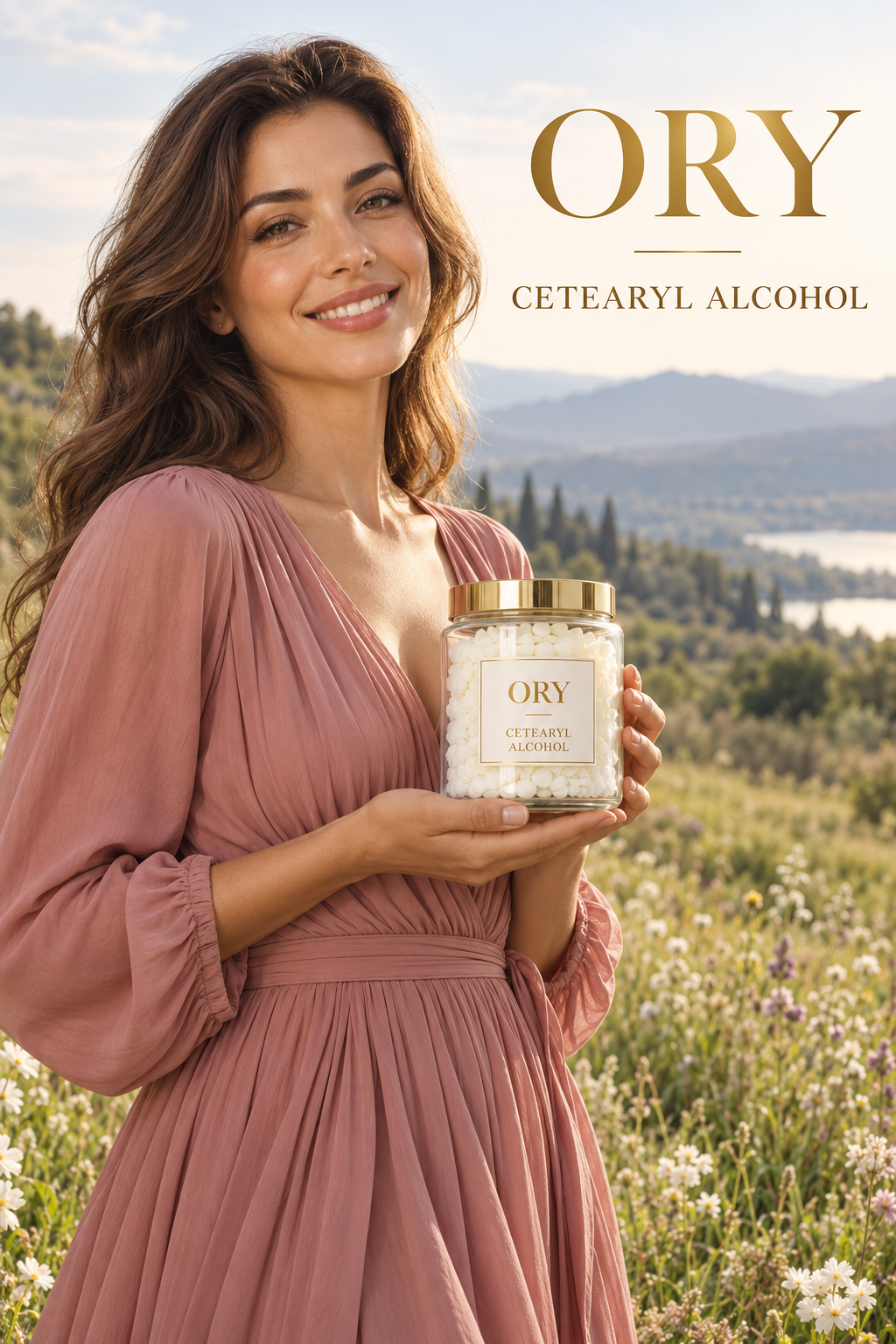
Cetearyl Alcohol

ORY® product lines:
☑ Skincare
☑ Haircare
◐ Handmade Soap (limited: syndet, lotion, and conditioner bars)
☑ Cosmetics — three-line functional ingredient
Cetearyl alcohol is the workhorse fatty alcohol of cosmetic formulation — a blend of cetyl and stearyl alcohols that combines the lightness of one with the cushion of the other. Plant-derived from coconut or palm, it is a moisturizing emollient, thickener, and emulsion stabilizer that appears in the majority of lotions and conditioners on the market, and it is the fatty-alcohol backbone of Emulsifying Wax NF and Montanov 68. The Cosmetic Ingredient Review Panel has concluded it is safe in cosmetics [1], and lipids of this class support barrier repair in dry-skin care [2]. It is not a drying alcohol; it leaves skin softer and hair smoother.
What is Cetearyl Alcohol made of?
Cetearyl alcohol is a blend of hydrogenated C16 and C18 fatty alcohols from coconut or palm oil. Points to know [1]:
- Cetyl (C16) + stearyl (C18) alcohols: Waxy white flakes; melts at ~50–55 °C depending on ratio.
- Co-emulsifier and lamellar structurant: Builds liquid-crystal networks with emulsifiers that hold water and improve stability and skin feel.
- Base of common emulsifier blends: Emulsifying Wax NF (with polysorbate 60/ceteareth-20) and Montanov 68 (with cetearyl glucoside).
- Vegan; RSPO or coconut grades available.
What skin type is best suited for Cetearyl Alcohol?
Cetearyl alcohol is a universal texture agent suitable for all seven ORY® skin types:
- Dry: Fatty-alcohol emollience softens and reduces water loss; cetearyl alcohol lets ORY® build richer creams.
- Sensitive: Non-irritating, fragrance-free structural ingredient; suitable for reactive and eczema-prone skin (rare fatty-alcohol allergy — patch test).
- Mature: Supports rich, cushioning creams and barrier balms.
- Normal: Everyday lotion and cream structure.
- Combination: Adjust level for lighter lotions.
- Oily: Use at the low end for light lotions; non-greasy at 1–2%.
- Acne-prone: Low comedogenicity at typical levels; keep formulas light.
What hair type is best suited for Cetearyl Alcohol?
Cetearyl alcohol is the most common conditioning fatty alcohol:
- Dry or damaged: Cetearyl alcohol adds slip, softness, and body to conditioners and masks.
- Curly and coily: Thickens rich conditioners and leave-ins for detangling.
- Color-treated or chemically processed: Cushioning conditioner base for fragile hair.
- Straight and wavy: Light conditioners at low levels.
- Oily scalp: Rinse-off use; keep leave-in levels low.
- Sensitive scalp, dandruff-prone, mature or thinning: Inert structural ingredient; neutral for scalp conditions.
What are the benefits of Cetearyl Alcohol?
Cetearyl alcohol’s benefits are functional and thoroughly established [1, 2, 3]:
- Emollient: Softens and smooths; protective lipid film.
- Thickener: Builds viscosity in lotions, creams, and conditioners.
- Emulsion stabilizer: Lamellar structures improve stability and freeze–thaw resistance.
- Barrier support: Reduces water loss and supports dry-skin repair [2].
- Hair conditioning: Slip, softness, and detangling [3].
- Balanced texture: Between cetyl lightness and stearyl richness.
- Opacity and cushion: Creamy appearance and feel.
Dual use across ORY® product lines
Cetearyl alcohol serves emulsions, conditioners, and cosmetics, and firms solid bars; cold-process soap does not use it.
Pros and cons of Cetearyl Alcohol
Pros
Cons
- Versatile, balanced texture: The default fatty alcohol.
- Gentle, CIR-reviewed: [1].
- Stabilizing: Lamellar structure holds water.
- Vegan, plant-derived: Coconut or certified palm.
- Affordable, stable: Long shelf life.
- Not an emulsifier alone: Needs a primary emulsifier (unless in a blend).
- Rare contact allergy: Documented in eczema patients; patch test.
- Name confusion: Not a drying alcohol.
- Waxy above ~5%: Balance with lighter esters.
- Palm sourcing: Specify certified material.
What is the best application of Cetearyl Alcohol?
Cetearyl alcohol is built into product bases:
- Lotion: 2–3%.
- Cream: 3–6%.
- Conditioner: 3–8% with BTMS.
- Conditioner or lotion bar: 15–25%.
- Cosmetics: Cream and stick structure.
Peer-reviewed references
- Elder RL (ed). Final report on the safety assessment of cetearyl alcohol, cetyl alcohol, isostearyl alcohol, myristyl alcohol, and behenyl alcohol. Journal of the American College of Toxicology. 1988;7(3):359–413.
- Lodén M. Role of topical emollients and moisturizers in the treatment of dry skin barrier disorders. American Journal of Clinical Dermatology. 2003;4(11):771–788.
- Gavazzoni Dias MFR. Hair cosmetics: an overview. International Journal of Trichology. 2015;7(1):2–15.
Disclaimer:
The information on this page is provided by ORY International, LC for educational purposes only. It summarizes published research about cetearyl alcohol as an ingredient, including laboratory and animal studies and clinical studies of formulas that may differ from ORY® products. Results from these studies may not apply to every person or to ORY® products. This page is not medical advice and does not replace advice from a dermatologist, physician, or other qualified healthcare provider.
ORY® Skincare, Haircare, Handmade Soap, and Cosmetics products are cosmetics. They are not intended to diagnose, treat, cure, mitigate, or prevent any disease or condition, including eczema, dermatitis, acne, dandruff, or any other condition. References to FDA or Cosmetic Ingredient Review (CIR) findings describe the ingredient, not ORY® products, and do not mean FDA has reviewed or approved any ORY® product.
Results vary by skin and scalp type, formulation, and use. Fatty alcohols rarely cause allergy, but cases have been reported, mostly in people with existing dermatitis, and any cosmetic can cause irritation, sometimes from other ingredients. Always patch test, follow label directions, and stop use if irritation occurs. If you are pregnant, nursing, have a medical condition, or are buying for a child, consult a healthcare provider before use.
ORY International, LC works to keep this page accurate and current but makes no warranty as to its completeness. To the fullest extent permitted by law, ORY International, LC is not liable for any loss or injury arising from reliance on this information or from use of any product contrary to its label directions. To report a reaction, contact us at [insert contact email / phone].