No products in the cart.: $0.00

Curcumin
ORY® product lines:
☑ Skincare
☑ Haircare (scalp)
☑ Handmade Soap (turmeric powder/infused oil; natural yellow colorant)
☑ Cosmetics (tetrahydrocurcumin; turmeric-tinted products) — full dual-use ingredient with staining caveats
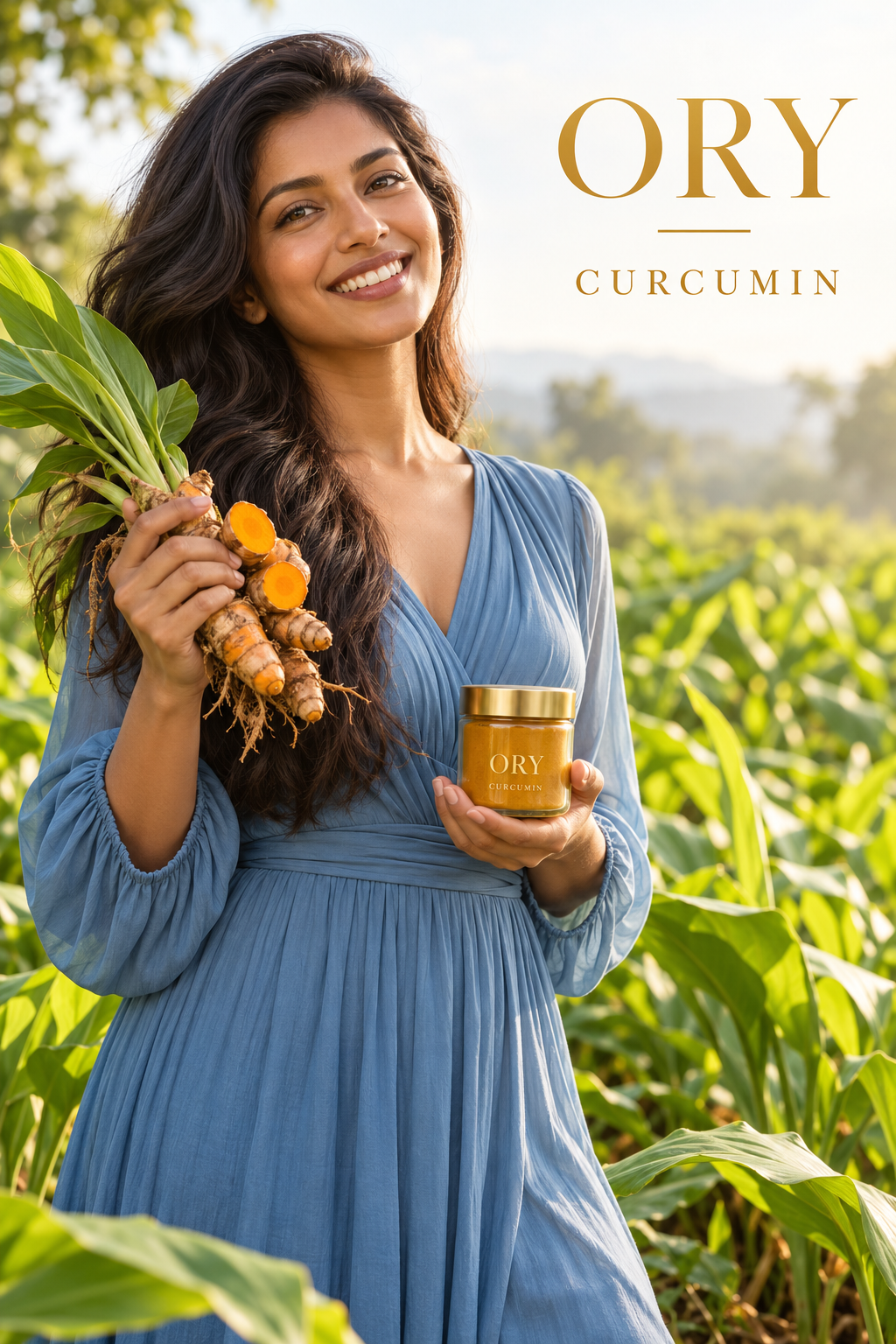
Curcumin is the golden polyphenol of turmeric (Curcuma longa), used in Ayurvedic skin care for millennia and now one of the most researched natural anti-inflammatories. A systematic review of clinical trials found that topical and oral turmeric/curcumin improved a range of skin conditions, including acne, photoaging, radiation dermatitis, and psoriasis, with a good safety profile [1]. Curcumin inhibits the NF-κB inflammatory pathway, scavenges free radicals, has antibacterial activity against acne bacteria, and inhibits tyrosinase for a brightening effect [2, 3]. Its two practical challenges — intense yellow staining and poor stability — are solved in ORY® formulas by using low concentrations, oil dispersion, or the colorless derivative tetrahydrocurcumin, which retains antioxidant and brightening activity without the color.
What is Curcumin made of?
Curcumin is extracted from dried turmeric rhizome with ethanol or acetone and purified to 95% curcuminoids; turmeric powder and infused oil are the crude forms. Constituents:
- Curcumin (diferuloylmethane, ~77% of curcuminoids): The main anti-inflammatory, antioxidant, and antimicrobial compound [2].
- Demethoxycurcumin and bisdemethoxycurcumin: Companion curcuminoids with similar activity.
- Tetrahydrocurcumin: Hydrogenated, colorless, more stable metabolite; strong antioxidant and tyrosinase inhibitor — preferred for cosmetics and light-colored products.
- Turmerone and essential-oil components (in crude extract/oil): Additional anti-inflammatory and antimicrobial activity.
- Solubility: Oil-soluble, poorly water-soluble; unstable at alkaline pH and in light.
What skin type is best suited for Curcumin?
Curcumin is an anti-inflammatory and brightening active for congested, inflamed, and uneven skin:
- Acne-prone: Anti-inflammatory and antibacterial; reduces lesions and post-inflammatory marks [1, 3].
- Oily: Antimicrobial and mattifying in masks and cleansers.
- Combination: Brightening serums (tetrahydrocurcumin) for uneven tone.
- Mature: Antioxidant protection against photoaging; improved facial appearance in clinical studies [1].
- Sensitive: Calms inflammation; use tetrahydrocurcumin or low-level extract to avoid staining/irritation.
- Normal: Antioxidant and brightening maintenance.
- Dry: Turmeric-infused oils nourish while calming.
What hair type is best suited for Curcumin?
Curcumin’s anti-inflammatory and antimicrobial action supports scalp health, with traditional use for dandruff and scalp irritation:
- Dandruff-prone scalp: Antifungal and anti-inflammatory support against flaking.
- Oily scalp: Antimicrobial, sebum-balancing tradition.
- Sensitive scalp: Calms inflammation (use low levels to avoid yellow residue).
- Mature or thinning: Antioxidant scalp support; supportive of a healthy follicle environment.
- Dry or damaged: Turmeric-infused oil pre-shampoo treatment.
- Straight, wavy, curly, coily, color-treated: Scalp-only use; avoid on light or blonde hair (staining).
What are the benefits of Curcumin?
Curcumin’s skin benefits are documented in clinical and mechanistic studies [1–3]:
- Anti-inflammatory: Inhibits NF-κB and inflammatory cytokines; benefits in acne, psoriasis, and dermatitis [1, 2].
- Antioxidant: Potent free-radical scavenger; protects against UV-induced oxidative stress.
- Antimicrobial: Active against acne bacteria and Malassezia.
- Brightening: Inhibits tyrosinase and melanin synthesis; tetrahydrocurcumin is used specifically for this purpose.
- Wound healing: Promotes collagen deposition and re-epithelialization in preclinical studies [3].
- Photoaging: Clinical improvement in facial redness and appearance reported [1].
- Scalp support: Anti-dandruff and anti-inflammatory tradition.
- Natural colorant: Warm yellow-gold color for soap and cosmetics.
Dual use across ORY® product lines
Curcumin is usable in every ORY® line, provided its color and stability are managed — turmeric powder gives soap a warm gold, while tetrahydrocurcumin gives cosmetics the benefits without the stain.
Pros and cons of Curcumin
Pros
Cons
- Strong research base: Systematic review of clinical trials [1].
- Multifunctional: Anti-inflammatory, antioxidant, antimicrobial, brightening.
- Colorless option: Tetrahydrocurcumin solves the staining problem for face and cosmetics.
- Natural colorant: Dye-free gold for soap.
- Affordable and traditional: Strong Ayurvedic heritage.
- Staining: Turns skin, hair, fabric, and light formulas yellow; problematic for blonde hair.
- Poor stability: Degrades in light and alkaline conditions; oxidizes in water.
- Poor water solubility: Needs oil, solubilizer, or encapsulation.
- Contact allergy: Reported but uncommon; patch test.
- Variable extracts: Curcuminoid content ranges from 2–3% (powder) to 95% (standardized).
What is the best application of Curcumin?
Curcumin is used in targeted masks, spot care, and colorless brightening products:
- Turmeric mask: Weekly with kaolin, honey, or yogurt for acne-prone and dull skin (rinse thoroughly).
- Spot treatment: Low-level curcumin in a gel for inflamed blemishes.
- Brightening serum: Tetrahydrocurcumin with niacinamide and licorice, AM/PM.
- Face oil: Turmeric-infused jojoba for calming and antioxidant support (PM).
- Cleanser: Turmeric cleansing balm or bar.
- Scalp pre-shampoo oil: For flaky, irritated scalps (dark hair).
- Soap: Golden turmeric bar for oily or blemish-prone body skin.
- Cosmetics: Tetrahydrocurcumin brightening base; turmeric-tinted balm.
Peer-reviewed references
- Vaughn AR, Branum A, Sivamani RK. Effects of turmeric (Curcuma longa) on skin health: a systematic review of the clinical evidence. Phytotherapy Research. 2016;30(8):1243–1264.
- Hewlings SJ, Kalman DS. Curcumin: a review of its effects on human health. Foods. 2017;6(10):92.
- Thangapazham RL, Sharma A, Maheshwari RK. Beneficial role of curcumin in skin diseases. Advances in Experimental Medicine and Biology. 2007;595:343–357.
Disclaimer:
The information on this page is provided by ORY International, LC for educational purposes only. It summarizes published research about curcumin and turmeric as an ingredient, including laboratory and animal studies and clinical studies of formulas that may differ from ORY® products. Results from these studies may not apply to every person or to ORY® products. This page is not medical advice and does not replace advice from a dermatologist, physician, or other qualified healthcare provider.
ORY® Skincare, Haircare, Handmade Soap, and Cosmetics products are cosmetics. They are not intended to diagnose, treat, cure, mitigate, or prevent any disease or condition, including acne, psoriasis, dermatitis, dandruff, wounds, infections, hyperpigmentation disorders, or hair loss. References to FDA or Cosmetic Ingredient Review (CIR) findings describe the ingredient, not ORY® products, and do not mean FDA has reviewed or approved any ORY® product.
Results vary by skin and scalp type, formulation, and use. Turmeric and curcumin can cause allergic contact dermatitis in some people and may temporarily tint skin, nails, hair, and fabric yellow, and any cosmetic can cause irritation, sometimes from other ingredients. Always patch test, follow label directions, and stop use if irritation occurs. If you are pregnant, nursing, have a medical condition, or are buying for a child, consult a healthcare provider before use.
ORY International, LC works to keep this page accurate and current but makes no warranty as to its completeness. To the fullest extent permitted by law, ORY International, LC is not liable for any loss or injury arising from reliance on this information or from use of any product contrary to its label directions. To report a reaction, contact us at [insert contact email / phone].