No products in the cart.: $0.00

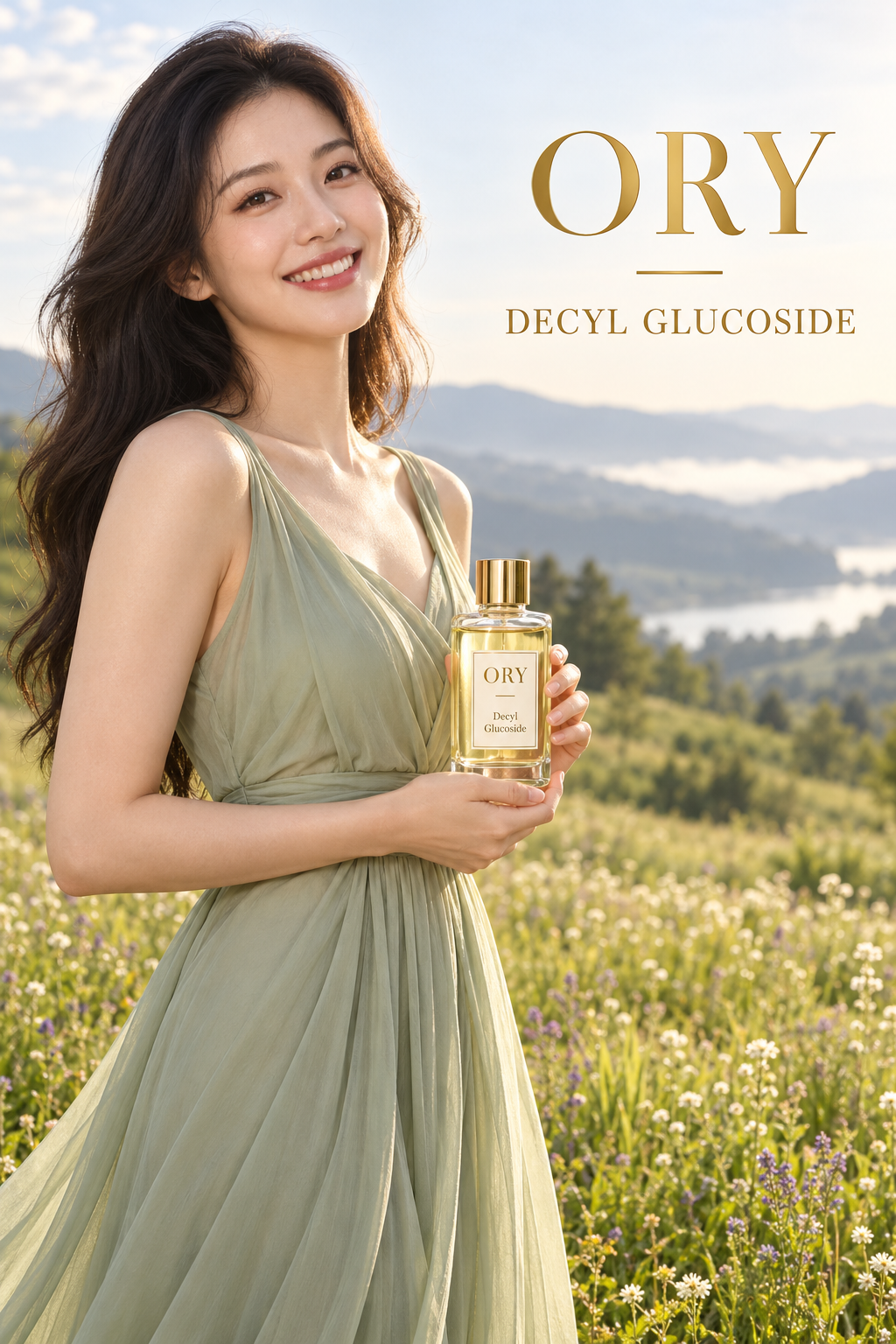
Decyl Glucoside

ORY® product lines:
☑ Skincare
☑ Haircare
◐ Handmade Soap (limited: liquid soap, syndet and shampoo bars)
☑ Cosmetics — three-line functional ingredient
Decyl glucoside is a sugar-based, non-ionic surfactant made from coconut-derived decyl alcohol and glucose — one of the mildest foaming cleansers available and a cornerstone of natural, sulfate-free, and baby-care formulation. Alkyl polyglucosides are biodegradable, COSMOS/Ecocert-approved, and gentle enough to be used in leave-on products; surfactant research ranks them among the least barrier-disrupting cleansers [1]. The Cosmetic Ingredient Review Panel has concluded decyl glucoside and related glucosides are safe as used [2]. Its one caveat is a documented, though uncommon, contact allergy that earned alkyl glucosides “Allergen of the Year” in 2017 [3] — relevant mainly to leave-on products and to customers with existing dermatitis.
What is Decyl Glucoside made of?
Decyl glucoside is produced by condensing decyl (C10) alcohol from coconut or palm-kernel oil with glucose from corn or wheat starch. Points to know [2]:
- Alkyl polyglucoside (APG): Non-ionic; cleansing chain from coconut, water-loving head from sugar.
- Shorter chain (C10) than lauryl glucoside (C12): More foam, thinner viscosity, slightly stronger cleansing.
- Supplied as ~50% aqueous solution: Amber, viscous; naturally alkaline (pH 11–12) — must be neutralized to pH 5–6 in formulas.
- COSMOS-approved, biodegradable, palm-free grades available.
What skin type is best suited for Decyl Glucoside?
Decyl glucoside is one of the gentlest surfactants for all seven ORY® skin types:
- Sensitive: Decyl glucoside is among the mildest cleansing surfactants; suitable for reactive and eczema-prone skin (patch test).
- Dry: Low-stripping cleansing preserves barrier lipids; pair with glycerin and oils.
- Normal: Everyday gentle cleansing.
- Combination: Balanced foaming cleansers.
- Oily: Effective cleansing without over-drying; combine with a foam booster for richer lather.
- Acne-prone: Gentle base for salicylic-acid or tea-tree cleansers.
- Mature: Non-stripping cleansing for thinning, drier skin.
What hair type is best suited for Decyl Glucoside?
Decyl glucoside is a leading sulfate-free shampoo surfactant:
- Sensitive scalp: Glucoside shampoos reduce scalp irritation compared with sulfates.
- Dry or damaged: Low-stripping cleansing preserves natural oils.
- Curly and coily: Sulfate-free co-wash and low-poo formulas.
- Color-treated or chemically processed: Gentle cleansing prolongs color and reduces fading.
- Dandruff-prone scalp: Mild base for antifungal or salicylic-acid shampoos.
- Oily scalp: Adequate cleansing; combine with a stronger co-surfactant for heavy oil.
- Straight, wavy, mature or thinning: Gentle daily-use shampoos.
What are the benefits of Decyl Glucoside?
Decyl glucoside’s benefits are documented in surfactant and safety science [1, 2]:
- Very mild cleansing: Minimal barrier disruption and protein denaturation [1].
- Good foam: The best-foaming glucoside.
- Non-ionic compatibility: Works with all surfactant classes and most actives.
- Leave-on safe: Used in micellar waters and wipes.
- Biodegradable, natural-origin: COSMOS-approved.
- Solubilizer: Disperses small amounts of essential oils in water.
- Eye-mild: Baby-wash suitable.
Dual use across ORY® product lines
Decyl glucoside serves cleansers, shampoos, liquid soaps, syndet bars, and micellar products; not cold-process soap.
Pros and cons of Decyl Glucoside
Pros
Cons
- Exceptionally mild: [1].
- Natural, COSMOS-approved, biodegradable: Clean-label.
- Good foam for a glucoside: Consumer-pleasing.
- CIR-reviewed safe: [2].
- Versatile: Rinse-off and leave-on.
- Alkyl-glucoside contact allergy: Uncommon but documented; patch test in dermatitis-prone customers [3].
- Alkaline as supplied: Requires pH adjustment (citric or lactic acid).
- Thin viscosity: Hard to thicken; needs gums or a thickening co-surfactant.
- Cost: Higher than sulfates.
- Flat, less “squeaky” cleansing: Some customers expect stronger stripping.
What is the best application of Decyl Glucoside?
Decyl glucoside is a primary or secondary surfactant in gentle cleansers:
- Facial cleanser: 10% decyl glucoside with 5% CAPB; pH 5.5; thicken with xanthan.
- Micellar water: 2–3%.
- Baby wash: 10–15% with lauryl glucoside and CAPB.
- Sulfate-free shampoo: 15–20% with CAPB and SLGC.
- Natural liquid soap: Primary surfactant.
- Shampoo bar: With solid glucoside or SCI.
Peer-reviewed references
- Ananthapadmanabhan KP, Moore DJ, Subramanyan K, Misra M, Meyer F. Cleansing without compromise: the impact of cleansers on the skin barrier and the technology of mild cleansing. Dermatologic Therapy. 2004;17(Suppl 1):16–25.
- Fiume MM, Heldreth B, Bergfeld WF, et al. Safety assessment of decyl glucoside and other alkyl glucosides as used in cosmetics. International Journal of Toxicology. 2013;32(5 Suppl):22S–48S.
- Loranger C, Alfalah M, Ferrier Le Bouedec MC, Sasseville D. Alkyl glucosides in contact dermatitis. Dermatitis. 2019;30(1):5–13.
Disclaimer:
The information on this page is provided by ORY International, LC for educational purposes only. It summarizes published research about decyl glucoside as an ingredient, including laboratory and animal studies and clinical studies of formulas that may differ from ORY® products. Results from these studies may not apply to every person or to ORY® products. This page is not medical advice and does not replace advice from a dermatologist, physician, or other qualified healthcare provider.
ORY® Skincare, Haircare, Handmade Soap, and Cosmetics products are cosmetics. They are not intended to diagnose, treat, cure, mitigate, or prevent any disease or condition, including eczema, dermatitis, acne, dandruff, or any other condition. References to FDA or Cosmetic Ingredient Review (CIR) findings describe the ingredient, not ORY® products, and do not mean FDA has reviewed or approved any ORY® product.
Results vary by skin and scalp type, formulation, and use. Alkyl glucosides are an uncommon but recognized cause of allergic contact dermatitis, and any cleanser can cause irritation, sometimes from other ingredients. Always patch test, follow label directions, and stop use if irritation occurs. If you are pregnant, nursing, have a medical condition, or are buying for a child, consult a healthcare provider before use.
ORY International, LC works to keep this page accurate and current but makes no warranty as to its completeness. To the fullest extent permitted by law, ORY International, LC is not liable for any loss or injury arising from reliance on this information or from use of any product contrary to its label directions. To report a reaction, contact us at [insert contact email / phone].