No products in the cart.: $0.00

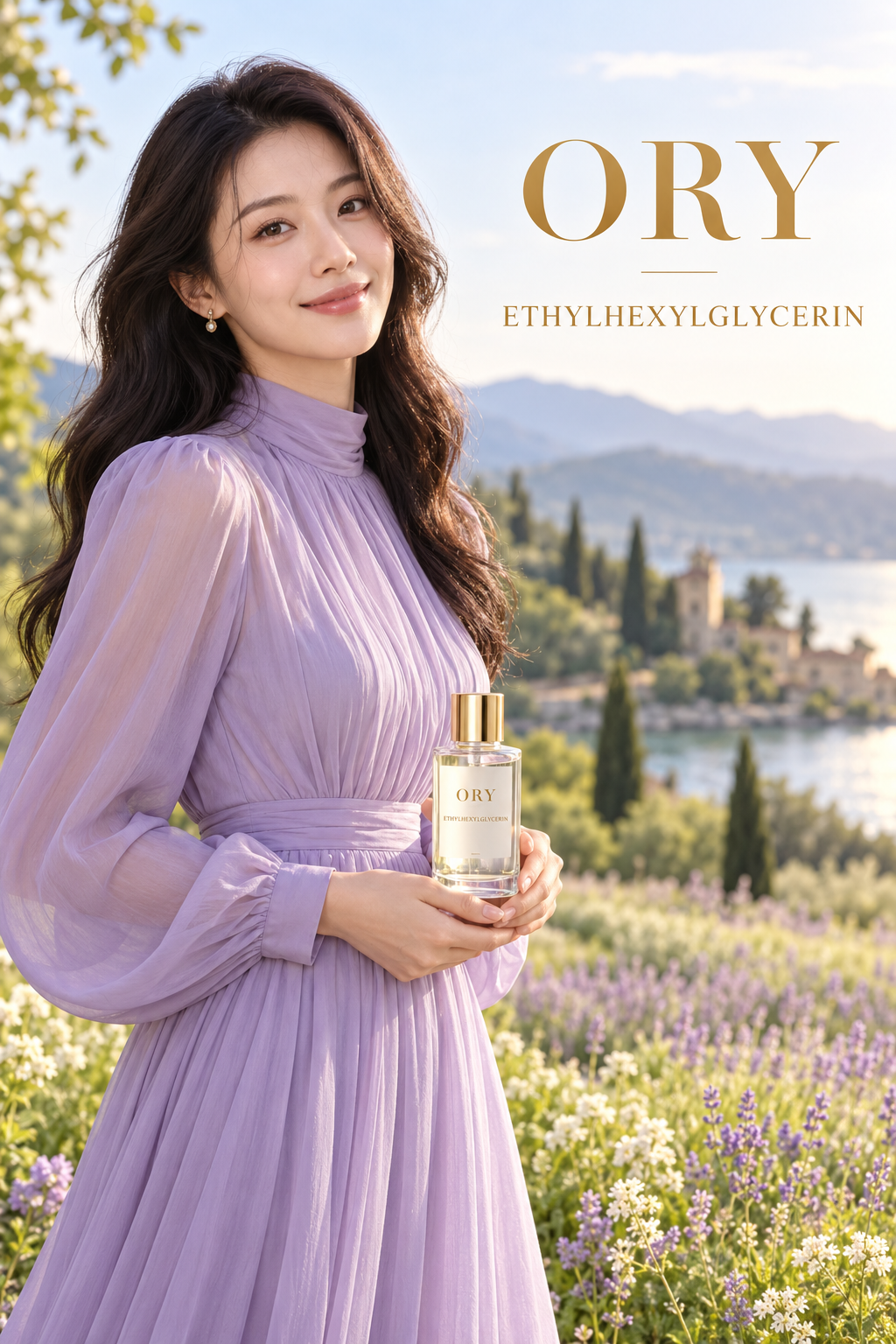
Ethylhexylglycerin
ORY® product lines:
☑ Skincare
☑ Haircare
◐ Handmade Soap (liquid and water-containing products)
☑ Cosmetics — three-line functional ingredient
Ethylhexylglycerin is a glycerin-derived skin-conditioning agent and preservative booster — not a preservative on its own in most jurisdictions, but a multifunctional that disrupts microbial cell membranes, lowers surface tension, and dramatically increases the effectiveness of phenoxyethanol and other preservatives, allowing lower total preservative loads. It is the “EHG” in the widely used phenoxyethanol/ethylhexylglycerin blends (e.g., Euxyl PE 9010). It also acts as a deodorant active (inhibiting odor-causing bacteria) and a mild humectant emollient. The Cosmetic Ingredient Review Panel has concluded it is safe as used [1]. Its one caveat is that, as its use has spread — often in “hypoallergenic” products — it has emerged as a low-frequency but relevant contact allergen [2], so ORY® keeps levels moderate and patch-tests sensitive customers.
What is Ethylhexylglycerin made of?
Ethylhexylglycerin is produced by reacting glycerin with 2-ethylhexanol (from vegetable or petrochemical sources). Points to know [1]:
- Glyceryl ether (C₁₁H₂₄O₃): Clear, nearly odorless liquid; oil-dispersible, slightly water-soluble.
- Mechanism: Reduces microbial surface tension and disrupts membranes, potentiating preservatives (especially against Gram-positive bacteria and yeast).
- Multifunctional: Skin conditioner, deodorant active, mild humectant, emollient.
- pH 3–12, heat-stable; typical use 0.3–1.0% (0.5% with 0.5% phenoxyethanol is the classic pairing).
What skin type is best suited for Ethylhexylglycerin?
Ethylhexylglycerin is a formulation-level ingredient suitable for all seven ORY® skin types:
- All skin types: Ethylhexylglycerin is a formulation-level ingredient rather than a skin-type active; at its use level it is suitable for every ORY® skin type.
- Sensitive: Low-frequency but documented contact allergen [2]; patch test in dermatitis-prone customers.
- Acne-prone: Prevents microbial growth that can worsen breakouts; non-comedogenic.
- Dry: Protects water-rich hydrating products.
- Oily and Combination: Protects gels, toners, and light lotions.
- Mature: Protects active-rich serums and creams over their shelf life.
- Normal: Everyday product protection.
What hair type is best suited for Ethylhexylglycerin?
Ethylhexylglycerin boosts preservation in all ORY® haircare products:
- All hair and scalp types: Ethylhexylglycerin protects water-based shampoos, conditioners, leave-ins, and scalp serums; no direct effect on hair.
- Sensitive scalp: Low-irritation preservation at use levels; patch test if preservative-sensitive.
- Curly and coily: Essential in water-rich curl creams and leave-ins that stay on the hair.
- Dandruff-prone scalp: Prevents contamination of scalp treatments applied to compromised skin.
- Oily scalp, dry or damaged, color-treated, mature or thinning, straight, wavy: Neutral; formulation-level protection for all.
What are the benefits of Ethylhexylglycerin?
Ethylhexylglycerin’s benefits are functional [1–3]:
- Preservative booster: Increases phenoxyethanol efficacy, closing yeast/mold gaps at lower total levels.
- Skin conditioning: Mild emollient, humectant feel.
- Deodorant activity: Inhibits odor-causing bacteria — used in natural deodorants.
- Broad compatibility: pH 3–12; works with cationics, anionics, actives.
- Lower preservative load: Allows 0.5% phenoxyethanol instead of 1%.
- Nearly odorless: Formulation-neutral.
- CIR-reviewed: Safe as used [1].
Dual use across ORY® product lines
Ethylhexylglycerin serves water-containing products in three ORY® lines; cold-process bars need no preservative.
Pros and cons of Ethylhexylglycerin
Pros
Cons
- Reduces total preservative: Cleaner-label preservation.
- Multifunctional: Booster, conditioner, deodorant.
- Wide pH range: Versatile.
- Glycerin-derived: Plant-based option.
- CIR-reviewed: [1].
- Emerging contact allergen: Low frequency but relevant [2]; patch test.
- Not a stand-alone preservative: Must pair with phenoxyethanol or similar.
- Can sting on broken skin: Keep ≤0.5% in products for compromised skin.
- Cost: Higher than phenoxyethanol.
- Solubility: Pre-mix with phenoxyethanol or glycol.
What is the best application of Ethylhexylglycerin?
Ethylhexylglycerin is paired with a primary preservative:
- Serum, toner, cream: 0.5% ethylhexylglycerin + 0.5% phenoxyethanol.
- Shampoo/conditioner: 0.3–0.5% with phenoxyethanol.
- Natural deodorant: 0.5–1.0% as deodorant active.
- Liquid soap: 0.3–0.5% with phenoxyethanol.
- Cosmetics: 0.5% with phenoxyethanol.
- Challenge testing: Confirm efficacy per formula.
Peer-reviewed references
- Johnson W Jr, Bergfeld WF, Belsito DV, et al. Safety assessment of alkyl glyceryl ethers as used in cosmetics. International Journal of Toxicology. 2013;32(3 Suppl):5S–21S.
- Aerts O, Verhulst L, Goossens A. Ethylhexylglycerin: a low-risk, but highly relevant, sensitizer in “hypo-allergenic” cosmetics. Contact Dermatitis. 2016;74(5):281–288.
- Dréno B, Zuberbier T, Gelmetti C, Gontijo G, Marinovich M. Safety review of phenoxyethanol when used as a preservative in cosmetics. Journal of the European Academy of Dermatology and Venereology. 2019;33(Suppl 7):15–24.
- Lundov MD, Moesby L, Zachariae C, Johansen JD. Contamination versus preservation of cosmetics: a review on legislation, usage, infections, and contact allergy. Contact Dermatitis. 2009;60(2):70–78.
Disclaimer:
The information on this page is provided by ORY International, LC for educational purposes only. It summarizes published research about ethylhexylglycerin as an ingredient, including laboratory and animal studies and clinical studies of formulas that may differ from ORY® products. Results from these studies may not apply to every person or to ORY® products. This page is not medical advice and does not replace advice from a dermatologist, physician, or other qualified healthcare provider.
ORY® Skincare, Haircare, Handmade Soap, and Cosmetics products are cosmetics. They are not intended to diagnose, treat, cure, mitigate, or prevent any disease or condition, including eczema, dermatitis, acne, dandruff, or any other condition. References to FDA or Cosmetic Ingredient Review (CIR) findings describe the ingredient, not ORY® products, and do not mean FDA has reviewed or approved any ORY® product.
Results vary by skin and scalp type, formulation, and use. Ethylhexylglycerin is an uncommon but documented contact allergen. Any cosmetic can cause irritation, sometimes from other ingredients. Always patch test, follow label directions, and stop use if irritation occurs. If you are pregnant, nursing, have a medical condition, or are buying for a child, consult a healthcare provider before use.
ORY International, LC works to keep this page accurate and current but makes no warranty as to its completeness. To the fullest extent permitted by law, ORY International, LC is not liable for any loss or injury arising from reliance on this information or from use of any product contrary to its label directions. To report a reaction, contact us at [insert contact email / phone].