No products in the cart.: $0.00

Orange Essential Oil
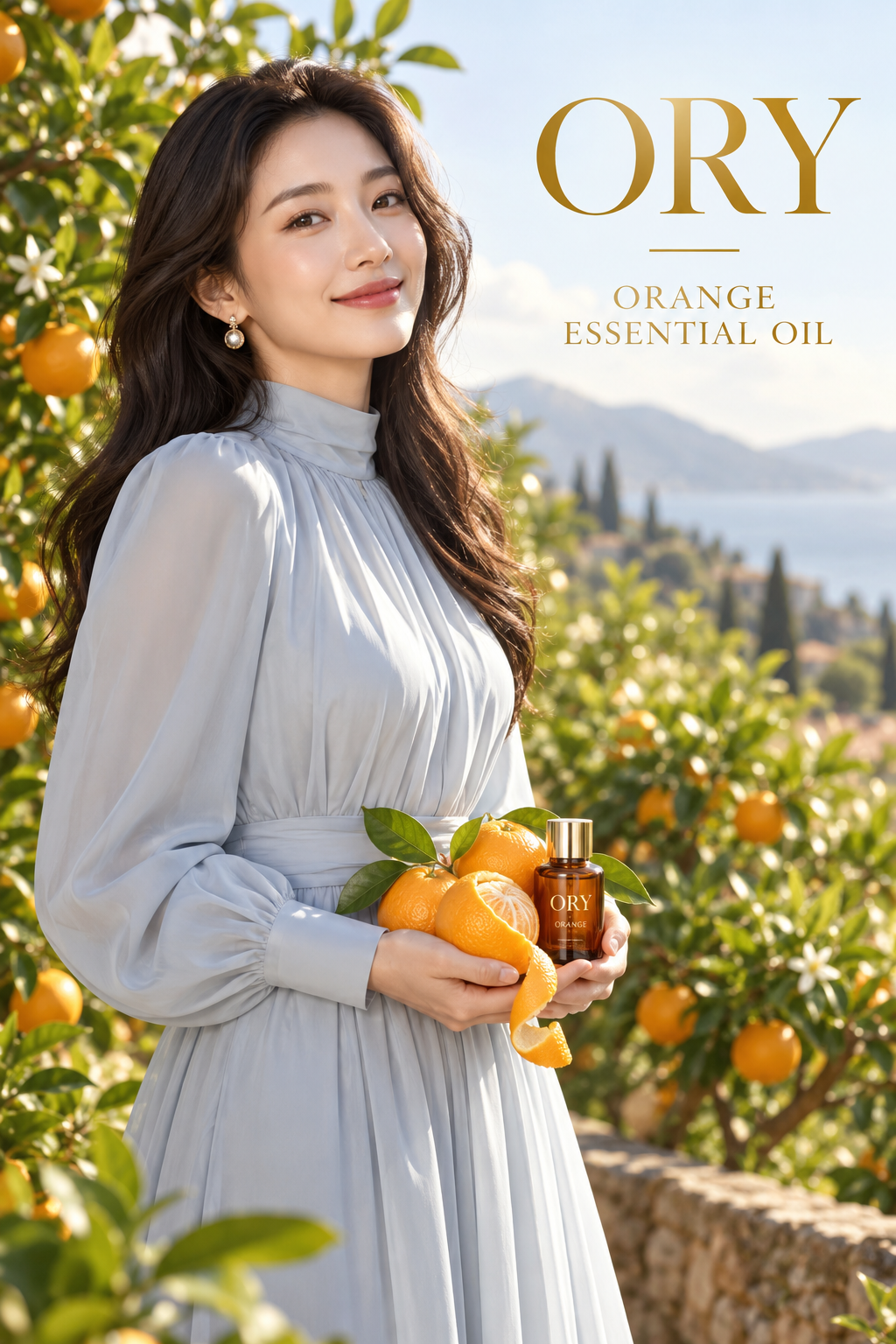

ORY® product lines:
☑ Skincare (low-level; not phototoxic when sweet orange)
☑ Haircare
☑ Handmade Soap (fades unless folded/anchored)
☑ Cosmetics (low-level) — full dual-use ingredient
Sweet orange essential oil is cold-pressed (or steam-distilled) from the peel of Citrus sinensis and consists of roughly 90–95% d-limonene, giving it a bright, familiar, uplifting scent at very low cost. Unlike bergamot, lime, or bitter orange, sweet orange oil is not phototoxic, so it can be used in leave-on products without sun-avoidance warnings [1]. Limonene and orange oil are antimicrobial and mildly anti-inflammatory, and ambient orange aroma reduced anxiety and improved mood in a clinical setting [3]. The important caveat is that limonene oxidizes readily on air exposure into hydroperoxides that are potent contact allergens [2], so orange oil must be fresh, antioxidant-protected, and labeled for limonene. In cold-process soap its scent fades unless a “5×/10× folded” oil or an anchoring note is used.
What is Orange Essential Oil made of?
Sweet orange oil is expressed from the peel during juice production (yield ~0.3–0.5%); folded grades are vacuum-concentrated. Composition [1, 4]:
- d-Limonene (90–95%): Bright citrus terpene; antimicrobial, solvent; oxidizes to allergenic hydroperoxides [2].
- Myrcene (1–3%), α-pinene, sabinene, linalool, decanal, octanal: Aroma-defining minors.
- Furanocoumarins: Absent/negligible in sweet orange (non-phototoxic), unlike bitter orange and bergamot [1].
- Dermal maximum: No phototoxic limit for sweet orange; use fresh oil with antioxidants; typical leave-on 0.5–1%, soap 3–5% (folded preferred) [4].
What skin type is best suited for Orange Essential Oil?
Sweet orange suits most ORY® skin types at low levels:
- Oily: Purifying, degreasing in cleansers and light oils.
- Acne-prone: Antimicrobial limonene in blemish washes.
- Normal: Uplifting body oils and creams.
- Combination: Bright, light-feeling blends.
- Mature: Antioxidant support; cheerful aroma.
- Dry: In body butters at 0.5–1%.
- Sensitive: Use ≤0.5% fresh oil; oxidized limonene sensitizes — patch test.
What hair type is best suited for Orange Essential Oil?
Orange oil brightens and degreases haircare:
- Oily scalp: Limonene dissolves sebum and product buildup; 0.5–1% in clarifying shampoos.
- Dandruff-prone scalp: Antimicrobial support in shampoos and pre-shampoo scalp oils.
- Dry or damaged: Aromatic addition to hair oils (lengths and ends).
- Straight, wavy, curly, coily: Fragrance and scalp-comfort addition at low levels for all textures.
- Color-treated: Low-level use; avoid the first 48 hours after coloring.
- Sensitive scalp: Use at the lowest end of the range; patch test.
- Mature or thinning: Scalp-massage oils (with rosemary and lavender) for a healthy scalp environment.
What are the benefits of Orange Essential Oil?
Orange essential oil’s benefits are supported by pharmacological and clinical-setting studies [1, 3]:
- Antimicrobial: Limonene inhibits bacteria and fungi [1].
- Non-phototoxic citrus: Safe for daytime leave-on use, unlike many citrus oils [1].
- Mood and anxiety benefit: Ambient orange aroma reduced anxiety and improved mood [3].
- Degreasing and clarifying: Solvent action removes buildup on skin and scalp.
- Antioxidant: Modest radical scavenging.
- Affordable natural fragrance: Juice-industry by-product.
- Blending: Brightens lavender, vanilla, spice, and mint blends.
- Soap: Cheerful scent; folded oil or anchoring with litsea, may chang, or lemongrass improves retention.
Dual use across ORY® product lines
Sweet orange serves all four ORY® lines as a bright, non-phototoxic citrus note.
Pros and cons of Orange Essential Oil
Pros
Cons
- Non-phototoxic citrus: Daytime-safe [1].
- Affordable and abundant: Upcycled peel.
- Universally loved aroma: Mood evidence [3].
- Antimicrobial and clarifying: Functional.
- Four-line utility: All ORY® products.
- Limonene oxidation: Oxidized oil is a potent sensitizer [2]; freshness critical.
- Allergen labeling: Limonene must be declared.
- Scent fades in soap: Requires folded oil or anchors.
- Confusion with bitter orange/bergamot: Those are phototoxic; label sweet orange clearly.
- Pets: Citrus oils are toxic to cats.
What is the best application of Orange Essential Oil?
Sweet orange oil brightens products across lines:
- Body oil or butter: 0.5–1% with vanilla or lavender.
- Cleanser: 0.5% for oily skin.
- Body or room mist: Solubilized 0.5–1%.
- Clarifying shampoo: 0.5–1%.
- Soap: 3–5% of oils, folded orange or with litsea.
- Cosmetics: 0.1–0.5% in lip balm or solid perfume.
Peer-reviewed references
- Dosoky NS, Setzer WN. Biological activities and safety of Citrus spp. essential oils. International Journal of Molecular Sciences. 2018;19(7):1966.
- Karlberg AT, Magnusson K, Nilsson U. Air oxidation of d-limonene (the citrus solvent) creates potent allergens. Contact Dermatitis. 1992;26(5):332–340.
- Lehrner J, Marwinski G, Lehr S, Johren P, Deecke L. Ambient odors of orange and lavender reduce anxiety and improve mood in a dental office. Physiology & Behavior. 2005;86(1–2):92–95.
- Tisserand R, Young R. Essential Oil Safety: A Guide for Health Care Professionals. 2nd ed. Churchill Livingstone/Elsevier; 2014. (Dermal-limit reference.)
Disclaimer:
The information on this page is provided by ORY International, LC for educational purposes only. It summarizes published research about sweet orange essential oil as an ingredient, including laboratory and animal studies and clinical studies of formulas that may differ from ORY® products. Results from these studies may not apply to every person or to ORY® products. This page is not medical advice and does not replace advice from a dermatologist, physician, or other qualified healthcare provider.
ORY® Skincare, Haircare, Handmade Soap, and Cosmetics products are cosmetics. They are not intended to diagnose, treat, cure, mitigate, or prevent any disease or condition, including eczema, acne, dandruff, infections, wounds, pain, headache, anxiety, insomnia, hair loss, or any other condition. References to FDA or Cosmetic Ingredient Review (CIR) findings describe the ingredient, not ORY® products, and do not mean FDA has reviewed or approved any ORY® product.
Results vary by skin and scalp type, formulation, and use. Oxidized limonene is a potent skin allergen. Any cosmetic can cause irritation, sometimes from other ingredients. Always patch test, follow label directions, and stop use if irritation occurs. If you are pregnant, nursing, have a medical condition, or are buying for a child, consult a healthcare provider before use.
ORY International, LC works to keep this page accurate and current but makes no warranty as to its completeness. To the fullest extent permitted by law, ORY International, LC is not liable for any loss or injury arising from reliance on this information or from use of any product contrary to its label directions. To report a reaction, contact us at [insert contact email / phone].