No products in the cart.: $0.00

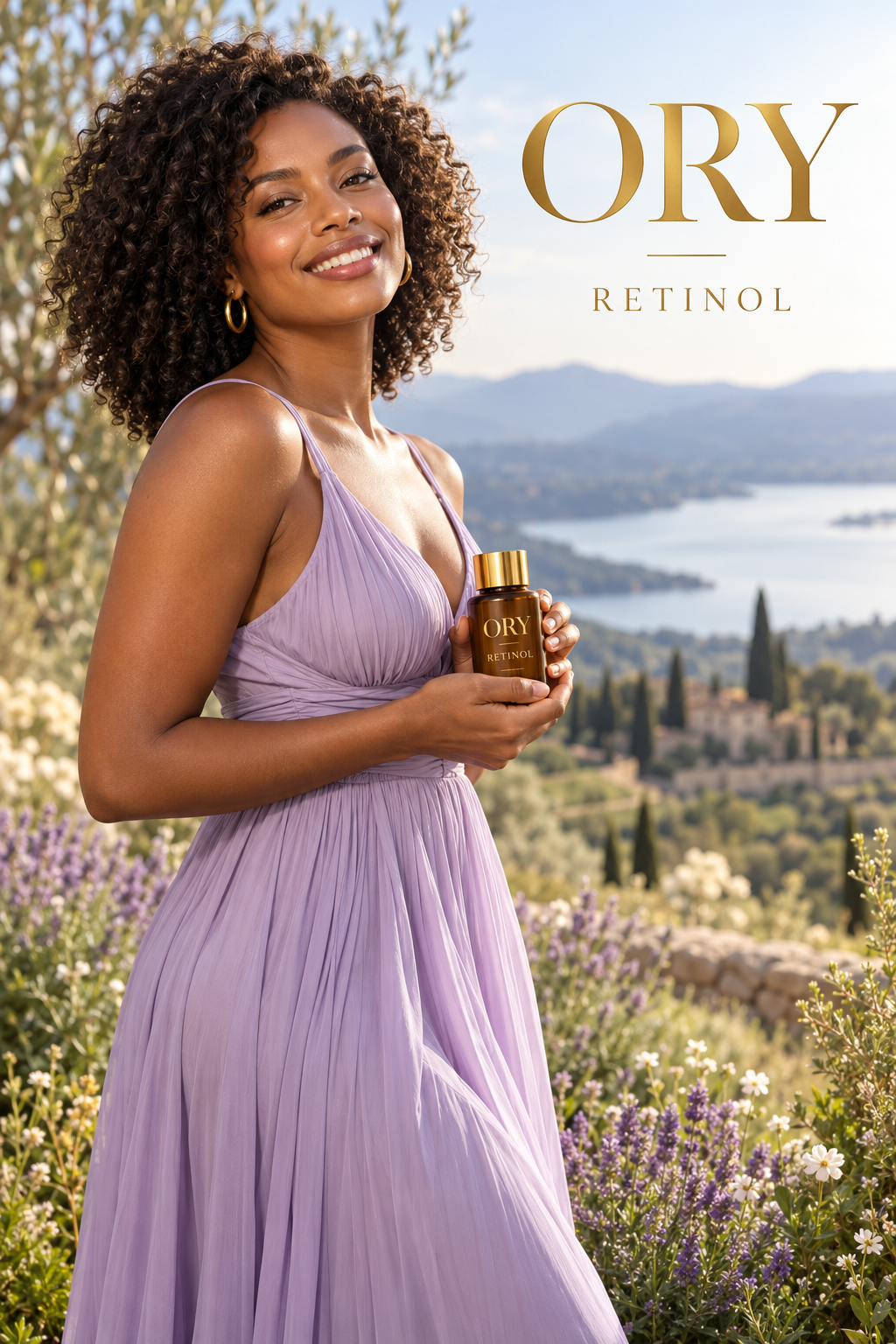
Retinol

ORY® product lines:
☑ Skincare
☒ Haircare (not recommended)
☒ Handmade Soap (unstable, rinse-off)
☑ Cosmetics (limited: low-level anti-aging foundations and night-wear tints) — primarily single-line ingredient
Retinol is pure vitamin A and the most evidence-backed over-the-counter anti-aging ingredient. In the skin it is converted to retinoic acid, which binds nuclear receptors to normalize cell turnover, increase collagen and glycosaminoglycan production, and reduce the enzymes that break down collagen [2, 3]. A double-blind, vehicle-controlled trial of 0.4% retinol on naturally aged skin showed significant reductions in fine wrinkles along with increased collagen and glycosaminoglycans after 24 weeks [1], and comparative work shows retinol produces retinoic-acid-like changes with less irritation [4]. Retinol is also effective for acne, texture, and pigmentation. It is, however, unstable in light and air, increases sun sensitivity, and is avoided during pregnancy — which confines it almost entirely to ORY® Skincare.
What is Retinol made of?
Retinol (C₂₀H₃₀O) is the alcohol form of vitamin A. Points to know:
- Source: Synthesized for cosmetic use; identical to dietary vitamin A.
- Conversion pathway: Retinol → retinaldehyde (retinal) → retinoic acid in the skin; each step reduces potency but also irritation, which is why retinol is gentler than prescription tretinoin [2].
- Oil-soluble and unstable: Degrades with light, oxygen, and heat; ORY® uses encapsulated or stabilized retinol with antioxidants (tocopherol, BHT) in airless, opaque packaging.
- Related esters: Retinyl palmitate is milder and more stable but must be converted twice; retinal is one step closer to retinoic acid and roughly ten times more potent than retinol.
What skin type is best suited for Retinol?
Retinol is best for resilient skin with aging or acne concerns, introduced gradually:
- Mature: The primary candidate — reduces fine lines, improves firmness and texture, and fades sun spots [1, 2].
- Acne-prone: Normalizes follicle keratinization, reducing comedones and post-acne marks; alternate with benzoyl peroxide.
- Oily: Reduces oiliness and refines pores over time.
- Normal: Preventive anti-aging from the late 20s at 0.25–0.5%.
- Combination: Start low (0.25%) and buffer with moisturizer.
- Dry: Use encapsulated retinol in a rich base; layer over moisturizer (“sandwich” method).
- Sensitive: Consider bakuchiol or retinyl palmitate instead; if retinol, 0.1–0.25% twice weekly.
What hair type is best suited for Retinol?
Retinol is not recommended in ORY® Haircare. Prescription tretinoin has been studied with minoxidil for hair loss, but cosmetic retinol on the scalp lacks clinical support, is unstable in shampoos, irritates the scalp, and increases sun sensitivity on an exposed area. Customers seeking scalp renewal should choose salicylic acid, niacinamide, peptides, or bakuchiol.
- All hair types: Not applicable in ORY® Haircare. For thinning hair, ORY® recommends peptides, caffeine, rosemary, and niacinamide leave-ins.
What are the benefits of Retinol?
Retinol’s benefits are supported by decades of clinical and histological research [1, 2, 3, 4]:
- Wrinkle reduction: Increases collagen and glycosaminoglycan synthesis; 0.4% significantly reduced fine wrinkles in 24 weeks [1].
- Cell turnover: Normalizes keratinocyte differentiation for smoother texture and fewer clogged pores.
- Hyperpigmentation: Disperses melanin and speeds turnover, fading sun spots and post-acne marks.
- Acne: Comedolytic; reduces both blackheads and inflammatory lesions.
- Collagen protection: Down-regulates matrix metalloproteinases that degrade collagen after UV exposure [3].
- Pore refinement and oil control: Reduces sebaceous activity over months of use.
- Epidermal thickening: Thickens the living epidermis while compacting the stratum corneum for a firmer, brighter appearance [4].
Dual use across ORY® product lines
Retinol’s instability, irritation potential, and photosensitivity make it a leave-on, night-time skincare active. It has no place in soap or standard haircare and only a narrow role in cosmetics.
Pros and cons of Retinol
Pros
Cons
- Gold-standard evidence: The most studied OTC anti-aging active [1, 2, 3].
- Multi-benefit: Wrinkles, pigmentation, acne, texture, and pores.
- Available without prescription: Effective at 0.25–1%.
- Long-term results: Structural collagen gains persist with continued use.
- Irritation: Redness, dryness, peeling, and “retinization” during the first 4–8 weeks.
- Photosensitivity: Night-only use with daily SPF 30+.
- Pregnancy: Avoided during pregnancy and breastfeeding as a precaution; customers should consult their physician.
- Instability: Oxidizes quickly; requires stabilization, antioxidants, and opaque, airless packaging.
- Incompatibility: Do not layer with benzoyl peroxide or high-strength AHAs/BHAs in the same application.
- Not for all lines: Skincare-only in practice.
What is the best application of Retinol?
Retinol works best when introduced slowly (“low and slow”) and used at night:
- Night serum or cream: Pea-sized amount to dry skin after cleansing; start 2 nights weekly at 0.25%, build to nightly, then increase strength.
- Sandwich method: Moisturizer → retinol → moisturizer for dry or sensitive skin.
- Eye cream: 0.1–0.3% formulated for the orbital area.
- Body: 0.25–0.5% lotions for keratosis pilaris, crepey arms, and neck.
- Acne: Nightly retinol with morning benzoyl peroxide or salicylic acid.
- Pairing: Hyaluronic acid, niacinamide, ceramides, peptides, and allantoin reduce irritation; alternate nights with AHAs; SPF 30+ every morning.
- Cosmetics: Night-wear tint or low-level anti-aging foundation for customers already tolerant of retinol.
Peer-reviewed references
- Kafi R, Kwak HSR, Schumacher WE, et al. Improvement of naturally aged skin with vitamin A (retinol). Archives of Dermatology. 2007;143(5):606–612.
- Mukherjee S, Date A, Patravale V, Korting HC, Roeder A, Weindl G. Retinoids in the treatment of skin aging: an overview of clinical efficacy and safety. Clinical Interventions in Aging. 2006;1(4):327–348.
- Zasada M, Budzisz E. Retinoids: active molecules influencing skin structure formation in cosmetic and dermatological treatments. Postępy Dermatologii i Alergologii. 2019;36(4):392–397.
- Kong R, Cui Y, Fisher GJ, et al. A comparative study of the effects of retinol and retinoic acid on histological, molecular, and clinical properties of human skin. Journal of Cosmetic Dermatology. 2016;15(1):49–58.
Disclaimer:
The information on this page is provided by ORY International, LC for educational purposes only. It summarizes published research about retinol as an ingredient, including laboratory and animal studies and clinical studies of formulas that may differ from ORY® products. Results from these studies may not apply to every person or to ORY® products. This page is not medical advice and does not replace advice from a dermatologist, physician, or other qualified healthcare provider.
ORY® Skincare and Cosmetics products are cosmetics. They are not intended to diagnose, treat, cure, mitigate, or prevent any disease or condition, including acne, sun damage, melasma, keratosis pilaris, or any skin condition. References to FDA or Cosmetic Ingredient Review (CIR) findings describe the ingredient, not ORY® products, and do not mean FDA has reviewed or approved any ORY® product.
Do not use retinol products if you are pregnant, trying to become pregnant, or breastfeeding unless a healthcare provider tells you it is safe. Use at night, and apply a broad-spectrum sunscreen every morning.
Results vary by skin and scalp type, formulation, and use. Retinol commonly causes redness, dryness, peeling, or stinging during the first weeks of use, and it can increase sensitivity to the sun. Always patch test, follow label directions, and stop use if irritation occurs. If you are pregnant, nursing, have a medical condition, or are buying for a child, consult a healthcare provider before use.
ORY International, LC works to keep this page accurate and current but makes no warranty as to its completeness. To the fullest extent permitted by law, ORY International, LC is not liable for any loss or injury arising from reliance on this information or from use of any product contrary to its label directions. To report a reaction, contact us at [insert contact email / phone].