No products in the cart.: $0.00

Sodium Lactate
ORY® product lines:
☑ Skincare
☑ Haircare
☑ Handmade Soap (classic hardener and humectant)
☑ Cosmetics — full dual-use ingredient (see also the Lactic Acid document)
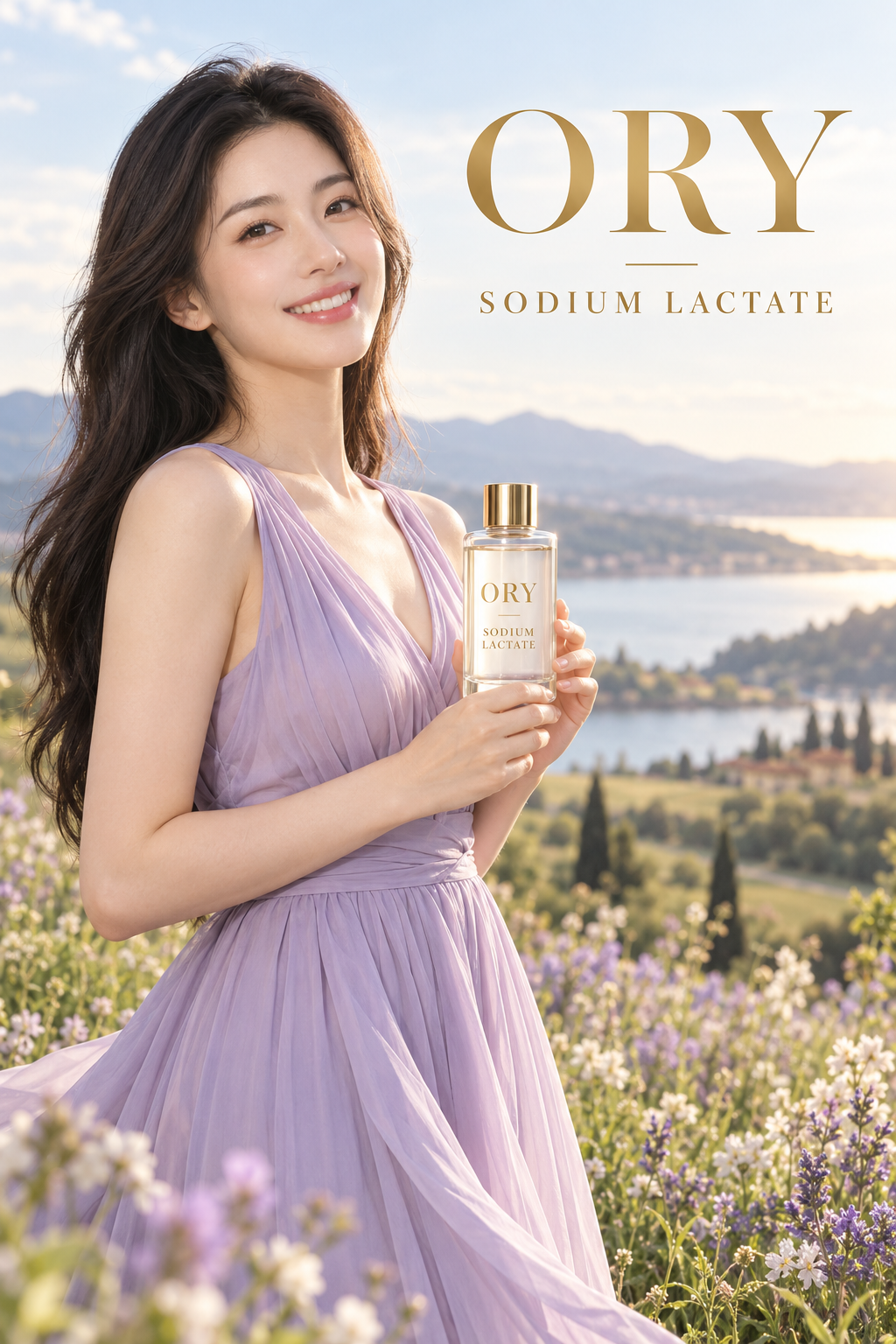
Sodium lactate is the neutralized salt of lactic acid — and, in the skin, a major component of the natural moisturizing factor (NMF): lactate makes up about 12% of the NMF, and the amount of lactate in the stratum corneum correlates directly with skin hydration and pliability [1, 3]. Unlike lactic acid, sodium lactate is not an exfoliant; it is a pure humectant with higher water-binding capacity than glycerin on a weight basis, and a pH buffer. The Cosmetic Ingredient Review Panel has concluded lactates are safe in cosmetics [2]. Sodium lactate is also one of the most useful additives in handmade soap: added to the lye water at 1–3%, it produces harder, smoother bars that unmold faster and last longer. Water-soluble, heat-stable, and skin-identical, it is a four-line ORY® ingredient.
What is Sodium Lactate made of?
Sodium lactate is produced by neutralizing fermentation-derived L-lactic acid with sodium hydroxide, supplied as a 60% solution. Points to know [1, 2]:
- Sodium salt of L-lactic acid: Clear, odorless, slightly viscous liquid; pH ~6.5–7.5; non-exfoliating.
- NMF component (~12% of NMF): Skin-identical humectant; regulates stratum-corneum water and pH [1, 3].
- High water-binding: Roughly 1.5× the humectancy of glycerin by weight; less tacky.
- Buffer: Maintains formula pH; pairs with lactic acid as a buffer system.
- Vegan, fermentation-derived; kosher grades available.
What skin type is best suited for Sodium Lactate?
Sodium lactate is a skin-identical humectant for all seven ORY® skin types:
- Dry: Sodium lactate draws and holds water in the stratum corneum — the primary beneficiary.
- Dehydrated / Sensitive: Non-irritating hydration that supports barrier recovery; suitable for reactive skin.
- Mature: Restores water content lost with age; plumps fine dehydration lines.
- Normal: Daily hydration maintenance.
- Combination: Oil-free hydration for all zones.
- Oily: Light, non-tacky hydration ideal for oily skin that dislikes glycerin’s feel.
- Acne-prone: Non-comedogenic; offsets the dryness of acne actives.
What hair type is best suited for Sodium Lactate?
Sodium lactate hydrates hair and scalp and buffers haircare pH:
- Dry or damaged: Sodium lactate binds water to the fiber and scalp, improving softness and pliability.
- Curly and coily: Humectant moisture supports curl definition; seal with oil or butter.
- Color-treated or chemically processed: Replenishes water lost in chemical services; reduces brittleness.
- Sensitive scalp: Hydrates a tight, flaky scalp without irritation.
- Straight and wavy: Light hydration and shine at low levels (high levels can feel sticky or attract humidity frizz).
- Oily scalp, dandruff-prone, mature or thinning: Water-based hydration that does not add oil; supports scalp comfort.
What are the benefits of Sodium Lactate?
Sodium lactate’s benefits are supported by NMF research and safety review [1–3]:
- Hydration: High water-binding humectant; stratum-corneum lactate correlates with hydration and elasticity [3].
- Barrier and NMF replenishment: Restores a native NMF component depleted in dry and aged skin [1].
- pH buffering: Stabilizes formula and skin-surface pH.
- Non-tacky feel: Less sticky than glycerin at equal humectancy.
- Anti-irritant: Reduces surfactant dryness in cleansers.
- Hair moisture: Binds water to the fiber; improves softness.
- Soap hardening: Harder, smoother, longer-lasting cold-process bars; faster unmolding [industry practice].
- Antimicrobial support: Mild preservative-boosting effect at higher levels.
Dual use across ORY® product lines
Sodium lactate is a rare humectant that serves all four ORY® lines — including cold-process soap, where it is a classic additive.
Pros and cons of Sodium Lactate
Pros
Cons
- Skin-identical NMF humectant: [1, 3].
- More humectant than glycerin, less tacky: Elegant feel.
- Soap hardener: Classic, proven additive.
- Buffer and anti-irritant: Multifunctional.
- Affordable, vegan, CIR-reviewed: [2].
- Humectant limitation: Pair with emollients in dry air.
- Electrolyte: Can thin some gels/emulsions at high levels (carbomer, some emulsifiers).
- Confusion with lactic acid: Not an exfoliant; label education.
- Slight salty feel at high %: Keep ≤5% in leave-ons.
- Soap over-use: Above 3% can make bars brittle or crumbly.
What is the best application of Sodium Lactate?
Sodium lactate is built into hydrating products and soap:
- Hydrating serum or toner: 2–3% with glycerin and sodium PCA (NMF blend).
- Cream or lotion: 2–4%.
- Cleanser: 1–2% to reduce dryness.
- Shampoo/conditioner: 1–2%.
- Soap: 1–3% of oils added to cooled lye water.
- Cosmetics: 1–2% in hydrating bases.
Peer-reviewed references
- Rawlings AV, Harding CR. Moisturization and skin barrier function. Dermatologic Therapy. 2004;17(Suppl 1):43–48.
- Andersen FA (Cosmetic Ingredient Review Expert Panel). Final report on the safety assessment of glycolic acid … and lactic acid, ammonium, calcium, potassium, sodium, and TEA-lactates … International Journal of Toxicology. 1998;17(Suppl 1):1–241.
- Nakagawa N, Sakai S, Matsumoto M, et al. Relationship between NMF (lactate and potassium) content and the physical properties of the stratum corneum in healthy subjects. Journal of Investigative Dermatology. 2004;122(3):755–763.
Disclaimer:
The information on this page is provided by ORY International, LC for educational purposes only. It summarizes published research about sodium lactate as an ingredient, including laboratory and animal studies and clinical studies of formulas that may differ from ORY® products. Results from these studies may not apply to every person or to ORY® products. This page is not medical advice and does not replace advice from a dermatologist, physician, or other qualified healthcare provider.
ORY® Skincare, Haircare, Handmade Soap, and Cosmetics products are cosmetics. They are not intended to diagnose, treat, cure, mitigate, or prevent any disease or condition, including eczema, ichthyosis, dry-skin disorders, or any other condition. References to FDA or Cosmetic Ingredient Review (CIR) findings describe the ingredient, not ORY® products, and do not mean FDA has reviewed or approved any ORY® product.
Results vary by skin and scalp type, formulation, and use. Sodium lactate is rarely irritating at normal use levels, and any cosmetic can cause irritation, sometimes from other ingredients. Always patch test, follow label directions, and stop use if irritation occurs. If you are pregnant, nursing, have a medical condition, or are buying for a child, consult a healthcare provider before use.
ORY International, LC works to keep this page accurate and current but makes no warranty as to its completeness. To the fullest extent permitted by law, ORY International, LC is not liable for any loss or injury arising from reliance on this information or from use of any product contrary to its label directions. To report a reaction, contact us at [insert contact email / phone].