No products in the cart.: $0.00
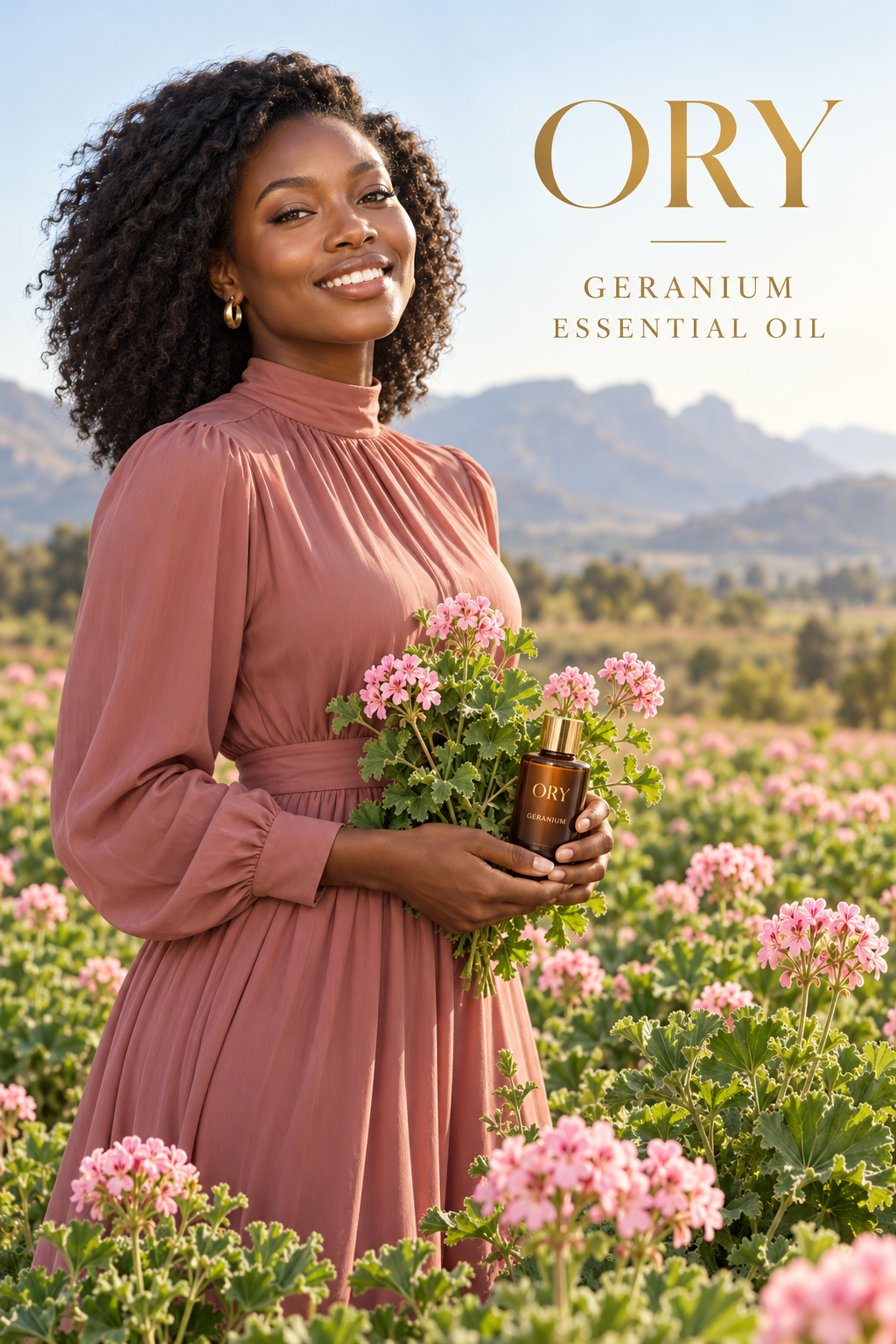
Geranium Essential Oil

ORY® product lines:
☑ Skincare
☑ Haircare
☑ Handmade Soap (may accelerate trace)
☑ Cosmetics (low-level fragrance) — full dual-use ingredient
Geranium essential oil is steam-distilled from the leaves and flowers of Pelargonium graveolens (rose geranium), yielding a rosy-green oil rich in citronellol and geraniol — the same alcohols that scent rose oil at a fraction of the cost. Geranium oil has documented anti-inflammatory activity, suppressing neutrophil accumulation and inflammatory mediators in animal skin [1, 2], plus broad antimicrobial and antifungal action against skin and scalp microbes. Aromatherapy tradition values it for balancing oily and dry skin and for hormonal-balance positioning (aroma-based, not proven). Its rose-like scent makes it a favorite in soap and cosmetics. Because citronellol, geraniol, and linalool are labeled fragrance allergens, geranium is used at moderate dilutions with allergen disclosure [3, 4].
What is Geranium Essential Oil made of?
Geranium essential oil is steam-distilled from the aerial parts of P. graveolens (yield ~0.1–0.3%). Composition [1, 5]:
- Citronellol (25–40%): Rosy alcohol; antimicrobial, insect-repellent; labeled allergen.
- Geraniol (10–20%): Rose alcohol; antimicrobial, anti-inflammatory; labeled allergen.
- Linalool (5–10%), citronellyl formate, geranyl formate, isomenthone, 10-epi-γ-eudesmol: Supporting aromatic and anti-inflammatory components.
- Dermal maximum: ~17.5% (Tisserand, based on geraniol/citral); typical leave-on 0.5–1.5%, soap 3–4% [5].
What skin type is best suited for Geranium Essential Oil?
Geranium is a balancing oil suited to most ORY® skin types:
- Combination: The classic “balancing” oil for mixed zones.
- Oily: Mild astringent, antimicrobial; 0.5–1% in light oils.
- Acne-prone: Antimicrobial and anti-inflammatory in blemish blends [1].
- Normal: Rosy daily face and body oils.
- Mature: Antioxidant support; traditional for tone and firmness.
- Dry: In richer creams and balms at 0.5–1%.
- Sensitive: Use ≤0.5%; allergen potential — patch test.
What hair type is best suited for Geranium Essential Oil?
Geranium balances the scalp and adds a rosy note to haircare:
- Oily scalp: Sebum-balancing tradition; 0.5–1% in scalp oils and shampoos.
- Dandruff-prone scalp: Antimicrobial support in shampoos and pre-shampoo scalp oils.
- Dry or damaged: Aromatic addition to hair oils (lengths and ends).
- Straight, wavy, curly, coily: Fragrance and scalp-comfort addition at low levels for all textures.
- Color-treated: Low-level use; avoid the first 48 hours after coloring.
- Sensitive scalp: Use at the lowest end of the range; patch test.
- Mature or thinning: Scalp-massage oils (with rosemary and lavender) for a healthy scalp environment.
What are the benefits of Geranium Essential Oil?
Geranium essential oil’s benefits are supported by animal and laboratory studies [1, 2]:
- Anti-inflammatory: Suppressed neutrophil accumulation and inflammatory mediators when applied to skin in animal models [1, 2].
- Antimicrobial and antifungal: Citronellol and geraniol inhibit skin bacteria and fungi.
- Sebum balancing: Traditional use for combination and oily skin.
- Antioxidant: Scavenges free radicals.
- Insect repellent: Citronellol is a recognized repellent.
- Rose-like fragrance: Affordable rose note for soap and cosmetics.
- Scalp balance: Oily-scalp and dandruff support.
- Aromatherapy tradition: Balancing and uplifting aroma (perceptual benefit).
Dual use across ORY® product lines
Geranium serves all four ORY® lines as a balancing active and rose-scented fragrance.
Pros and cons of Geranium Essential Oil
Pros
Cons
- Anti-inflammatory evidence: [1, 2].
- Affordable rose note: Versus rose otto.
- Balancing for combination skin: Traditional strength.
- Four-line utility: All ORY® products.
- Antimicrobial: Skin and scalp.
- Multiple labeled allergens: Citronellol, geraniol, linalool must be declared [3, 4].
- Trace acceleration in soap: Requires cool soaping.
- Hormone claims unproven: Keep to aroma/traditional language.
- Adulteration: Verify by GC/MS.
- Strong scent: Can dominate blends.
What is the best application of Geranium Essential Oil?
Geranium is diluted into balancing and rosy products:
- Balancing face oil: 0.5% in jojoba for combination skin.
- Body oil: 1–1.5% in sweet almond.
- Blemish blend: 0.5% with tea tree and lavender.
- Toner: Solubilized 0.3%.
- Scalp oil or shampoo: 0.5–1%.
- Soap: 3–4% of oils; rose-geranium bar.
- Cosmetics: 0.1–0.5% in lip balm or solid perfume.
Peer-reviewed references
- Maruyama N, Sekimoto Y, Ishibashi H, et al. Suppression of neutrophil accumulation in mice by cutaneous application of geranium essential oil. Journal of Inflammation (London). 2005;2:1.
- Boukhatem MN, Kameli A, Ferhat MA, Saidi F, Mekarnia M. Rose geranium essential oil as a source of new and safe anti-inflammatory drugs. Libyan Journal of Medicine. 2013;8:22520.
- de Groot AC, Frosch PJ. Adverse reactions to fragrances: a clinical review. Contact Dermatitis. 1997;36(2):57–86.
- Uter W, Geier J, Frosch P, Schnuch A. Contact allergy to fragrances: current patch test results (2005–2008) from the Information Network of Departments of Dermatology. Contact Dermatitis. 2010;63(5):254–261.
- Tisserand R, Young R. Essential Oil Safety: A Guide for Health Care Professionals. 2nd ed. Churchill Livingstone/Elsevier; 2014. (Dermal-limit reference.)
Disclaimer:
The information on this page is provided by ORY International, LC for educational purposes only. It summarizes published research about geranium essential oil as an ingredient, including laboratory and animal studies and clinical studies of formulas that may differ from ORY® products. Results from these studies may not apply to every person or to ORY® products. This page is not medical advice and does not replace advice from a dermatologist, physician, or other qualified healthcare provider.
ORY® Skincare, Haircare, Handmade Soap, and Cosmetics products are cosmetics. They are not intended to diagnose, treat, cure, mitigate, or prevent any disease or condition, including eczema, acne, dandruff, infections, wounds, pain, headache, anxiety, insomnia, hair loss, or any other condition. References to FDA or Cosmetic Ingredient Review (CIR) findings describe the ingredient, not ORY® products, and do not mean FDA has reviewed or approved any ORY® product.
Results vary by skin and scalp type, formulation, and use. Geranium oil contains citronellol, geraniol, and linalool, which can cause allergy. Any cosmetic can cause irritation, sometimes from other ingredients. Always patch test, follow label directions, and stop use if irritation occurs. If you are pregnant, nursing, have a medical condition, or are buying for a child, consult a healthcare provider before use.
ORY International, LC works to keep this page accurate and current but makes no warranty as to its completeness. To the fullest extent permitted by law, ORY International, LC is not liable for any loss or injury arising from reliance on this information or from use of any product contrary to its label directions. To report a reaction, contact us at [insert contact email / phone].