No products in the cart.: $0.00

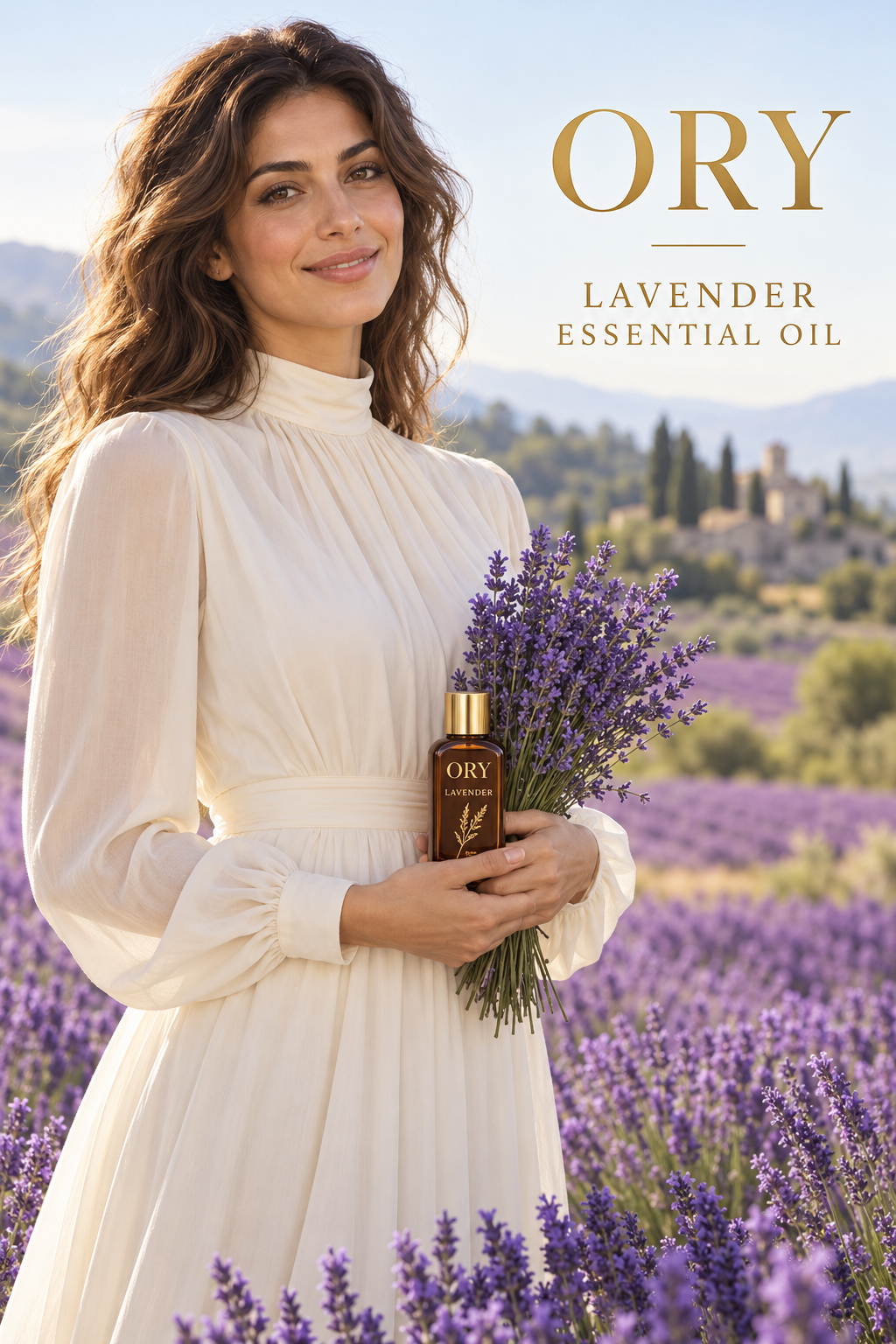
Lavender Essential Oil

ORY® product lines:
☑ Skincare
☑ Haircare
☑ Handmade Soap (anchor scent; well-behaved in cold process)
☑ Cosmetics (low-level fragrance) — full dual-use ingredient
Lavender essential oil is the steam-distilled oil of Lavandula angustifolia flowers and the most widely used essential oil in skincare, haircare, and handmade soap. Its two dominant constituents, linalool and linalyl acetate, are calming, antimicrobial, and anti-inflammatory [1]; lavender oil accelerated wound closure and collagen deposition through TGF-β signaling in an animal model [3]; and in a randomized trial, aromatherapy scalp massage with lavender, rosemary, thyme, and cedarwood in carrier oils significantly improved alopecia areata [2]. Lavender is also the classic “well-behaved” soap oil — it does not accelerate trace and holds its scent in cold-process bars. Its main caution is that linalool oxidizes on air exposure into sensitizing hydroperoxides [4], so freshness, antioxidant protection, and allergen labeling matter. This document covers the essential oil; the dried flower and oil infusion are covered in the Lavender document.
What is Lavender Essential Oil made of?
Lavender essential oil is steam-distilled from freshly cut flowering tops (yield ~1–1.5%). Composition of true lavender (ISO 3515) [1, 5]:
- Linalyl acetate (25–45%): Sweet-floral ester; calming, anti-inflammatory.
- Linalool (25–38%): Floral alcohol; antimicrobial, sedative, analgesic; oxidizes to allergenic hydroperoxides [4].
- Lavandulyl acetate, terpinen-4-ol, β-caryophyllene: Supporting anti-inflammatory and antimicrobial components.
- 1,8-cineole and camphor (<1–2% in true lavender; 5–15% in lavandin): Camphoraceous notes; ORY® specifies L. angustifolia, not lavandin (L. × intermedia), for skin products.
- Dermal maximum: No specific limit for fresh oil (Tisserand); typical leave-on 0.5–2%, rinse-off up to 3%, soap 3–5% [5].
What skin type is best suited for Lavender Essential Oil?
Lavender essential oil suits most ORY® skin types at proper dilution:
- Acne-prone: Antimicrobial and anti-inflammatory; 0.5–1% in serums and spot blends.
- Oily: Balancing in light oils and toners (solubilized).
- Normal: Calming daily oils, balms, and body products.
- Combination: Versatile at 0.5–1%.
- Dry: Soothing in richer balms and body oils.
- Mature: Wound-healing and antioxidant support [3]; relaxing night oils.
- Sensitive: Use ≤0.5%, fresh oil only; linalool sensitization is possible — patch test.
What hair type is best suited for Lavender Essential Oil?
Lavender is a leading scalp essential oil with clinical support:
- Mature or thinning: Randomized trial of lavender-containing scalp massage improved alopecia areata [2]; hair-growth promotion in mice; cosmetic support claims only.
- Dandruff-prone scalp: Antimicrobial and anti-inflammatory support in shampoos and scalp oils.
- Oily scalp: Balancing, antiseptic; 1% in scalp oils.
- Sensitive scalp: Calming at ≤0.5%; patch test.
- Dry or damaged: Aromatic hair oils and masks.
- Straight, wavy, curly, coily, color-treated: Scalp-massage and fragrance addition for all.
What are the benefits of Lavender Essential Oil?
Lavender essential oil’s benefits are supported by pharmacological, animal, and clinical studies [1–4]:
- Antimicrobial: Linalool and linalyl acetate inhibit bacteria and fungi, including acne-related species [1].
- Anti-inflammatory and analgesic: Reduces redness and discomfort [1].
- Wound healing: Accelerated wound contraction and collagen synthesis via TGF-β [3].
- Hair and scalp support: Clinical improvement in alopecia areata with lavender-containing massage [2].
- Calming aroma: Reduces anxiety and supports sleep in aromatherapy research; ideal for evening products.
- Insect-bite and minor-irritation relief: Traditional first-aid oil.
- Soap performance: Does not accelerate trace; scent survives saponification; blends with almost every other oil.
- Natural fragrance: Replaces synthetic perfume across all lines.
Dual use across ORY® product lines
Lavender essential oil is a true four-line ingredient and ORY®‘s most versatile natural fragrance.
Pros and cons of Lavender Essential Oil
Pros
Cons
- Best-evidenced essential oil: Clinical, animal, and pharmacological data [1–3].
- Gentle at proper dilution: Widely tolerated.
- Soap-friendly: No acceleration; good scent retention.
- Universal blender: Pairs with nearly every oil.
- Beloved aroma: High consumer demand.
- Oxidation sensitization: Oxidized linalool is a recognized allergen [4]; freshness and antioxidants are essential.
- Allergen labeling: Linalool (and limonene) must be declared above thresholds.
- Adulteration: Lavandin or synthetic linalyl acetate is often sold as lavender; require GC/MS.
- Endocrine reports: Case reports linked lavender/tea tree products to prepubertal gynecomastia; evidence is weak, but ORY® avoids marketing to young children.
- Not a drug: Hair and wound claims remain cosmetic.
What is the best application of Lavender Essential Oil?
Lavender essential oil is diluted into leave-on, rinse-off, and soap products:
- Night face oil: 0.5% in jojoba or squalane.
- Body or massage oil: 1–2% in sweet almond.
- Balm: 1–2% in a beeswax/shea balm for bites and minor irritation.
- After-sun: 0.5–1% with aloe (solubilized) and chamomile.
- Scalp-massage oil: 1% lavender + 1% rosemary in jojoba, 2–3 times weekly [2].
- Shampoo/conditioner: 0.5–1%.
- Soap: 3–5% of oils; classic lavender bar.
- Cosmetics: 0.1–0.5% in lip balm or solid perfume.
Peer-reviewed references
- Cavanagh HMA, Wilkinson JM. Biological activities of lavender essential oil. Phytotherapy Research. 2002;16(4):301–308.
- Hay IC, Jamieson M, Ormerod AD. Randomized trial of aromatherapy: successful treatment for alopecia areata. Archives of Dermatology. 1998;134(11):1349–1352.
- Mori HM, Kawanami H, Kawahata H, Aoki M. Wound healing potential of lavender oil by acceleration of granulation and wound contraction through induction of TGF-β in a rat model. BMC Complementary and Alternative Medicine. 2016;16:144.
- Sköld M, Hagvall L, Karlberg AT. Autoxidation of linalyl acetate, the main component of lavender oil, creates potent contact allergens. Contact Dermatitis. 2008;58(1):9–14.
- Tisserand R, Young R. Essential Oil Safety: A Guide for Health Care Professionals. 2nd ed. Churchill Livingstone/Elsevier; 2014. (Dermal-limit reference.)
Disclaimer:
The information on this page is provided by ORY International, LC for educational purposes only. It summarizes published research about lavender essential oil as an ingredient, including laboratory and animal studies and clinical studies of formulas that may differ from ORY® products. Results from these studies may not apply to every person or to ORY® products. This page is not medical advice and does not replace advice from a dermatologist, physician, or other qualified healthcare provider.
ORY® Skincare, Haircare, Handmade Soap, and Cosmetics products are cosmetics. They are not intended to diagnose, treat, cure, mitigate, or prevent any disease or condition, including eczema, acne, dandruff, infections, wounds, pain, headache, anxiety, insomnia, hair loss, or any other condition. References to FDA or Cosmetic Ingredient Review (CIR) findings describe the ingredient, not ORY® products, and do not mean FDA has reviewed or approved any ORY® product.
Results vary by skin and scalp type, formulation, and use. Lavender oil contains linalool and linalyl acetate, which form allergens when the oil oxidizes. Any cosmetic can cause irritation, sometimes from other ingredients. Always patch test, follow label directions, and stop use if irritation occurs. If you are pregnant, nursing, have a medical condition, or are buying for a child, consult a healthcare provider before use.
ORY International, LC works to keep this page accurate and current but makes no warranty as to its completeness. To the fullest extent permitted by law, ORY International, LC is not liable for any loss or injury arising from reliance on this information or from use of any product contrary to its label directions. To report a reaction, contact us at [insert contact email / phone].