No products in the cart.: $0.00

Tea Tree Oil

ORY® product lines:
☑ Skincare
☑ Haircare
☑ Handmade Soap
☑ Cosmetics (limited: blemish concealers, low level) — full dual-use ingredient
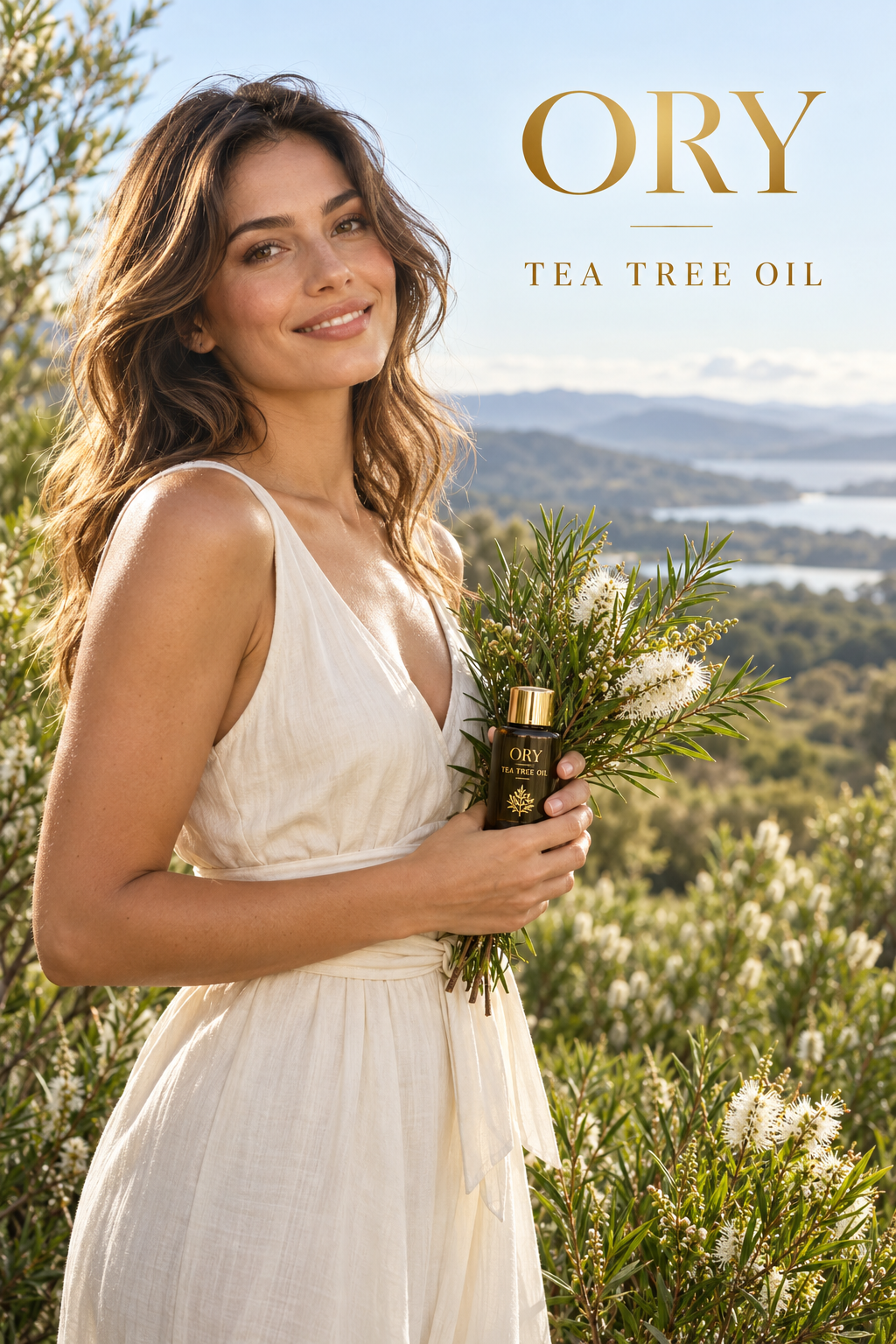
Tea tree oil is the steam-distilled essential oil of Melaleuca alternifolia, a shrub native to the coastal regions of New South Wales, Australia, where Aboriginal communities used the leaves as a traditional antiseptic. It is one of the few essential oils with a robust clinical record: a randomized trial found 5% tea tree oil gel as effective as 5% benzoyl peroxide for acne with fewer side effects [2], a placebo-controlled trial confirmed its benefit in mild-to-moderate acne [3], and a controlled trial of a 5% tea tree shampoo showed significant dandruff improvement [4]. Its antimicrobial activity spans bacteria, fungi (including Malassezia), and viruses [1]. Because it is oil-based, aromatic, and reasonably stable, it can be used in skincare, haircare, soap, and low-level cosmetics — with concentration limits to avoid sensitization.
What is Tea Tree Oil made of?
Tea tree oil is a complex mixture of more than 100 terpene compounds. Quality is defined by the international standard ISO 4730 [1, 5]:
Fresh oil is clear to pale yellow. On exposure to air and light, terpenes oxidize into peroxides and p-cymene, which are the main sensitizers — so storage and freshness directly affect safety.
- Terpinen-4-ol (30–48%): The primary antimicrobial and anti-inflammatory component.
- γ-Terpinene (10–28%) and α-terpinene (5–13%): Supporting antimicrobial terpenes.
- 1,8-Cineole (<15%, ideally <5%): A potential irritant; ORY® sources low-cineole oil.
- α-Terpineol, terpinolene, and others: Contribute to the characteristic camphoraceous scent.
What skin type is best suited for Tea Tree Oil?
Tea tree oil is targeted to oily, blemish-prone, and fungus-prone skin:
- Acne-prone: The primary indication — 5% gel matched benzoyl peroxide with less dryness and irritation [2, 3].
- Oily: Antimicrobial and mildly astringent; helps control surface bacteria and shine.
- Combination: Spot or T-zone use in a diluted serum.
- Normal: Occasional spot treatment.
- Dry: Use at 1% or less in an emollient base; avoid neat application.
- Mature: Limited benefit; antioxidant activity is modest compared with other options.
- Sensitive: Higher sensitization risk; 0.5–1% maximum in a soothing base, fresh oil only, patch test required.
What hair type is best suited for Tea Tree Oil?
Tea tree oil is a proven scalp active with a strong fit for dandruff and oily, itchy scalps:
- Dandruff-prone scalp: The core use — 5% shampoo reduced dandruff severity, itch, and greasiness in a controlled trial [4]; active against Malassezia [1].
- Oily scalp: Antimicrobial and clarifying; reduces greasiness.
- Sensitive scalp: Use 0.5–1% with allantoin or bisabolol; the itch relief is welcome, but the sensitization risk is higher.
- Mature or thinning: Keeps follicle openings clear of microbial buildup (supportive).
- Straight, wavy, curly, coily: Clarifying scalp treatments for all textures.
- Dry or damaged, color-treated: Scalp-focused only; avoid drying the fiber.
What are the benefits of Tea Tree Oil?
Tea tree oil’s benefits are unusual among essential oils in being clinically demonstrated [1–4]:
- Antibacterial: Terpinen-4-ol disrupts bacterial membranes, including C. acnes and Staphylococcus aureus [1].
- Antifungal: Active against Malassezia (dandruff), Candida, and dermatophytes [1].
- Acne reduction: Reduces lesion count comparably to benzoyl peroxide with fewer side effects [2, 3].
- Anti-inflammatory: Reduces histamine-induced swelling and redness.
- Dandruff control: Improves flaking, itching, and scalp greasiness [4].
- Soap antimicrobial and fragrance: Natural scent and antimicrobial contribution to handmade bars.
- Minor-wound and foot care: Traditional use for cuts, insect bites, and athlete’s foot.
Dual use across ORY® product lines
Tea tree oil’s oil solubility and volatility make it usable across all four ORY® lines, with careful concentration control.
Pros and cons of Tea Tree Oil
Pros
Cons
- Clinically proven: Comparable acne efficacy to benzoyl peroxide [2] and validated dandruff benefit [4].
- Broad-spectrum: Bacteria, fungi, and yeasts [1].
- Natural and botanical: Aligns with ORY®‘s botanical-infusion philosophy.
- Fewer side effects than benzoyl peroxide: No bleaching; less peeling.
- Four-line utility: Skin, scalp, soap, and select cosmetics.
- Sensitization: Oxidized oil is a recognized contact allergen; freshness and storage are critical [5].
- Irritation when neat: Undiluted oil can cause dermatitis; always dilute.
- Strong scent: Medicinal aroma may not suit all customers.
- Slower onset than benzoyl peroxide: Takes longer to reduce lesions [2].
- Toxic if swallowed: Serious toxicity in children and pets (especially cats and dogs) if ingested or applied heavily [5].
- Endocrine questions: Isolated case reports raised concerns with prolonged use in prepubertal boys; evidence is weak, but ORY® avoids marketing to young children.
What is the best application of Tea Tree Oil?
Tea tree oil should always be diluted and used at the lowest effective level:
- Spot treatment: 2–5% gel on individual blemishes, once or twice daily.
- Serum or toner: 0.5–2% for oily, congested skin.
- Cleanser: 1–2% in gel cleansers for daily use.
- Clay mask: 1–2% in kaolin or bentonite masks weekly.
- Foot and body: 2–5% in foot creams and body washes.
- Dandruff shampoo: 3–5% left on 3–5 minutes, 2–3 times weekly [4].
- Scalp serum: 0.5–2% in jojoba or squalane, massaged into the scalp before shampooing.
- Soap: Tea tree acne bar for body and back breakouts.
- Pairing: Works with salicylic acid, niacinamide, zinc, and allantoin; avoid combining with other strong essential oils.
Peer-reviewed references
- Carson CF, Hammer KA, Riley TV. Melaleuca alternifolia (tea tree) oil: a review of antimicrobial and other medicinal properties. Clinical Microbiology Reviews. 2006;19(1):50–62.
- Bassett IB, Pannowitz DL, Barnetson RS. A comparative study of tea-tree oil versus benzoylperoxide in the treatment of acne. Medical Journal of Australia. 1990;153(8):455–458.
- Enshaieh S, Jooya A, Siadat AH, Iraji F. The efficacy of 5% topical tea tree oil gel in mild to moderate acne vulgaris: a randomized, double-blind placebo-controlled study. Indian Journal of Dermatology, Venereology and Leprology. 2007;73(1):22–25.
- Satchell AC, Saurajen A, Bell C, Barnetson RS. Treatment of dandruff with 5% tea tree oil shampoo. Journal of the American Academy of Dermatology. 2002;47(6):852–855.
- Hammer KA, Carson CF, Riley TV, Nielsen JB. A review of the toxicity of Melaleuca alternifolia (tea tree) oil. Food and Chemical Toxicology. 2006;44(5):616–625.
Disclaimer:
The information on this page is provided by ORY International, LC for educational purposes only. It summarizes published research about tea tree oil as an ingredient, including laboratory and animal studies and clinical studies of formulas that may differ from ORY® products. Results from these studies may not apply to every person or to ORY® products. This page is not medical advice and does not replace advice from a dermatologist, physician, or other qualified healthcare provider.
ORY® Skincare, Haircare, Handmade Soap, and Cosmetics products are cosmetics. They are not intended to diagnose, treat, cure, mitigate, or prevent any disease or condition, including acne, dandruff, seborrheic dermatitis, fungal or bacterial infections, athlete’s foot, cuts, or insect bites. References to FDA or Cosmetic Ingredient Review (CIR) findings describe the ingredient, not ORY® products, and do not mean FDA has reviewed or approved any ORY® product.
Tea tree oil is toxic if swallowed. Keep all tea tree products away from children and pets, and never apply undiluted tea tree oil to skin. ORY® does not market tea tree products for young children.
Results vary by skin and scalp type, formulation, and use. Tea tree oil can cause skin irritation and allergic reactions, especially when the oil is old or oxidized, and any cosmetic can cause irritation, sometimes from other ingredients. Always patch test, follow label directions, and stop use if irritation occurs. If you are pregnant, nursing, have a medical condition, or are buying for a child, consult a healthcare provider before use.
ORY International, LC works to keep this page accurate and current but makes no warranty as to its completeness. To the fullest extent permitted by law, ORY International, LC is not liable for any loss or injury arising from reliance on this information or from use of any product contrary to its label directions. To report a reaction, contact us at [insert contact email / phone].