No products in the cart.: $0.00
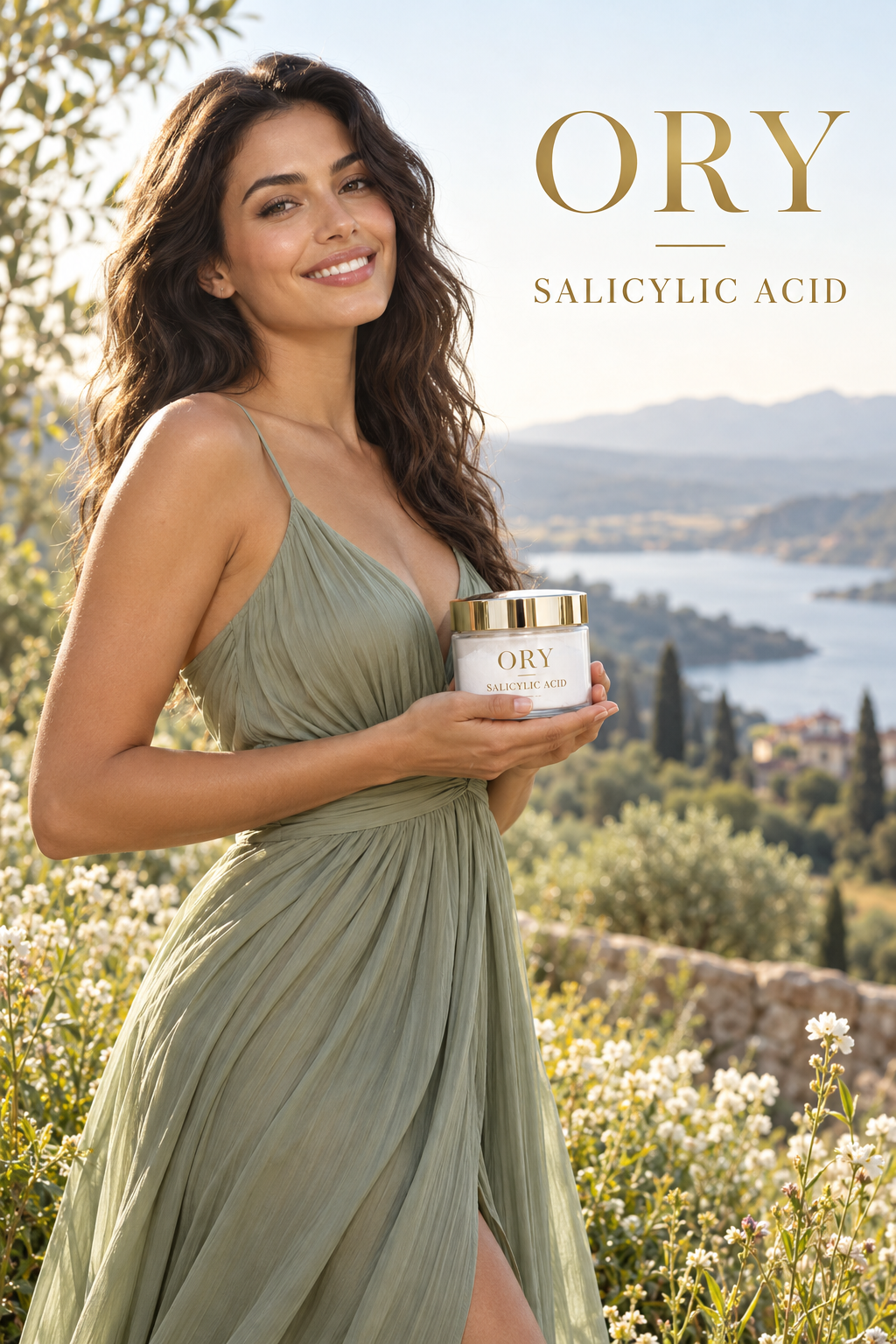
Salicylic Acid
ORY® product lines:
☑ Skincare
☑ Haircare (dandruff and scalp exfoliation)
☑ Handmade Soap (limited: syndet/liquid soap; neutralized in cold-process bars)
☑ Cosmetics (acne-friendly foundations and primers) — dual-use ingredient with formulation limits
Salicylic acid is the best-known beta-hydroxy acid (BHA), originally isolated from willow bark and related to aspirin. Unlike water-loving AHAs, it is oil-soluble, so it travels into the sebum-filled pore to dissolve the plugs that cause blackheads, whiteheads, and acne [1]. It is also keratolytic (loosens dead cells), anti-inflammatory, and mildly antimicrobial. In the U.S. it is recognized in two OTC drug monographs: acne treatment at 0.5–2% and dandruff/seborrheic dermatitis at 1.8–3% — making it one of the few actives with regulatory support for both skin and scalp [2, 3]. A clinical trial of a shampoo combining 3% salicylic acid with ciclopirox olamine showed dandruff control comparable to 2% ketoconazole [2].
What is Salicylic Acid made of?
Salicylic acid (C₇H₆O₃, 2-hydroxybenzoic acid) is a phenolic acid. Points to know:
- Source: Historically from willow bark and wintergreen; cosmetic grades are synthesized (from phenol via the Kolbe–Schmitt reaction) to USP purity.
- Oil-soluble BHA: Its lipophilic ring lets it penetrate sebum and pore linings, which AHAs cannot do.
- Low water solubility: Requires alcohol, glycols, or solubilizers; formula pH is typically 3–4 for activity.
- Willow bark extract: Contains salicin, a gentler precursor with weaker direct exfoliation; useful for sensitive positioning.
What skin type is best suited for Salicylic Acid?
Salicylic acid is the definitive pore-clearing active:
- Acne-prone: First choice for blackheads, whiteheads, and mild-to-moderate acne; 0.5–2% leave-on [1, 3].
- Oily: Dissolves excess sebum and keeps pores clear.
- Combination: Target the T-zone with a 1–2% toner or spot treatment.
- Normal: Weekly use to prevent congestion.
- Mature: Smooths texture and, at 20–30% in professional peels, treats photoaging [1]; use moderate levels at home.
- Dry: Use 0.5–1% in a hydrating base or a rinse-off cleanser; pair with HA.
- Sensitive: Willow-bark extract or betaine salicylate as gentler options; 0.5% maximum; patch test.
What hair type is best suited for Salicylic Acid?
Salicylic acid is one of the most effective and regulator-recognized scalp actives:
- Dandruff-prone scalp: The core use — loosens scales and reduces flaking at 1.8–3% (FDA dandruff monograph) [2].
- Oily scalp: Dissolves sebum and product buildup; extends time between washes.
- Sensitive scalp: Use 1% or less in a soothing base with allantoin or Centella.
- Mature or thinning: Clears follicle openings so growth-support actives can reach the scalp.
- Straight, wavy, curly, coily: Pre-shampoo scalp treatments clarify buildup for all textures; coily hair should follow with rich conditioning.
- Dry or damaged, color-treated: Scalp-only application at low levels; avoid the hair fiber, which can be dried.
What are the benefits of Salicylic Acid?
Salicylic acid’s benefits are pore-deep and well supported [1, 3]:
- Unclogs pores: Dissolves sebum plugs and dead cells inside the follicle — the mechanism behind blackhead and whitehead control.
- Exfoliates: Keratolytic action smooths rough, bumpy texture.
- Anti-inflammatory: Related to aspirin; reduces redness and swelling of acne lesions.
- Reduces oil: Helps normalize sebum on the skin and scalp.
- Antimicrobial: Creates an environment less favorable to C. acnes and Malassezia yeasts.
- Dandruff control: Removes scales and, with antifungals, controls seborrheic dermatitis [2].
- Photoaging support: Professional-strength peels improve fine lines and pigmentation [1].
Dual use across ORY® product lines
Salicylic acid works in any acidic, leave-on or short-contact product. Its main limitation is cold-process soap, where lye converts it to sodium salicylate and removes its exfoliating power.
| ORY® line | Dual use? | How it is used | Typical level |
|---|---|---|---|
|
ORY® Skincare |
Yes |
Acne cleansers, toners, serums, spot treatments, masks, body washes for body acne and keratosis pilaris (OTC acne monograph labeling at 0.5–2%). |
0.5–2% leave-on; up to 3% rinse-off |
|
ORY® Haircare |
Yes |
Dandruff and clarifying shampoos, scalp exfoliating serums and pre-shampoo treatments (OTC dandruff monograph at 1.8–3%). |
1.8–3% shampoo; 1–2% scalp serum |
|
ORY® Handmade Soap |
Limited |
Neutralized in cold-process bars. Functional only in syndet (synthetic detergent) bars or liquid castile-based washes kept at pH ≤5.5 — ORY® can offer a salicylic "acne bar" as a syndet product. |
1–2% in syndet or liquid soap |
|
ORY® Cosmetics |
Yes |
Acne-friendly foundations, tinted moisturizers, blemish-concealing primers. |
0.5–1% |
Pros and cons of Salicylic Acid
Pros
Cons
- Pore-penetrating: The only common exfoliant that reaches inside the pore.
- Dual regulatory support: Acne and dandruff monographs allow clear, compliant claims [3].
- Anti-inflammatory: Calms as it clears.
- Affordable and stable: Low cost, heat- and light-stable.
- Multi-line: Skin, scalp, syndet bars, and makeup.
- Drying: Over-use strips oil; balance with HA and niacinamide.
- Irritation: Stinging or peeling above 2% on the face.
- Aspirin allergy: Avoid in customers with salicylate sensitivity.
- Pregnancy caution: Low-level topical use is generally considered acceptable, but high-concentration or large-area use is discouraged; consult a physician.
- Cold-process soap: Loses activity in true soap.
- OTC drug labeling: Acne and dandruff claims trigger drug-facts labeling requirements.
What is the best application of Salicylic Acid?
Salicylic acid is most effective in products that stay on the skin or scalp long enough to reach the pore:
- Toner or liquid exfoliant: 1–2% applied after cleansing, 3–7 nights weekly.
- Cleanser: 2% for daily use; leave on 30–60 seconds before rinsing.
- Spot treatment: 2% gel on active lesions.
- Serum: 1–2% for oily, congested skin; pair with niacinamide.
- Body wash: 2% for back and chest acne; keratosis pilaris.
- Peel: Professional 20–30% peels for acne and photoaging [1].
- Dandruff shampoo: 1.8–3% left on the scalp 2–3 minutes before rinsing, 2–3 times weekly.
- Scalp serum: 1–2% pre-shampoo treatment for flakes and buildup.
- Cosmetics: Acne-friendly foundation for daily wear.
- Pairing: Morning salicylic acid, evening retinol; not with glycolic acid in the same application; SPF daily.
Peer-reviewed references
- Arif T. Salicylic acid as a peeling agent: a comprehensive review. Clinical, Cosmetic and Investigational Dermatology. 2015;8:455–461.
- Squire RA, Goode K. A randomised, single-blind, single-centre clinical trial to evaluate comparative clinical efficacy of shampoos containing ciclopirox olamine (1.5%) and salicylic acid (3%), or ketoconazole (2%, Nizoral) for the treatment of dandruff/seborrhoeic dermatitis. Journal of Dermatological Treatment. 2002;13(2):51–60.
- Reynolds RV, Yeung H, Cheng CE, et al. Guidelines of care for the management of acne vulgaris. Journal of the American Academy of Dermatology. 2024;90(5):1006.e1–1006.e30.
- Andersen FA (Cosmetic Ingredient Review Expert Panel). Safety assessment of salicylic acid, butyloctyl salicylate, calcium salicylate, C12-15 alkyl salicylate, capryloyl salicylic acid, hexyldodecyl salicylate, isocetyl salicylate, isodecyl salicylate, magnesium salicylate, MEA-salicylate, ethylhexyl salicylate, potassium salicylate, methyl salicylate, myristyl salicylate, sodium salicylate, TEA-salicylate, and tridecyl salicylate. International Journal of Toxicology. 2003;22(Suppl 3):1–108.
Disclaimer:
The information on this page is provided by ORY International, LC for educational purposes only. It summarizes published research and FDA rules about salicylic acid as an ingredient. It is not medical advice and does not replace advice from a dermatologist, physician, pharmacist, or other qualified healthcare provider.
OTC drug products: ORY® products labeled for acne or dandruff are over-the-counter drugs made and labeled under FDA rules (21 CFR Part 333, Subpart D; 21 CFR Part 358, Subpart H). They are intended only for the uses stated on the Drug Facts label. Read and follow the Drug Facts label. If your acne or scalp condition is severe or does not improve, see a dermatologist.
Cosmetic products: ORY® products that contain salicylic acid without acne or dandruff claims are cosmetics. They are not intended to diagnose, treat, cure, mitigate, or prevent any disease or condition.
Sunburn Alert: This product contains a beta hydroxy acid (BHA) that may increase your skin’s sensitivity to the sun and particularly the possibility of sunburn. Use a sunscreen, wear protective clothing, and limit sun exposure while using this product and for a week afterwards.
Results vary. Salicylic acid can cause dryness, peeling, or stinging. Do not use if you are allergic to salicylates, including aspirin. If you are pregnant, nursing, have a medical condition, use other acne medicines, or are buying for a child, ask a healthcare provider before use. Research cited here describes salicylic acid in published studies, not ORY® products specifically.
ORY International, LC works to keep this page accurate and current but makes no warranty as to its completeness. To the fullest extent permitted by law, ORY International, LC is not liable for any loss or injury arising from reliance on this information or from use of any product contrary to its label directions. To report a reaction or side effect, contact us at [insert contact email / phone].