No products in the cart.: $0.00

Castor Oil

ORY® product lines:
☑ Skincare
☑ Haircare (traditional; growth claims unproven)
☑ Handmade Soap (lather booster 5–10%)
☑ Cosmetics (lipstick gloss and pigment wetting) — full dual-use ingredient
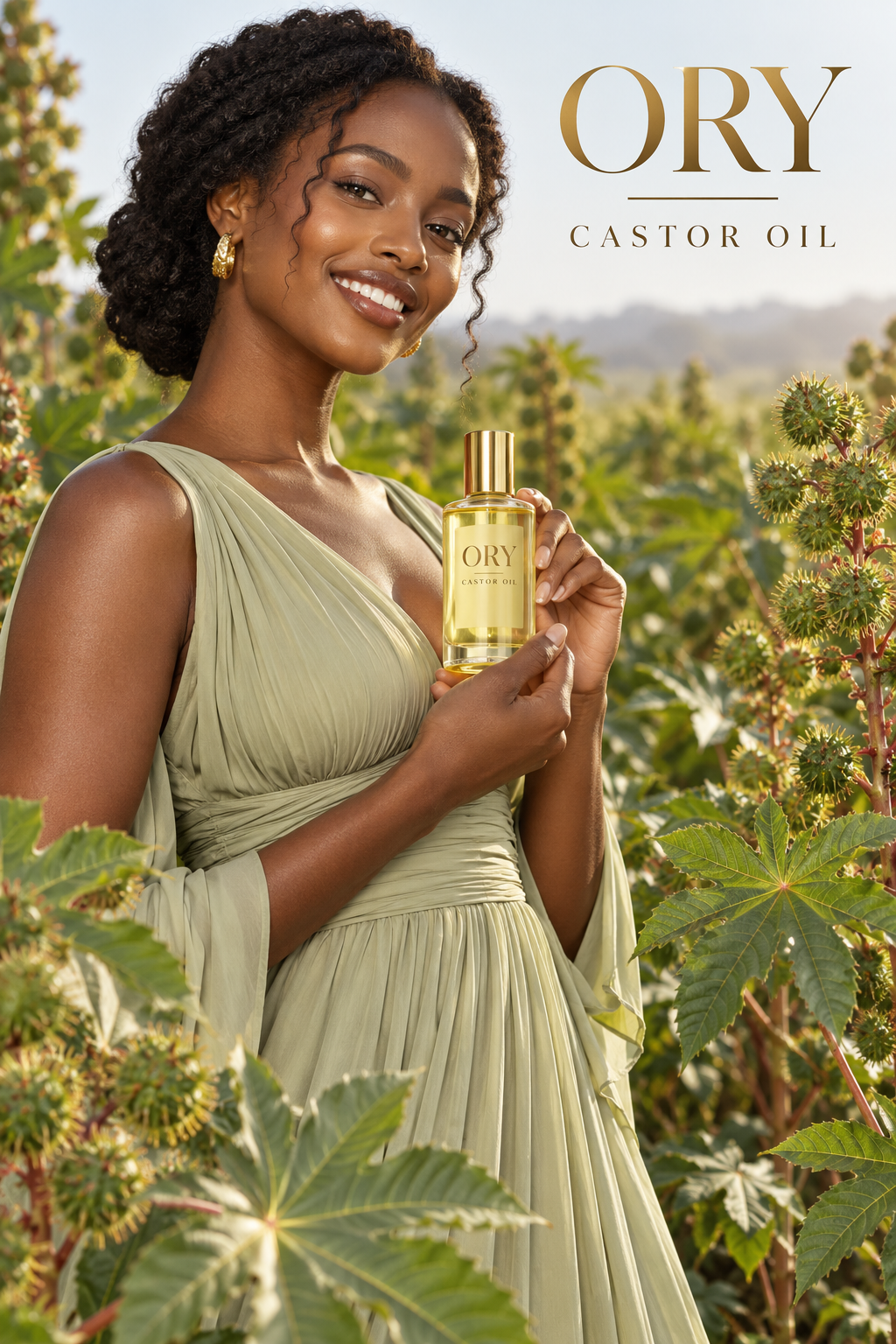
Castor oil is pressed from the seeds of Ricinus communis and is unlike any other carrier: about 90% of its fatty acids are ricinoleic acid, an unusual hydroxylated fatty acid that makes the oil thick, glossy, humectant, and strongly anti-inflammatory — ricinoleic acid reduced inflammation in acute and chronic animal models [1]. The seeds contain the toxin ricin, but ricin is water-soluble and stays in the seed cake; properly processed castor oil is ricin-free and has been reviewed as safe by the Cosmetic Ingredient Review Panel [2]. Castor oil is a classic in lipstick (gloss and pigment dispersion), in handmade soap (a lather booster), and in haircare, where its popular “hair-growth” reputation is traditional rather than evidence-based — it conditions, adds shine, and protects, but no controlled study shows it grows hair.
What is Castor Oil made of?
Castor oil is cold-pressed from seeds, then filtered (and optionally refined); the ricin-containing protein fraction remains in the press cake. Composition [2]:
- Ricinoleic acid (85–95%): Hydroxylated omega-9; anti-inflammatory, humectant, viscous, glossy [1].
- Oleic (3–5%), linoleic (3–5%), stearic and palmitic (1–2%) acids: Minor.
- Vitamin E traces.
- Comedogenic rating ~1; shelf life 2+ years; very viscous.
- Soap data: SAP ~0.128 g NaOH/g; boosts lather (dense, creamy, stable); 5–10% (higher makes sticky, soft bars); 100% = transparent/liquid soap base.
What skin type is best suited for Castor Oil?
Castor oil suits skin needing protection, gloss, or anti-inflammatory support:
- Dry: Humectant, glossy protective film; lip and cuticle care.
- Sensitive: Anti-inflammatory ricinoleic acid [1]; low allergen risk.
- Normal: Oil-cleansing blends, balms.
- Acne-prone: Low comedogenicity; used in oil-cleansing at 10–30%.
- Oily: Oil-cleansing partner (rinse-off).
- Combination: Blended use.
- Mature: Protective balms; brow and lash conditioning.
What hair type is best suited for Castor Oil?
Castor oil is the traditional thick hair and scalp oil — conditioning is proven, growth is not:
- Dry or damaged: Thick, glossy coating seals and protects; blend 10–30% with lighter oils.
- Curly and coily: Heavy sealing oil for ends and edges; Jamaican black castor tradition.
- Mature or thinning: Traditional scalp oil; conditions and reduces breakage, but growth claims are unproven — pair with rosemary for evidence-based support.
- Dandruff-prone scalp: Anti-inflammatory scalp massage oil (diluted).
- Color-treated: Protective ends treatment.
- Straight and wavy: Too heavy except as trace ends gloss.
- Oily scalp, sensitive scalp: Dilute heavily; lengths only for oily scalps.
What are the benefits of Castor Oil?
Castor oil’s benefits are supported by pharmacological study and safety review [1, 2]:
- Anti-inflammatory: Ricinoleic acid reduced inflammation in animal models [1].
- Humectant-emollient: Draws moisture and seals with a glossy film.
- Protective: Thick barrier for chapped lips, cuticles, and ends.
- Lash and brow conditioning: Traditional; reduces breakage (no growth evidence).
- Oil cleansing: Dissolves sebum and makeup in blends.
- Soap lather booster: Dense, creamy, stable lather at 5–10%.
- Cosmetic gloss and pigment wetting: The classic lipstick oil.
- Stability: Long shelf life; low allergen risk.
Dual use across ORY® product lines
Castor oil is a true four-line ingredient with distinct roles in each.
| ORY® line | Dual use? | How it is used | Typical level |
|---|---|---|---|
|
ORY® Skincare |
Yes |
Oil-cleansing blends, lip and cuticle balms, protective ointments, lash/brow serums. |
5–30% |
|
ORY® Haircare |
Yes |
Scalp massage oils (diluted), sealing oils for coily hair, ends balms, edge control. |
10–30% in blends |
|
ORY® Handmade Soap |
Yes |
Lather booster; base of transparent and liquid soaps. |
5–10% of oils |
|
ORY® Cosmetics |
Yes |
Lipsticks, glosses, mascaras, brow gels (gloss, pigment dispersion, flexibility). |
10–50% in lip products |
Pros and cons of Castor Oil
Pros
Cons
- Unique ricinoleic acid: Anti-inflammatory, humectant [1].
- CIR-reviewed safe: Ricin-free [2].
- Soap lather booster: Small amount, big effect.
- Lipstick classic: Gloss and pigment wetting.
- Stable, affordable: Long shelf life.
- Very thick and sticky: Must be blended.
- Hair-growth myth: No controlled evidence; keep claims to conditioning.
- Soft, sticky soap above ~10%: Keep low.
- Can cause hair matting (“felting”) if used heavily on some hair: Dilute; use sparingly.
- Sourcing: Choose hexane-free, certified ricin-free grades.
What is the best application of Castor Oil?
Castor oil is a blend ingredient:
- Oil cleanser: 20% castor with 80% jojoba or sunflower.
- Lip balm or gloss: 20–40%.
- Cuticle balm: With shea.
- Lash/brow serum: Trace with castor and jojoba (conditioning).
- Scalp massage oil: 20% castor + 80% jojoba + 1% rosemary essential oil.
- Ends sealing oil: Trace amount on coily ends.
- Soap: 5–10% of oils.
- Cosmetics: Lipstick base.
Peer-reviewed references
- Vieira C, Evangelista S, Cirillo R, Lippi A, Maggi CA, Manzini S. Effect of ricinoleic acid in acute and subchronic experimental models of inflammation. Mediators of Inflammation. 2000;9(5):223–228.
- Cosmetic Ingredient Review Expert Panel. Final report on the safety assessment of Ricinus communis (castor) seed oil, hydrogenated castor oil, glyceryl ricinoleate, glyceryl ricinoleate SE, ricinoleic acid, potassium ricinoleate, sodium ricinoleate, zinc ricinoleate, cetyl ricinoleate, ethyl ricinoleate, glycol ricinoleate, isopropyl ricinoleate, methyl ricinoleate, and octyldodecyl ricinoleate. International Journal of Toxicology. 2007;26(Suppl 3):31–77.
- Vaughn AR, Clark AK, Sivamani RK, Shi VY. Natural oils for skin-barrier repair: ancient compounds now backed by modern science. American Journal of Clinical Dermatology. 2018;19(1):103–117.
Disclaimer:
The information on this page is provided by ORY International, LC for educational purposes only. It summarizes published research about castor oil as an ingredient, including laboratory and animal studies and clinical studies of formulas that may differ from ORY® products. Results from these studies may not apply to every person or to ORY® products. This page is not medical advice and does not replace advice from a dermatologist, physician, or other qualified healthcare provider.
ORY® Skincare, Haircare, Handmade Soap, and Cosmetics products are cosmetics. They are not intended to diagnose, treat, cure, mitigate, or prevent any disease or condition, including eczema, acne, wounds, dandruff, hair loss, or any other condition. References to FDA or Cosmetic Ingredient Review (CIR) findings describe the ingredient, not ORY® products, and do not mean FDA has reviewed or approved any ORY® product.
Results vary by skin and scalp type, formulation, and use. Allergy to this oil is uncommon, and any cosmetic can cause irritation, sometimes from other ingredients. Always patch test, follow label directions, and stop use if irritation occurs. If you are pregnant, nursing, have a medical condition, or are buying for a child, consult a healthcare provider before use.
ORY International, LC works to keep this page accurate and current but makes no warranty as to its completeness. To the fullest extent permitted by law, ORY International, LC is not liable for any loss or injury arising from reliance on this information or from use of any product contrary to its label directions. To report a reaction, contact us at [insert contact email / phone].