No products in the cart.: $0.00

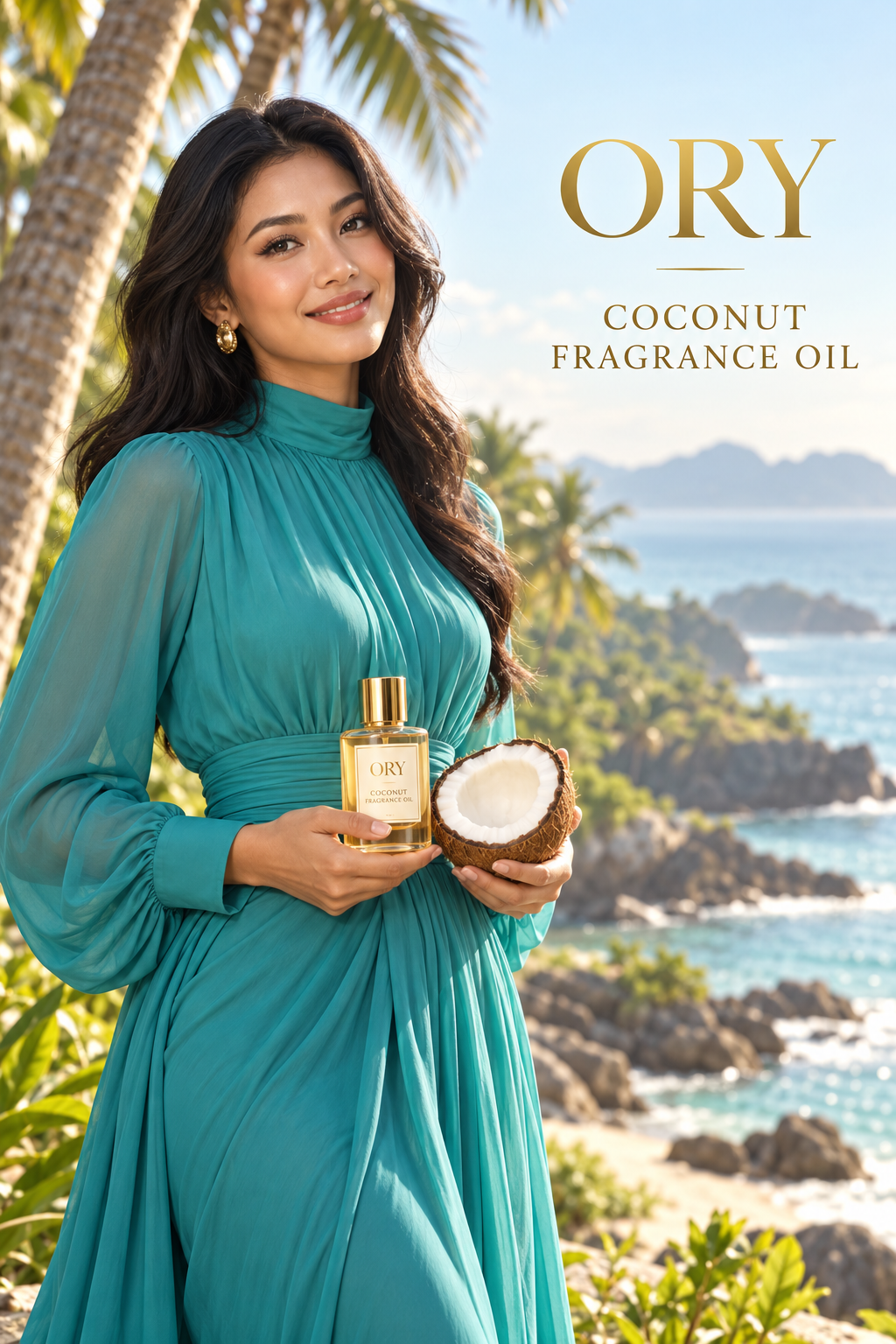
Coconut Fragrance Oil

ORY® product lines:
☑ Skincare (per IFRA category limits)
☑ Haircare
☑ Handmade Soap (excellent stability; may discolor if vanillin-rich)
☑ Cosmetics (per IFRA lip/face limits) — full dual-use ingredient (fragrance, not an active)
Coconut fragrance oil is a professionally composed aroma blend that recreates the creamy, sweet scent of coconut — a scent that cannot be obtained by distillation, since coconut produces no essential oil. It is built from nature-identical and synthetic lactones (the “creamy coconut” molecules), vanillin, and supporting notes, dissolved in a cosmetic-grade carrier. Fragrance oils are governed not by pharmacological studies but by the safety system of the fragrance industry: the Research Institute for Fragrance Materials (RIFM) evaluates each ingredient [1], and the International Fragrance Association (IFRA) sets maximum use levels by product category [2], which every reputable supplier documents on an IFRA certificate. Fragrance blends can contain labeled allergens and are a recognized cause of contact allergy in a minority of people [3, 4], so ORY® selects skin-safe, phthalate-free, IFRA-compliant coconut fragrance and labels allergens. Its value is sensory and emotional — a beloved tropical scent — and it is exceptionally stable in cold-process soap.
What is Coconut Fragrance Oil made of?
Coconut fragrance oil is compounded by a fragrance house from aroma chemicals and, sometimes, natural isolates. Typical components [1, 2]:
- Lactones (γ-nonalactone, δ-decalactone, γ-octalactone “coconut aldehyde”): The creamy coconut heart of the accord; low allergen concern.
- Vanillin and ethyl vanillin: Sweet warmth; can discolor soap and cosmetics brown (vanilla stabilizers mitigate).
- Ethyl maltol, benzyl benzoate, coumarin, linalool (blend-dependent): Sweet/fixative notes; benzyl benzoate, coumarin, and linalool are labeled allergens.
- Carrier (dipropylene glycol, isopropyl myristate, or triglyceride): Dilutes and stabilizes the blend.
- Phthalate-free, skin-safe, IFRA-certified grade: Required by ORY®; each blend carries its own category limits.
What skin type is best suited for Coconut Fragrance Oil?
Coconut fragrance oil is a sensory addition suitable for most ORY® skin types within IFRA limits:
- Normal: Tropical-scented body products.
- Dry: Body butters and oils where a creamy scent fits.
- Oily: Body washes and mists (rinse-off or low leave-on).
- Combination: Body products; fragrance-free facial products preferred.
- Mature: Body care; keep facial products fragrance-light.
- Acne-prone: Body care only; avoid fragrance in facial acne products.
- Sensitive: Prefer fragrance-free; if used, ≤0.5% and patch test [3].
What hair type is best suited for Coconut Fragrance Oil?
Coconut fragrance scents haircare without functional claims:
- Dry or damaged: Coconut-scented masks, oils, and leave-ins.
- Curly and coily: Popular scent for curl creams and conditioners.
- Straight and wavy: Shampoos, conditioners, shine sprays.
- Color-treated: Neutral; fragrance only.
- Oily scalp, dandruff-prone, mature or thinning: Fragrance only; no scalp benefit.
- Sensitive scalp: Fragrance-free preferred; low level if used.
What are the benefits of Coconut Fragrance Oil?
Coconut fragrance oil’s benefits are sensory and formulation-related [1, 2]:
- Signature scent: Creamy tropical aroma unavailable from natural essential oils.
- Emotional and sensory appeal: Fragrance drives product enjoyment and repeat use.
- Soap stability: Lactone-based accords hold scent through cold process far better than most essential oils.
- Consistency: Batch-to-batch uniformity, unlike variable naturals.
- Cost-effective: Affordable strong scent.
- Versatility: Blends with vanilla, lime, pineapple, and floral notes.
- Regulated safety: RIFM-evaluated ingredients and IFRA category limits [1, 2].
Dual use across ORY® product lines
Coconut fragrance oil is usable in all four ORY® lines, each governed by its IFRA category limit on the supplier certificate.
Pros and cons of Coconut Fragrance Oil
Pros
Cons
- Beloved, consistent scent: High customer demand.
- Excellent in soap: Stable and strong.
- IFRA-regulated: Documented category limits [2].
- Affordable: Economical fragrance.
- Four-line utility: Every ORY® product.
- No active benefit: Purely aromatic; no botanical or clinical claims.
- Contact allergy: Fragrance is a leading cosmetic allergen [3, 4]; label allergens.
- Synthetic: Not suited to natural/essential-oil-only positioning; disclose as “fragrance.”
- Discoloration: Vanillin-rich blends brown soap and cosmetics.
- Supplier-dependent safety: Requires IFRA certificate and SDS for each blend.
What is the best application of Coconut Fragrance Oil?
Coconut fragrance oil is added at cool-down within category limits:
- Body butter or lotion: 1–2%.
- Body wash or scrub: 1–2%.
- Body mist: Solubilized 1–2%.
- Shampoo/conditioner: 0.5–1.5%.
- Soap: 3–6% of oils; use vanilla stabilizer if vanillin-rich.
- Lip balm: ≤0.5% (verify Category 1 limit).
- Solid perfume: 3–5%.
Peer-reviewed references
- Api AM, Belsito D, Bruze M, et al. Criteria for the Research Institute for Fragrance Materials, Inc. (RIFM) safety evaluation process for fragrance ingredients. Food and Chemical Toxicology. 2015;82(Suppl):S1–S19.
- International Fragrance Association. IFRA Standards, 51st Amendment. IFRA; 2023. (Regulatory fragrance-safety limits by product category.)
- de Groot AC, Frosch PJ. Adverse reactions to fragrances: a clinical review. Contact Dermatitis. 1997;36(2):57–86.
- Uter W, Geier J, Frosch P, Schnuch A. Contact allergy to fragrances: current patch test results (2005–2008) from the Information Network of Departments of Dermatology. Contact Dermatitis. 2010;63(5):254–261.
Disclaimer:
The information on this page is provided by ORY International, LC for educational purposes only. It summarizes published research about coconut fragrance oil (listed as Fragrance/Parfum) as an ingredient, including laboratory and animal studies and clinical studies of formulas that may differ from ORY® products. Results from these studies may not apply to every person or to ORY® products. This page is not medical advice and does not replace advice from a dermatologist, physician, or other qualified healthcare provider.
ORY® Skincare, Haircare, Handmade Soap, and Cosmetics products are cosmetics. They are not intended to diagnose, treat, cure, mitigate, or prevent any disease or condition, including eczema, dermatitis, acne, dandruff, or any other condition. References to FDA or Cosmetic Ingredient Review (CIR) findings describe the ingredient, not ORY® products, and do not mean FDA has reviewed or approved any ORY® product.
Results vary by skin and scalp type, formulation, and use. Fragrance is one of the most common causes of cosmetic contact allergy. Any cosmetic can cause irritation, sometimes from other ingredients. Always patch test, follow label directions, and stop use if irritation occurs. If you are pregnant, nursing, have a medical condition, or are buying for a child, consult a healthcare provider before use.
ORY International, LC works to keep this page accurate and current but makes no warranty as to its completeness. To the fullest extent permitted by law, ORY International, LC is not liable for any loss or injury arising from reliance on this information or from use of any product contrary to its label directions. To report a reaction, contact us at [insert contact email / phone].