No products in the cart.: $0.00

Cocamidopropyl Betaine (CAPB)
ORY® product lines:
☑ Skincare
☑ Haircare
◐ Handmade Soap (limited: liquid soap, syndet and shampoo bars; not cold-process)
☑ Cosmetics (cleansers, makeup removers) — three-line functional ingredient
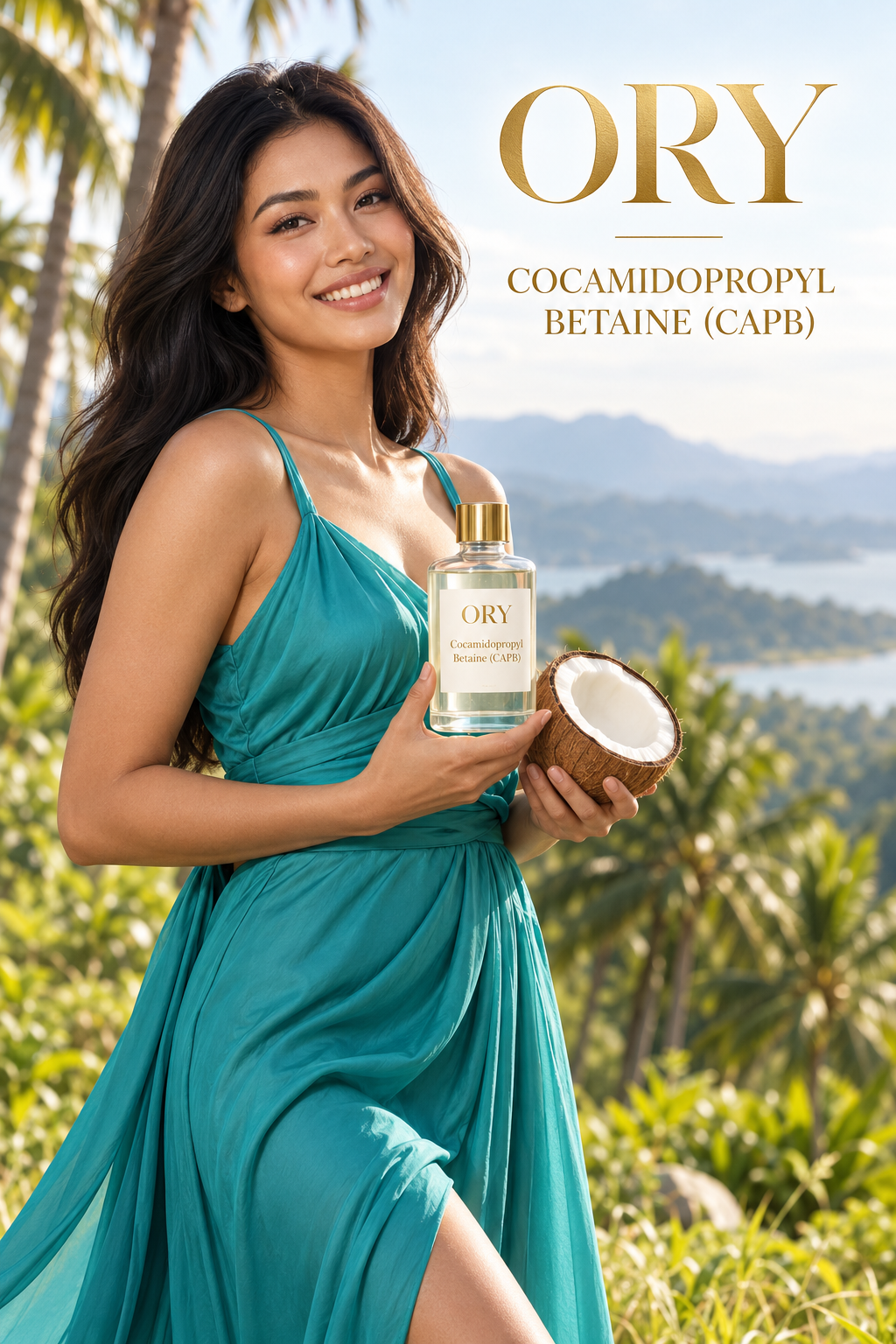
Cocamidopropyl betaine (CAPB) is a coconut-derived amphoteric (zwitterionic) surfactant that carries both a positive and a negative charge, which makes it mild on skin and eyes and an ideal partner for other cleansing agents: it boosts foam, thickens, and — most importantly — reduces the irritation of anionic surfactants when blended with them [1]. It is a mainstay of “tear-free” baby washes, sulfate-free shampoos, and gentle facial cleansers. The Cosmetic Ingredient Review Panel has concluded CAPB is safe in rinse-off and leave-on cosmetics, provided manufacturing impurities (amidoamine and dimethylaminopropylamine) are minimized [2]. Those impurities — not CAPB itself — are the cause of the contact allergy that led to its “Allergen of the Year” designation in 2004 [3], so ORY® sources low-impurity grades.
What is Cocamidopropyl Betaine (CAPB) made of?
CAPB is produced by reacting coconut fatty acids with dimethylaminopropylamine (DMAPA) to form cocamidopropyl dimethylamine, then with sodium chloroacetate to add the betaine group. Points to know [2]:
- Amphoteric/zwitterionic: Carries positive and negative charges; mild, compatible with anionic, cationic, and non-ionic surfactants.
- Coconut fatty-acid chain (C12 dominant): Provides cleansing and foaming.
- Supplied as ~30% active aqueous solution: Clear to pale yellow liquid.
- Impurities to control: Amidoamine (<0.5%) and DMAPA (<15 ppm) — the actual sensitizers [3].
- Biodegradable; palm-free coconut grades available.
What skin type is best suited for Cocamidopropyl Betaine (CAPB)?
CAPB is a gentle cleansing surfactant for all seven ORY® skin types:
- Sensitive: CAPB is among the mildest cleansing surfactants; suitable for reactive and eczema-prone skin (patch test).
- Dry: Low-stripping cleansing preserves barrier lipids; pair with glycerin and oils.
- Normal: Everyday gentle cleansing.
- Combination: Balanced foaming cleansers.
- Oily: Effective cleansing without over-drying; combine with a foam booster for richer lather.
- Acne-prone: Gentle base for salicylic-acid or tea-tree cleansers.
- Mature: Non-stripping cleansing for thinning, drier skin.
What hair type is best suited for Cocamidopropyl Betaine (CAPB)?
CAPB is the standard secondary surfactant in gentle and sulfate-free shampoos:
- Sensitive scalp: CAPB-based shampoos reduce scalp irritation compared with sulfates.
- Dry or damaged: Low-stripping cleansing preserves natural oils.
- Curly and coily: Sulfate-free co-wash and low-poo formulas.
- Color-treated or chemically processed: Gentle cleansing prolongs color and reduces fading.
- Dandruff-prone scalp: Mild base for antifungal or salicylic-acid shampoos.
- Oily scalp: Adequate cleansing; combine with a stronger co-surfactant for heavy oil.
- Straight, wavy, mature or thinning: Gentle daily-use shampoos.
What are the benefits of Cocamidopropyl Betaine (CAPB)?
CAPB’s benefits are well documented in surfactant science [1, 2]:
- Mild cleansing: Low irritation to skin and eyes; basis of tear-free formulas.
- Irritation reduction: Reduces the harshness of anionic surfactants (e.g., SLES, SLGC) when blended [1].
- Foam boosting and stabilizing: Creamy, stable lather.
- Thickening: Builds viscosity with salt in surfactant systems.
- Conditioning feel: Amphoteric charge leaves skin and hair soft.
- Broad compatibility: Works with all surfactant classes.
- Biodegradable: Coconut-derived.
Dual use across ORY® product lines
CAPB serves cleansers, shampoos, liquid soaps, syndet bars, and makeup removers; it has no role in cold-process bar soap.
Pros and cons of Cocamidopropyl Betaine (CAPB)
Pros
Cons
- Mild and eye-safe: Tear-free heritage.
- Reduces irritation of co-surfactants: [1].
- Foam and viscosity builder: Formulation workhorse.
- CIR-reviewed safe with impurity limits: [2].
- Affordable, biodegradable: Coconut-derived.
- Contact allergy from impurities: Amidoamine/DMAPA; require low-impurity grade [3].
- Not a stand-alone cleanser: Weak primary foaming alone; pair with a primary surfactant.
- Synthetic processing: Not COSMOS-approved in all standards (some allow it).
- Perception: Sometimes confused with harsh surfactants.
What is the best application of Cocamidopropyl Betaine (CAPB)?
CAPB is built into cleansing bases:
- Facial cleanser: 5–8% CAPB with 5–10% decyl glucoside or SLGC.
- Body wash: 8–12% with a primary surfactant.
- Baby wash: 10% CAPB with glucosides.
- Sulfate-free shampoo: 10–15% with SLGC or lauryl glucoside.
- Liquid soap: Foam and mildness booster.
- Syndet or shampoo bar: 10–20% with solid surfactants.
- Micellar water: 1–2%.
Peer-reviewed references
- Ananthapadmanabhan KP, Moore DJ, Subramanyan K, Misra M, Meyer F. Cleansing without compromise: the impact of cleansers on the skin barrier and the technology of mild cleansing. Dermatologic Therapy. 2004;17(Suppl 1):16–25.
- Burnett CL, Bergfeld WF, Belsito DV, et al. Final report of the Cosmetic Ingredient Review Expert Panel on the safety assessment of cocamidopropyl betaine (CAPB). International Journal of Toxicology. 2012;31(4 Suppl):77S–111S.
- Jacob SE, Amini S. Cocamidopropyl betaine. Dermatitis. 2008;19(3):157–160.
Disclaimer:
The information on this page is provided by ORY International, LC for educational purposes only. It summarizes published research about cocamidopropyl betaine (CAPB) as an ingredient, including laboratory and animal studies and clinical studies of formulas that may differ from ORY® products. Results from these studies may not apply to every person or to ORY® products. This page is not medical advice and does not replace advice from a dermatologist, physician, or other qualified healthcare provider.
ORY® Skincare, Haircare, Handmade Soap, and Cosmetics products are cosmetics. They are not intended to diagnose, treat, cure, mitigate, or prevent any disease or condition, including eczema, dermatitis, acne, dandruff, or any other condition. References to FDA or Cosmetic Ingredient Review (CIR) findings describe the ingredient, not ORY® products, and do not mean FDA has reviewed or approved any ORY® product.
Results vary by skin and scalp type, formulation, and use. Cocamidopropyl betaine can cause allergic contact dermatitis in some people, mostly because of manufacturing impurities, and any cleanser can cause irritation, sometimes from other ingredients. Always patch test, follow label directions, and stop use if irritation occurs. If you are pregnant, nursing, have a medical condition, or are buying for a child, consult a healthcare provider before use.
ORY International, LC works to keep this page accurate and current but makes no warranty as to its completeness. To the fullest extent permitted by law, ORY International, LC is not liable for any loss or injury arising from reliance on this information or from use of any product contrary to its label directions. To report a reaction, contact us at [insert contact email / phone].