No products in the cart.: $0.00

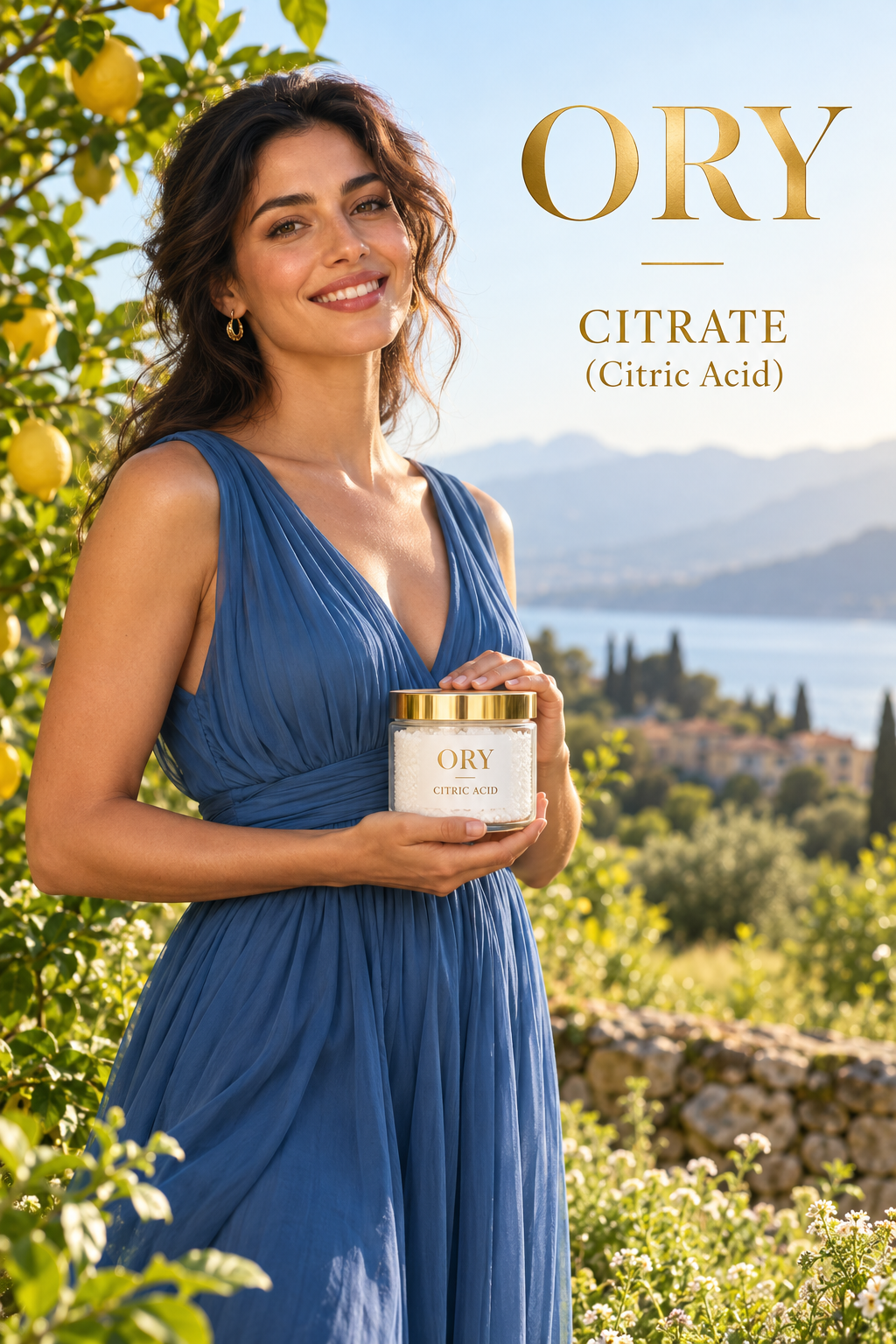
Citrate (Citric Acid)
ORY® product lines:
☑ Skincare
☑ Haircare
☑ Handmade Soap (as sodium citrate chelator — prevents soap scum)
☑ Cosmetics — full dual-use ingredient
Citric acid is the alpha-hydroxy acid of citrus fruit, produced today by fermentation, and its salts (citrates) are among the most widely used functional ingredients in cosmetics. It works on three levels. As a pH adjuster and buffer it sets the acidity of nearly every ORY® shampoo, toner, and cream. As a chelator it binds calcium, magnesium, and iron, protecting formulas from oxidation and — in soap — preventing the scum that hard water leaves on skin. And as an AHA active at higher concentrations it exfoliates: a clinical study found that 20% citric acid increased viable epidermal thickness and glycosaminoglycan content in sun-damaged skin [1]. The Cosmetic Ingredient Review Panel has concluded citric acid and its salts are safe in cosmetics [3].
What is Citrate (Citric Acid) made of?
Citric acid (C₆H₈O₇) is a tricarboxylic acid. Sources and forms:
- Fermentation (primary source): Produced by Aspergillus niger fermentation of sugars; vegan, high purity, identical to citrus-derived acid.
- Citrus fruit: Lemons and limes contain 5–8% citric acid; the natural origin story, though not the commercial source.
- Sodium/potassium citrate: Neutralized salts used as buffers and chelators; no exfoliating action.
- Chelating action: The three carboxyl groups grip metal ions — the basis of its anti-scum, antioxidant-support, and preservative-boosting effects.
- Larger AHA molecule: Penetrates more slowly than glycolic or lactic acid, so it is gentler but less potent as an exfoliant [2].
What skin type is best suited for Citrate (Citric Acid)?
Citric acid at functional levels is invisible to the customer; as an exfoliant it suits resilient skin:
- Oily: Mild exfoliation and mild astringency in toners.
- Combination: pH-balancing toners; low-level AHA brightening.
- Normal: Antioxidant support and gentle weekly exfoliation.
- Mature: At 10–20% (professional), increases epidermal thickness and GAGs [1]; home use 2–5%.
- Acne-prone: pH adjustment keeps salicylic acid formulas active; mild keratolytic.
- Dry: Functional levels only; choose lactic acid for exfoliation.
- Sensitive: Functional (buffer) levels only; AHA use can sting.
What hair type is best suited for Citrate (Citric Acid)?
Citric acid is a cornerstone of haircare chemistry — pH adjustment, cuticle sealing, and hard-water chelation:
- Dry or damaged: Acidic rinses close the cuticle and improve smoothness and shine.
- Color-treated or chemically processed: Low-pH rinses re-seal the cuticle after alkaline services and prolong color.
- Straight and wavy: Clarifying and shine rinses.
- Curly and coily: pH-balanced formulas and chelating rinses remove mineral buildup that dulls curls.
- Oily scalp: Clarifying, mineral-removing rinses.
- Dandruff-prone, sensitive, mature or thinning: Functional pH balancing in all formulas.
What are the benefits of Citrate (Citric Acid)?
Citric acid’s value is largely functional, with genuine exfoliating benefit at higher levels [1–3]:
- pH adjustment: Sets and buffers the pH of shampoos, toners, and emulsions for skin compatibility and active performance.
- Chelation: Binds metal ions, reducing oxidation, boosting preservative efficacy, and preventing hard-water scum on skin and hair.
- Exfoliation (AHA): Loosens dead cells; 20% increased epidermal thickness and GAGs in photoaged skin [1].
- Antioxidant support: Metal chelation slows rancidity of oils and color change.
- Brightening: Mild turnover-driven tone evening.
- Cuticle sealing: Low-pH rinses flatten the cuticle for shine and reduced frizz.
- Soap performance: As sodium citrate, prevents soap scum, softens lather, and reduces rancidity (“dreaded orange spots”).
Dual use across ORY® product lines
Citric acid is present in some form in nearly every ORY® product; in soap it is deliberately converted to sodium citrate, one of the most useful cold-process additives.
Pros and cons of Citrate (Citric Acid)
Pros
Cons
- Essential formulation tool: pH control, buffering, and chelation in one inexpensive ingredient.
- Improves preservation and stability: Chelation boosts preservatives and slows oxidation.
- Soap upgrade: Sodium citrate is a proven anti-scum, anti-rancidity additive.
- Natural, vegan, affordable: Fermentation-derived.
- Four-line utility: Every ORY® product.
- Weak exfoliant: Less effective than glycolic or lactic acid at cosmetic levels.
- Stinging at AHA levels: Can irritate sensitive or compromised skin.
- Photosensitivity at AHA levels: SPF advisory applies for exfoliating products.
- Lye math in soap: Requires precise extra lye calculation.
- Not a “hero” ingredient: Customers may undervalue a functional additive.
What is the best application of Citrate (Citric Acid)?
Citric acid is built into formulas rather than applied as a stand-alone step, with two customer-facing exceptions:
- Acid hair rinse: 1–2% citric acid in water (pH ~3.5) after conditioning; leave 1 minute, rinse; weekly for shine and clarification.
- Chelating “hard-water” rinse: Removes mineral buildup that dulls hair and irritates scalps.
- Exfoliating toner: 2–5% citric acid (pH 3.5–4) 2–3 nights weekly; follow with moisturizer and daily SPF.
- Peel: Professional 10–20% for photoaging [1].
- Formulation: pH adjustment to 4.5–5.5 for skincare, 4.5–6 for haircare.
- Soap: Sodium citrate in every ORY® bar for hard-water performance.
- Cosmetics: Buffer and chelator to stabilize pigments and preservatives.
Peer-reviewed references
- Bernstein EF, Underhill CB, Lakkakorpi J, et al. Citric acid increases viable epidermal thickness and glycosaminoglycan content of sun-damaged skin. Dermatologic Surgery. 1997;23(8):689–694.
- Tang SC, Yang JH. Dual effects of alpha-hydroxy acids on the skin. Molecules. 2018;23(4):863.
- Fiume MM, Heldreth BA, Bergfeld WF, et al. Safety assessment of citric acid, inorganic citrate salts, and alkyl citrate esters as used in cosmetics. International Journal of Toxicology. 2014;33(2 Suppl):16S–46S.
Disclaimer:
The information on this page is provided by ORY International, LC for educational purposes only. It summarizes published research about citric acid and citrates as an ingredient, including laboratory and animal studies and clinical studies of formulas that may differ from ORY® products. Results from these studies may not apply to every person or to ORY® products. This page is not medical advice and does not replace advice from a dermatologist, physician, or other qualified healthcare provider.
ORY® Skincare, Haircare, Handmade Soap, and Cosmetics products are cosmetics. They are not intended to diagnose, treat, cure, mitigate, or prevent any disease or condition, including sun damage, hyperpigmentation disorders, acne, dandruff, or any skin condition. References to FDA or Cosmetic Ingredient Review (CIR) findings describe the ingredient, not ORY® products, and do not mean FDA has reviewed or approved any ORY® product.
Sunburn Alert (exfoliating products only): This product contains an alpha hydroxy acid (AHA) that may increase your skin’s sensitivity to the sun and particularly the possibility of sunburn. Use a sunscreen, wear protective clothing, and limit sun exposure while using this product and for a week afterwards.
Results vary by skin and scalp type, formulation, and use. At exfoliating strengths, citric acid can sting, especially on sensitive or compromised skin, and any cosmetic can cause irritation, sometimes from other ingredients. Always patch test, follow label directions, and stop use if irritation occurs. If you are pregnant, nursing, have a medical condition, or are buying for a child, consult a healthcare provider before use.
ORY International, LC works to keep this page accurate and current but makes no warranty as to its completeness. To the fullest extent permitted by law, ORY International, LC is not liable for any loss or injury arising from reliance on this information or from use of any product contrary to its label directions. To report a reaction, contact us at [insert contact email / phone].