No products in the cart.: $0.00

Behenyl Alcohol
ORY® product lines:
☑ Skincare
☑ Haircare
◐ Handmade Soap (limited: solid bars)
☑ Cosmetics — three-line functional ingredient
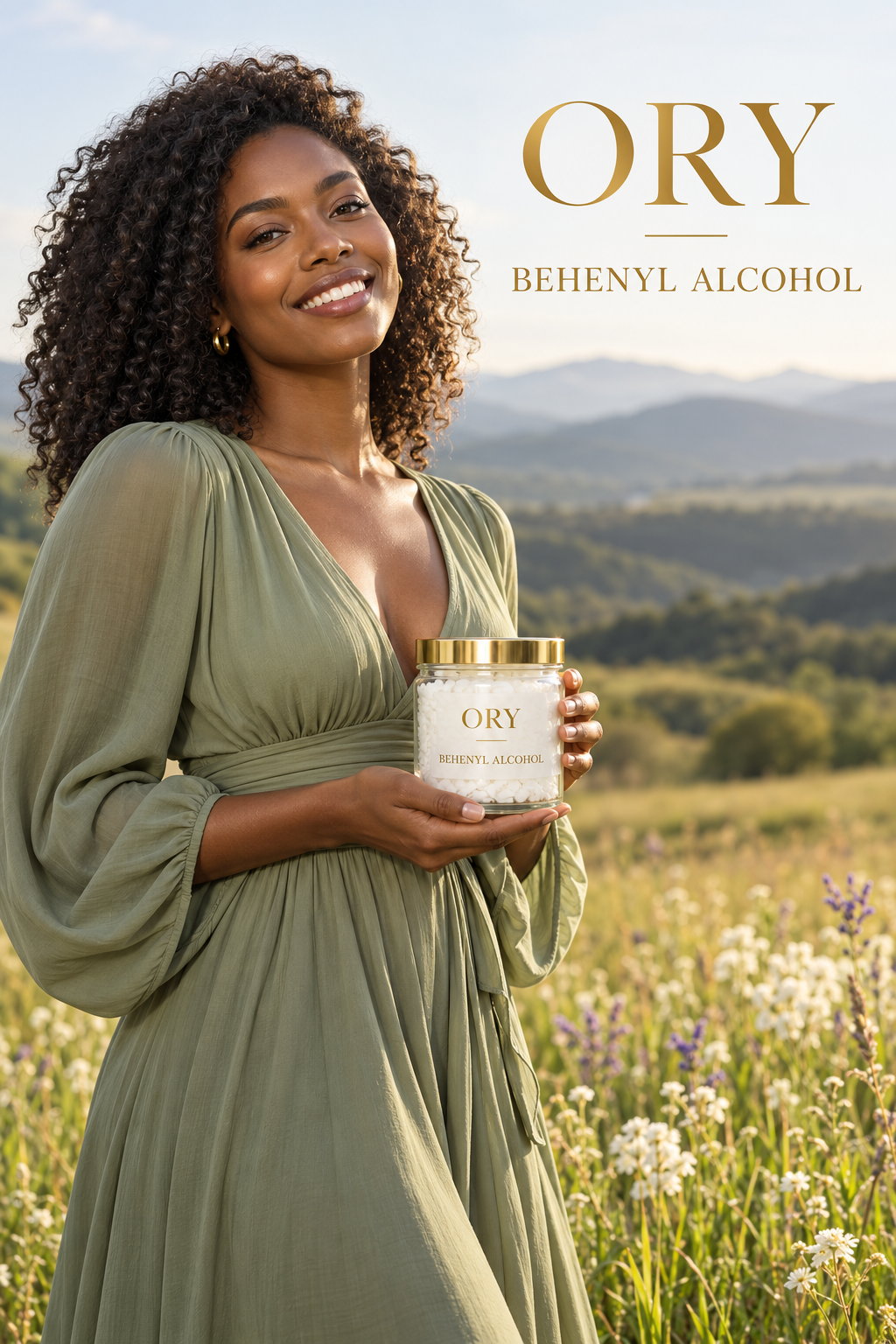
Behenyl alcohol is the longest-chain fatty alcohol in common cosmetic use (22 carbons), derived from rapeseed or palm oil. It shares the emollient, thickening, and emulsion-stabilizing roles of cetyl and stearyl alcohol but with a higher melting point (~70 °C), a drier, less waxy skin feel, and superior heat stability — qualities that make it valuable in premium creams, lightweight-yet-firm sticks, and warm-climate products. The Cosmetic Ingredient Review Panel has concluded behenyl alcohol is safe in cosmetics [1]. Uniquely among fatty alcohols, behenyl alcohol (docosanol) is also an FDA-approved over-the-counter antiviral for cold sores at 10%, where it inhibits viral fusion with cell membranes [2] — a pharmaceutical pedigree that underscores its safety, though ORY® uses it only for its cosmetic functions.
What is Behenyl Alcohol made of?
Behenyl alcohol is produced by hydrogenating behenic acid from high-erucic rapeseed or palm oil. Points to know [1]:
- C22 saturated fatty alcohol: White waxy pellets; melts at ~70 °C — the highest of the common fatty alcohols.
- Dry, powdery after-feel: Less waxy than stearyl alcohol at equal levels.
- Co-emulsifier and structurant: Builds firm, stable emulsions and sticks.
- Also known as docosanol: FDA OTC cold-sore antiviral at 10% (drug use — not claimed by ORY®).
- Vegan; rapeseed-derived grades are palm-free.
What skin type is best suited for Behenyl Alcohol?
Behenyl alcohol suits all seven ORY® skin types, with a drier feel that oily and combination skin appreciate:
- Dry: Fatty-alcohol emollience softens and reduces water loss; behenyl alcohol lets ORY® build richer creams.
- Sensitive: Non-irritating, fragrance-free structural ingredient; suitable for reactive and eczema-prone skin (rare fatty-alcohol allergy — patch test).
- Mature: Supports rich, cushioning creams and barrier balms.
- Normal: Everyday lotion and cream structure.
- Combination: Adjust level for lighter lotions.
- Oily: Drier, less waxy feel than other fatty alcohols; good for oil-free-feel creams.
- Acne-prone: Low comedogenicity at typical levels; keep formulas light.
What hair type is best suited for Behenyl Alcohol?
Behenyl alcohol pairs naturally with behentrimonium methosulfate (BTMS) in conditioners:
- Dry or damaged: Behenyl alcohol adds slip, softness, and body to conditioners and masks.
- Curly and coily: Thickens rich conditioners and leave-ins for detangling.
- Color-treated or chemically processed: Cushioning conditioner base for fragile hair.
- Straight and wavy: Light conditioners at low levels.
- Oily scalp: Rinse-off use; keep leave-in levels low.
- Sensitive scalp, dandruff-prone, mature or thinning: Inert structural ingredient; neutral for scalp conditions.
What are the benefits of Behenyl Alcohol?
Behenyl alcohol’s benefits are functional [1, 3]:
- Emollient with dry after-feel: Softens without waxiness.
- Thickener and structurant: Firm creams and sticks with heat stability.
- Emulsion stabilizer: Robust emulsions for warm climates and shipping.
- Barrier support: Substantive lipid film reduces water loss.
- Hair conditioning: Slip and body; synergistic with BTMS [3].
- Heat stability: Products hold shape above 60 °C.
- Pharmaceutical safety record: Approved OTC active (docosanol) [2].
Dual use across ORY® product lines
Behenyl alcohol serves emulsions, conditioners, sticks, and cosmetics; not used in cold-process soap.
Pros and cons of Behenyl Alcohol
Pros
Cons
- Dry, elegant feel: Premium sensory.
- Heat-stable: Warm-climate and shipping robustness.
- Gentle, CIR-reviewed; OTC drug pedigree: [1, 2].
- Vegan, palm-free options: Rapeseed-derived.
- Synergy with BTMS: Conditioner performance.
- Cost: Higher than cetyl/stearyl alcohol.
- High melting point: Requires hotter processing (75–80 °C).
- Not an emulsifier alone: Pair with a primary emulsifier.
- Rare contact allergy: Patch test.
- No cosmetic antiviral claims: Docosanol drug use is outside cosmetic labeling.
What is the best application of Behenyl Alcohol?
Behenyl alcohol is built into premium bases:
- Premium cream: 2–4% for firm, dry-touch richness.
- Sunscreen: 1–3% for stability and dry feel.
- Lip or balm stick: 3–10% for heat-stable structure.
- Conditioner: 2–4% with BTMS.
- Conditioner bar: 10–20%.
- Cosmetics: Lipstick and foundation structure.
Peer-reviewed references
- Elder RL (ed). Final report on the safety assessment of cetearyl alcohol, cetyl alcohol, isostearyl alcohol, myristyl alcohol, and behenyl alcohol. Journal of the American College of Toxicology. 1988;7(3):359–413.
- Katz DH, Marcelletti JF, Khalil MH, Pope LE, Katz LR. Antiviral activity of 1-docosanol, an inhibitor of lipid-enveloped viruses including herpes simplex. Proceedings of the National Academy of Sciences USA. 1991;88(23):10825–10829.
- Gavazzoni Dias MFR. Hair cosmetics: an overview. International Journal of Trichology. 2015;7(1):2–15.
Disclaimer:
The information on this page is provided by ORY International, LC for educational purposes only. It summarizes published research about behenyl alcohol as an ingredient, including laboratory and animal studies and clinical studies of formulas that may differ from ORY® products. Results from these studies may not apply to every person or to ORY® products. This page is not medical advice and does not replace advice from a dermatologist, physician, or other qualified healthcare provider.
ORY® Skincare, Haircare, Handmade Soap, and Cosmetics products are cosmetics. They are not intended to diagnose, treat, cure, mitigate, or prevent any disease or condition, including eczema, dermatitis, acne, dandruff, or any other condition. References to FDA or Cosmetic Ingredient Review (CIR) findings describe the ingredient, not ORY® products, and do not mean FDA has reviewed or approved any ORY® product.
Behenyl alcohol (docosanol) at 10% is also the active ingredient in an FDA-approved over-the-counter cold-sore medicine. ORY® uses behenyl alcohol only for its cosmetic functions and makes no antiviral or cold-sore claims.
Results vary by skin and scalp type, formulation, and use. Fatty alcohols rarely cause allergy, but cases have been reported, mostly in people with existing dermatitis, and any cosmetic can cause irritation, sometimes from other ingredients. Always patch test, follow label directions, and stop use if irritation occurs. If you are pregnant, nursing, have a medical condition, or are buying for a child, consult a healthcare provider before use.
ORY International, LC works to keep this page accurate and current but makes no warranty as to its completeness. To the fullest extent permitted by law, ORY International, LC is not liable for any loss or injury arising from reliance on this information or from use of any product contrary to its label directions. To report a reaction, contact us at [insert contact email / phone].