No products in the cart.: $0.00

Glycerin
ORY® product lines:
☑ Skincare
☑ Haircare
☑ Handmade Soap (naturally produced by saponification; can be added)
☑ Cosmetics — full dual-use ingredient
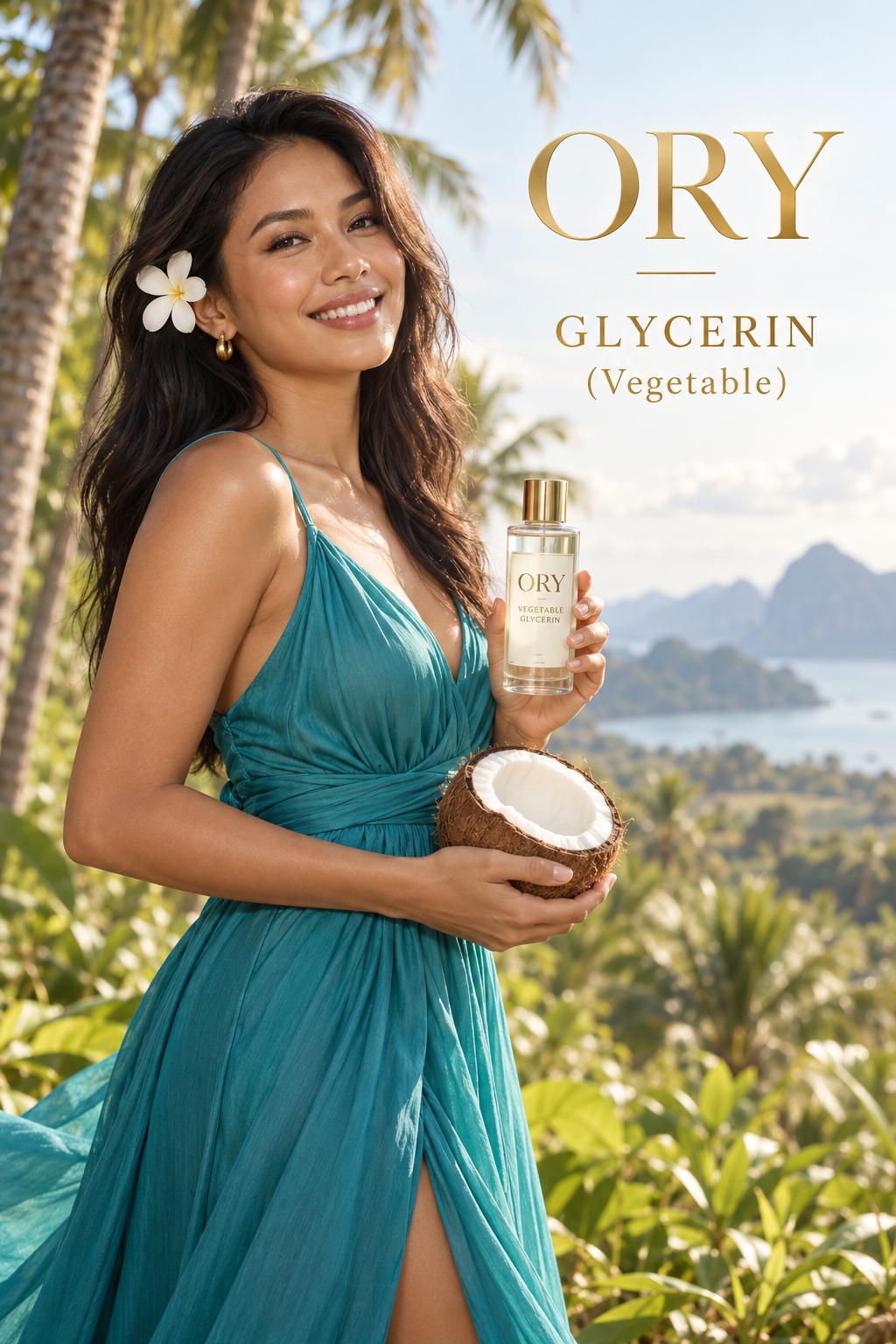
Glycerin (glycerol) is the most widely used humectant in the world and, by the evidence, one of the most effective. It is a small sugar-alcohol produced when fats are split into fatty acids — which is exactly what happens in soap making, so every ORY® cold-process bar naturally contains its own glycerin. In the skin, glycerin is not merely a water magnet: it is transported into the stratum corneum by the skin’s own aquaporin-3 channels, keeps lipids in a fluid, healthy state, supports desquamation, and accelerates barrier recovery [1]. A cream containing 20% glycerin improved barrier function and hydration measurably against its vehicle [2], and the Cosmetic Ingredient Review Panel has concluded glycerin is safe in cosmetics [3]. Vegetable-derived, vegan, inexpensive, and compatible with every active, glycerin is the foundation humectant of every ORY® line.
What is Glycerin made of?
Cosmetic glycerin is produced by hydrolysis or saponification of vegetable oils (a by-product of biodiesel and soap manufacture), then distilled to USP purity. Points to know [1, 3]:
- Trihydroxy sugar alcohol (C₃H₈O₃): Three hydroxyl groups bind water strongly; clear, viscous, odorless, sweet-tasting liquid.
- Skin-identical: Glycerol is a natural component of the skin’s NMF and sebaceous lipids; transported by aquaporin-3 [1].
- Hygroscopic: Attracts water from the atmosphere (above ~65% humidity) and from deeper skin layers.
- Vegetable, vegan, palm-free options; kosher/halal grades available.
- Also a solvent and extract carrier: Glycerin extracts (glycerites) of botanicals; antimicrobial above ~50%.
What skin type is best suited for Glycerin?
Glycerin is the universal humectant for all seven ORY® skin types:
- Dry: Glycerin draws and holds water in the stratum corneum — the primary beneficiary.
- Dehydrated / Sensitive: Non-irritating hydration that supports barrier recovery; suitable for reactive skin.
- Mature: Restores water content lost with age; plumps fine dehydration lines.
- Normal: Daily hydration maintenance.
- Combination: Oil-free hydration for all zones.
- Oily: Water-based, weightless hydration; well-hydrated skin often produces less compensatory sebum.
- Acne-prone: Non-comedogenic; offsets the dryness of acne actives.
What hair type is best suited for Glycerin?
Glycerin hydrates hair and scalp and is a staple of curl care:
- Dry or damaged: Glycerin binds water to the fiber and scalp, improving softness and pliability.
- Curly and coily: Humectant moisture supports curl definition; seal with oil or butter.
- Color-treated or chemically processed: Replenishes water lost in chemical services; reduces brittleness.
- Sensitive scalp: Hydrates a tight, flaky scalp without irritation.
- Straight and wavy: Light hydration and shine at low levels (high levels can feel sticky or attract humidity frizz).
- Oily scalp, dandruff-prone, mature or thinning: Water-based hydration that does not add oil; supports scalp comfort.
What are the benefits of Glycerin?
Glycerin’s benefits are among the best documented of any moisturizer ingredient [1, 2, 3]:
- Deep hydration: Binds water in the stratum corneum; aquaporin-3 transports it into living skin [1].
- Barrier repair: Improved barrier function and reduced water loss at 20% [2]; accelerates recovery after damage.
- Lipid fluidity: Keeps stratum-corneum lipids in a healthy liquid-crystal state [1].
- Desquamation support: Helps shed dead cells normally, reducing flakiness.
- Skin protection: Reduces irritation from surfactants; anti-irritant in cleansers.
- Wound-healing and antimicrobial (high %): Concentrated glycerin is bacteriostatic and used in wound care.
- Hair moisture and elasticity: Reduces breakage in dry and curly hair.
- Soap: Naturally present in handmade soap; extra glycerin adds humectancy and softer lather.
Dual use across ORY® product lines
Glycerin is a true four-line ingredient — and the reason handmade soap is gentler than commercial bars, which have their glycerin removed.
Pros and cons of Glycerin
Pros
Cons
- Gold-standard humectant: Strong clinical evidence [1, 2].
- Skin-identical and gentle: Safe for infants, eczema, and reactive skin [3].
- Inexpensive and universal: Compatible with every active.
- Natural in soap: Built-in benefit of ORY® bars.
- Vegan, sustainable: Vegetable-derived.
- Tacky feel at high levels: Above ~10% can feel sticky; balance with esters or silicone alternatives.
- Humidity dependence: In very dry air, uncovered humectants can pull water from skin — pair with an occlusive.
- Humidity frizz in hair: High glycerin in humid climates can swell the cuticle; lower levels for straight hair.
- Perceived as “basic”: Customers may undervalue it despite its evidence.
- Sourcing: Specify vegetable and palm-free/RSPO.
What is the best application of Glycerin?
Glycerin is built into nearly every hydrating product:
- Hydrating serum or toner: 3–5% with hyaluronic acid and sodium PCA.
- Barrier cream: 10–20% with ceramides for very dry or eczema-prone skin [2].
- Cleanser: 3–5% to reduce surfactant dryness.
- Mist: 2–3%.
- Curl cream or gel: 3–8%.
- Conditioner: 2–3%.
- Soap: Naturally present; add 1–3% at trace for humectancy.
- Cosmetics: 3–5% in hydrating foundations and primers.
Peer-reviewed references
- Fluhr JW, Darlenski R, Surber C. Glycerol and the skin: holistic approach to its origin and functions. British Journal of Dermatology. 2008;159(1):23–34.
- Lodén M, Wessman W. The influence of a cream containing 20% glycerin and its vehicle on skin barrier properties. International Journal of Cosmetic Science. 2001;23(2):115–119.
- Becker LC, Bergfeld WF, Belsito DV, et al. Safety assessment of glycerin as used in cosmetics. International Journal of Toxicology. 2019;38(3 Suppl):6S–22S.
Disclaimer:
The information on this page is provided by ORY International, LC for educational purposes only. It summarizes published research about glycerin as an ingredient, including laboratory and animal studies and clinical studies of formulas that may differ from ORY® products. Results from these studies may not apply to every person or to ORY® products. This page is not medical advice and does not replace advice from a dermatologist, physician, or other qualified healthcare provider.
ORY® Skincare, Haircare, Handmade Soap, and Cosmetics products are cosmetics. They are not intended to diagnose, treat, cure, mitigate, or prevent any disease or condition, including eczema, atopic dermatitis, wounds, or any other condition. References to FDA or Cosmetic Ingredient Review (CIR) findings describe the ingredient, not ORY® products, and do not mean FDA has reviewed or approved any ORY® product.
Results vary by skin and scalp type, formulation, and use. Glycerin is rarely irritating, and any cosmetic can cause irritation, sometimes from other ingredients. Always patch test, follow label directions, and stop use if irritation occurs. If you are pregnant, nursing, have a medical condition, or are buying for a child, consult a healthcare provider before use.
ORY International, LC works to keep this page accurate and current but makes no warranty as to its completeness. To the fullest extent permitted by law, ORY International, LC is not liable for any loss or injury arising from reliance on this information or from use of any product contrary to its label directions. To report a reaction, contact us at [insert contact email / phone].