No products in the cart.: $0.00

Shea Butter

ORY® product lines:
☑ Skincare
☑ Haircare
☑ Handmade Soap (hardness and conditioning)
☑ Cosmetics — full dual-use ingredient
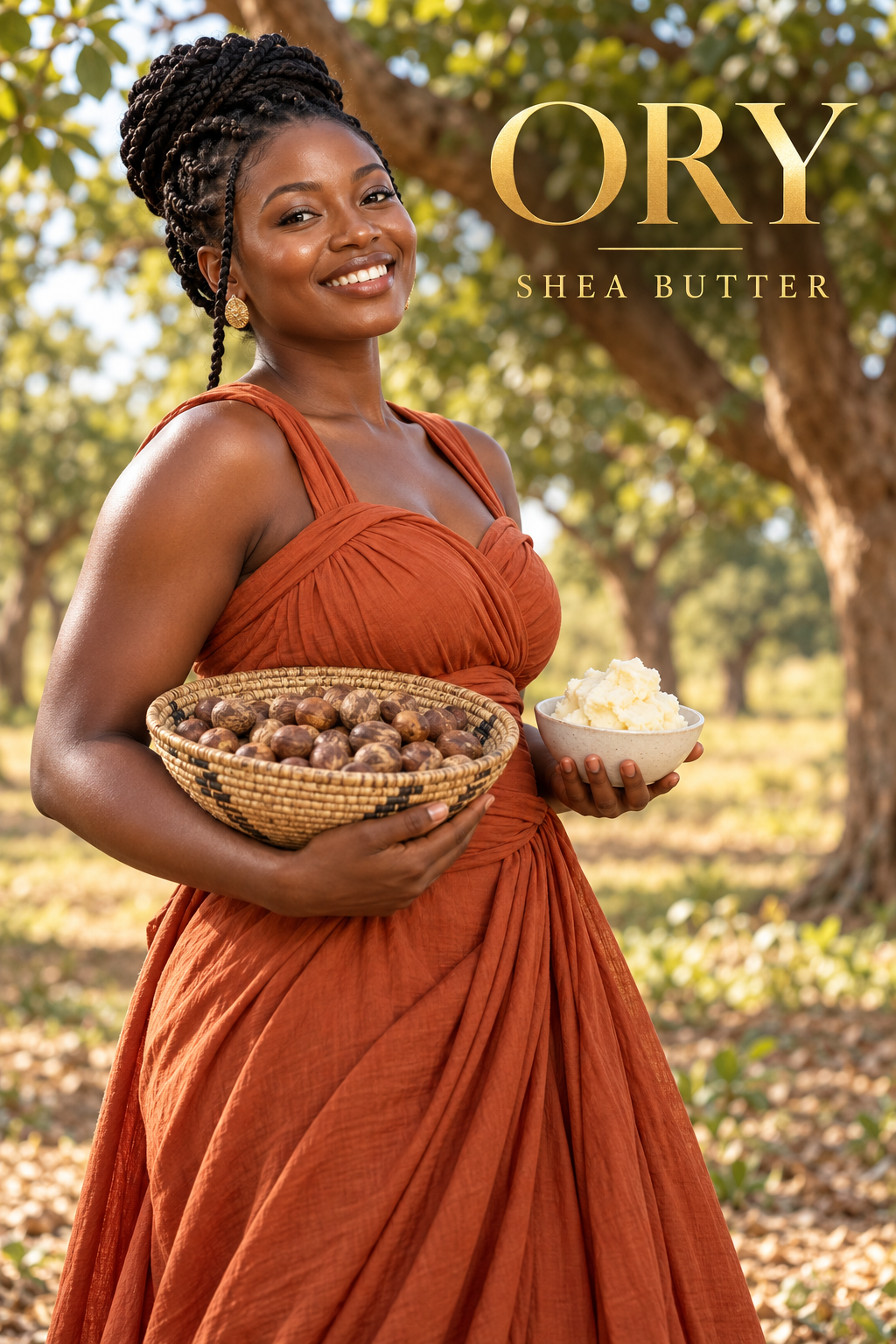
Shea butter is the fat pressed from the nuts of the West African shea tree (Vitellaria paradoxa), harvested and processed largely by women’s cooperatives across the Sahel. It is unusual among plant fats for its high content of unsaponifiable triterpene esters — cinnamate and acetate esters of lupeol, α- and β-amyrin, and butyrospermol — which have demonstrated anti-inflammatory activity in laboratory studies [1], alongside stearic and oleic acids that form a protective, cushioning emollient film. A clinical comparison found a shea-based lipid cream and cleanser performed comparably to a ceramide product for eczema [2], and its tocopherol content varies with origin [3]. Shea is the structural butter of balms, body butters, hair masks, conditioner bars, and handmade soap, where it adds hardness and creamy, conditioning lather.
What is Shea Butter made of?
Shea butter is produced by crushing, roasting, and kneading the nut kernels (traditional) or by pressing and refining. Composition [1, 3]:
- Stearic acid (35–45%) and oleic acid (40–55%): Semi-solid, cushioning emollient; barrier-supporting.
- Linoleic (3–8%), palmitic (3–7%) acids: Minor.
- Unsaponifiables (5–17% — very high): triterpene cinnamates/acetates (lupeol, amyrins), tocopherols, phytosterols, karitene: Anti-inflammatory, UV-absorbing minors [1].
- Comedogenic rating 0–2; shelf life 18–24 months; melts at ~32–38 °C.
- Soap data: SAP ~0.128 g NaOH/g; adds hardness, creamy conditioning lather; 5–15% of oils (higher makes brittle bars).
What skin type is best suited for Shea Butter?
Shea suits dry, sensitive, and mature skin best, with lighter use for oily types:
- Dry: Rich, protective; the classic body butter.
- Sensitive: Anti-inflammatory triterpenes; eczema support comparable to a ceramide cream [2].
- Mature: Cushioning barrier repair; antioxidant tocopherols [3].
- Normal: Balms, hand and lip care.
- Combination: Body and dry zones.
- Oily: Body only; too rich for the face.
- Acne-prone: Low comedogenicity but heavy; body use; refined shea in light lotions only.
What hair type is best suited for Shea Butter?
Shea is the sealing butter of curly and coily haircare:
- Dry or damaged: Shea butter coats and softens the fiber, reducing moisture loss and mechanical breakage.
- Curly and coily: Sealing oil over water-based leave-ins (LOC/LCO method).
- Color-treated or chemically processed: Replenishes lipids stripped by chemical services.
- Straight and wavy: Too heavy for fine/straight hair except as a trace ends balm.
- Oily scalp: Lengths and ends only.
- Sensitive scalp: Neutral carrier for scalp actives; patch test.
- Dandruff-prone, mature or thinning: Carrier for rosemary, peppermint, or tea tree scalp treatments.
What are the benefits of Shea Butter?
Shea butter’s benefits are supported by laboratory, clinical, and compositional studies [1–3]:
- Anti-inflammatory: Triterpene esters inhibit inflammatory mediators [1].
- Barrier protection: Semi-occlusive film reduces water loss; eczema support [2].
- Deep moisturization: Stearic–oleic cushion.
- Antioxidant: Tocopherols and phytosterols [3].
- Mild UV absorption: Cinnamate esters (not a sunscreen).
- Hair sealing and definition: Curly/coily moisture retention.
- Soap hardness and creamy lather: Conditioning structural fat.
- Cosmetic structure: Lip balms, sticks, cream blush.
Dual use across ORY® product lines
Shea butter is a true four-line ingredient and a structural staple.
Pros and cons of Shea Butter
Pros
Cons
- High unsaponifiables: Rare anti-inflammatory triterpenes [1].
- Clinical eczema support: [2].
- Structural and stable: Long shelf life; builds sticks and bars.
- Fair-trade, women-led supply: Strong story.
- Four-line utility: All ORY® products.
- Heavy: Not for oily faces or fine hair.
- Graininess: Can crystallize into grains if cooled slowly; temper properly.
- Nutty odor (unrefined): Refined for neutral products.
- Brittle soap above ~15%: Balance with liquid oils.
- Nut-family caution: Rare; patch test (shea is generally tolerated by tree-nut-allergic individuals).
What is the best application of Shea Butter?
Shea is a balm, butter, and bar staple:
- Body butter: Whipped shea with jojoba and vitamin E.
- Healing balm: Shea, beeswax, calendula-infused oil.
- Hand and foot cream: 10–20% shea.
- Lip balm: 20–30%.
- Curl butter or hair mask: With avocado oil.
- Conditioner bar: 10–20% with BTMS.
- Soap: 5–15%.
- Cosmetics: Lipstick and cream-stick structure.
Peer-reviewed references
- Akihisa T, Kojima N, Kikuchi T, et al. Anti-inflammatory and chemopreventive effects of triterpene cinnamates and acetates from shea fat. Journal of Oleo Science. 2010;59(6):273–280.
- Hon KL, Tsang YC, Pong NH, et al. Patient acceptability, efficacy, and skin biophysiology of a cream and cleanser containing lipid complex with shea butter extract versus a ceramide product for eczema. Hong Kong Medical Journal. 2015;21(5):417–425.
- Maranz S, Wiesman Z. Influence of climate on the tocopherol content of shea butter. Journal of Agricultural and Food Chemistry. 2004;52(10):2934–2937.
Disclaimer:
The information on this page is provided by ORY International, LC for educational purposes only. It summarizes published research about shea butter as an ingredient, including laboratory and animal studies and clinical studies of formulas that may differ from ORY® products. Results from these studies may not apply to every person or to ORY® products. This page is not medical advice and does not replace advice from a dermatologist, physician, or other qualified healthcare provider.
ORY® Skincare, Haircare, Handmade Soap, and Cosmetics products are cosmetics. They are not intended to diagnose, treat, cure, mitigate, or prevent any disease or condition, including eczema, atopic dermatitis, inflammation, sunburn, or any other condition. References to FDA or Cosmetic Ingredient Review (CIR) findings describe the ingredient, not ORY® products, and do not mean FDA has reviewed or approved any ORY® product.
Results vary by skin and scalp type, formulation, and use. Shea comes from a tree nut, but shea butter allergy is rare; people with nut allergies should still patch test. Any cosmetic can cause irritation, sometimes from other ingredients. Always patch test, follow label directions, and stop use if irritation occurs. If you are pregnant, nursing, have a medical condition, or are buying for a child, consult a healthcare provider before use.
ORY International, LC works to keep this page accurate and current but makes no warranty as to its completeness. To the fullest extent permitted by law, ORY International, LC is not liable for any loss or injury arising from reliance on this information or from use of any product contrary to its label directions. To report a reaction, contact us at [insert contact email / phone].