No products in the cart.: $0.00

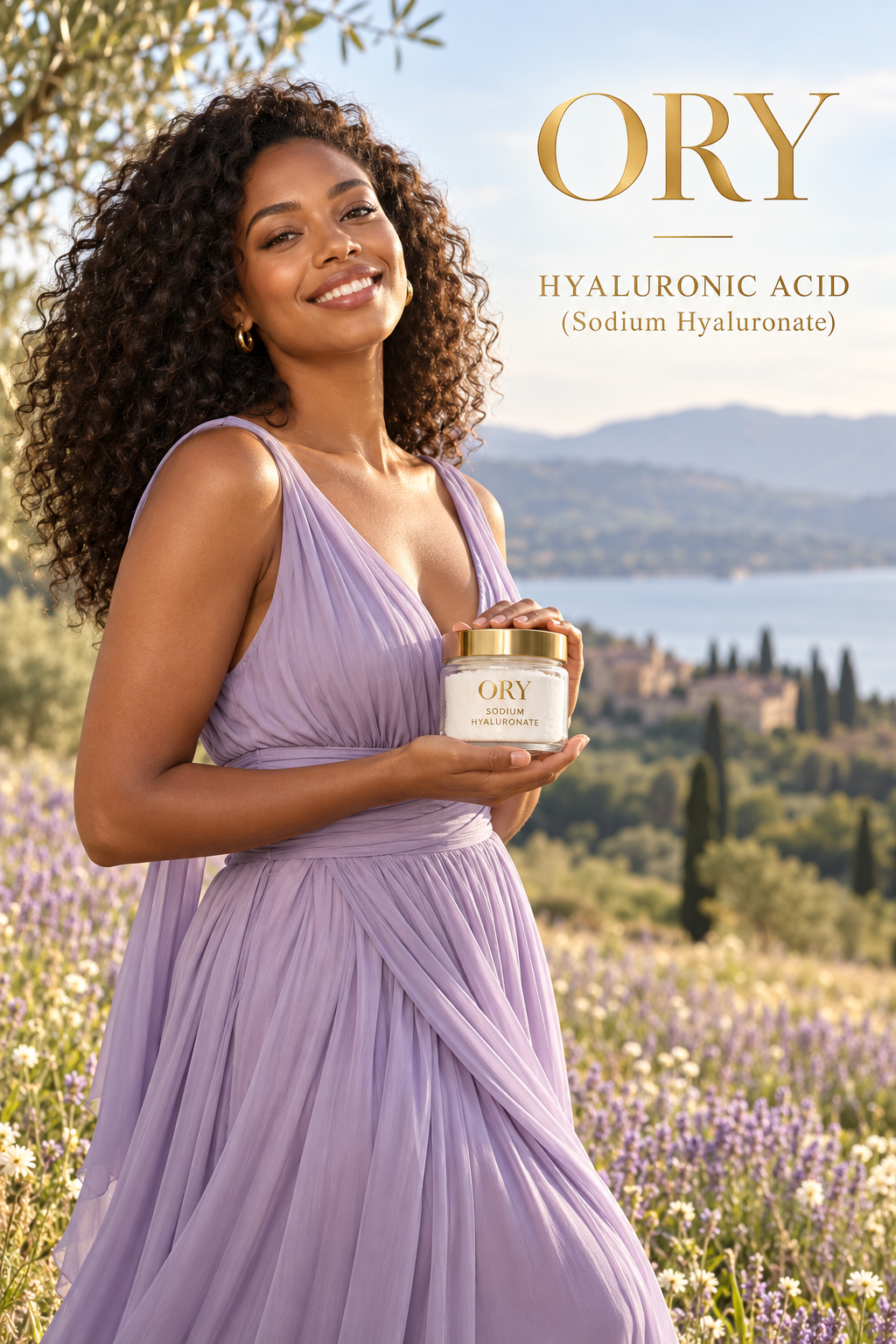
Hyaluronic Acid (Sodium Hyaluronate)
ORY® product lines:
☑ Skincare
☑ Haircare
☒ Handmade Soap (rinse-off; no functional benefit)
☑ Cosmetics — three-line dual-use ingredient
Hyaluronic acid (HA) is a naturally occurring glycosaminoglycan found throughout the human body, with about half of it in the skin, where it binds water and gives the dermis its plumpness. Skin HA declines with age and sun exposure, contributing to dryness and wrinkles [1]. Topical HA is a humectant that can hold many times its weight in water; larger molecules form a hydrating film on the surface while smaller (low-molecular-weight) fractions penetrate further and have shown greater wrinkle-depth improvement in clinical studies [2]. Cosmetic HA is produced by bacterial fermentation, is vegan, and has been judged safe by the Cosmetic Ingredient Review Panel [4].
What is Hyaluronic Acid made of?
Hyaluronic acid is a long chain of repeating disaccharide units (D-glucuronic acid and N-acetyl-D-glucosamine). Key facts for ORY® customers:
- Source: Modern cosmetic HA is produced by fermentation of Streptococcus zooepidemicus or engineered Bacillus strains — no animal (rooster comb) sourcing.
- Sodium hyaluronate: The stable sodium salt, smaller and more soluble than the free acid; the form used in most ORY® formulas.
- Molecular weight matters: High MW (>1,000 kDa) forms a breathable surface film that reduces water loss; medium MW (100–1,000 kDa) hydrates the upper epidermis; low MW (<50 kDa, hydrolyzed HA) penetrates deeper and improved wrinkle depth and elasticity in a 60-day clinical comparison [2].
- Water-soluble powder: Dispersed into the water phase; forms a gel at about 1%.
What skin type is best suited for Hyaluronic Acid?
Hyaluronic acid is suitable for all seven ORY® skin types; the choice of molecular weight and base tailors it to each:
- Dry: Multi-weight HA in a cream base for both surface and deeper hydration.
- Mature: Low-MW HA improves wrinkle depth, elasticity, and skin roughness [2].
- Sensitive: Non-irritating; high-MW HA is also anti-inflammatory and supports barrier recovery.
- Oily: Water-light HA serums hydrate without oil; well-hydrated skin often produces less compensatory sebum.
- Acne-prone: Non-comedogenic hydration; buffers the drying effect of acne actives.
- Combination: Hydrates dry zones without adding weight to oily zones.
- Normal: Daily hydration and plumpness maintenance.
What hair type is best suited for Hyaluronic Acid?
HA hydrates the scalp exactly as it hydrates skin, and on the hair fiber it binds water to the cuticle for softness and reduced static:
- Dry or damaged: The best match — leave-in HA treatments improve moisture and manageability.
- Curly and coily: Adds water-based moisture that supports curl definition without heavy oils.
- Color-treated or chemically processed: Replenishes water lost during chemical services and reduces brittleness.
- Sensitive scalp: Soothing hydration for a tight, flaky scalp.
- Mature or thinning: Hydrates an aging scalp; supportive rather than growth-promoting.
- Straight, wavy: Lightweight hydration and shine without weighing hair down.
- Oily and dandruff-prone scalp: Hydration without oil; helps balance a scalp dried out by clarifying actives.
What are the benefits of Hyaluronic Acid?
Hyaluronic acid’s benefits center on hydration and everything that follows from it [1, 2, 3]:
- Intense hydration: Binds water in the stratum corneum, raising skin hydration measurably within hours.
- Plumping and wrinkle reduction: Well-hydrated skin looks smoother; low-MW HA reduced wrinkle depth in clinical testing [2].
- Barrier support: High-MW HA reduces transepidermal water loss and supports recovery after acids or retinol.
- Anti-inflammatory and wound support: HA is a native component of the wound-healing matrix; topical HA supports repair.
- Elasticity: Improves firmness and elasticity measurements with continued use [2, 3].
- Antioxidant support: Helps scavenge reactive oxygen species generated by UV exposure.
- Hair and scalp moisture: Hydrates the scalp and binds water to the hair cuticle, improving softness and reducing breakage from dryness.
Dual use across ORY® product lines
HA is a water-phase humectant that performs in leave-on and low-rinse products. In cold-process soap it is stable but rinses away immediately, so it provides marketing value only — ORY® does not recommend it there.
Pros and cons of Hyaluronic Acid
Pros
Cons
- Universally tolerated: Suitable for every skin and hair type, including reactive and post-procedure skin.
- Immediate visible effect: Plumper, dewier skin within a single application.
- Layer-friendly: Compatible with virtually all actives; enhances comfort of acids and retinol.
- Vegan and sustainable: Fermentation-derived.
- Tunable: Molecular-weight selection lets ORY® customize depth of action.
- Humectant limitation: In very dry climates HA can pull water from the skin if not sealed with a moisturizer or oil.
- Temporary results: Plumping is hydration-based and fades without continued use.
- Preservation: HA solutions are microbe-friendly; robust preservation is required.
- Viscosity: High-MW HA thickens formulas and can feel tacky above 1%.
- Cost: Low-MW and crosspolymer grades are premium-priced.
- No benefit in soap: Wasted in rinse-off bars.
What is the best application of Hyaluronic Acid?
Hyaluronic acid performs best on damp skin, sealed with a moisturizer:
- Serum: Apply to damp skin after cleansing/toning, AM and PM, then seal with cream or oil.
- Moisturizer: Built into creams for all-day hydration.
- Sheet or overnight masks: Weekly intensive hydration.
- Eye cream: Reduces fine dehydration lines under the eyes.
- Post-active support: Layer over glycolic, salicylic, or retinol products to offset dryness.
- Leave-in hair treatment: Apply to damp hair mid-length to ends; seal with a light oil for curly/coily hair.
- Scalp serum: Hydrating leave-in for dry, tight scalps.
- Cosmetics: Hydrating primer or foundation for a dewy finish; lip balm for plump lips.
Peer-reviewed references
- Papakonstantinou E, Roth M, Karakiulakis G. Hyaluronic acid: a key molecule in skin aging. Dermato-Endocrinology. 2012;4(3):253–258.
- Pavicic T, Gauglitz GG, Lersch P, et al. Efficacy of cream-based novel formulations of hyaluronic acid of different molecular weights in anti-wrinkle treatment. Journal of Drugs in Dermatology. 2011;10(9):990–1000.
- Bukhari SNA, Roswandi NL, Waqas M, et al. Hyaluronic acid, a promising skin rejuvenating biomedicine: a review of recent updates and pre-clinical and clinical investigations on cosmetic and nutricosmetic effects. International Journal of Biological Macromolecules. 2018;120(Pt B):1682–1695.
- Becker LC, Bergfeld WF, Belsito DV, et al. Final report of the safety assessment of hyaluronic acid, potassium hyaluronate, and sodium hyaluronate. International Journal of Toxicology. 2009;28(4 Suppl):5–67.
Disclaimer:
The information on this page is provided by ORY International, LC for educational purposes only. It summarizes published research about hyaluronic acid as an ingredient, including laboratory and animal studies and clinical studies of formulas that may differ from ORY® products. Results from these studies may not apply to every person or to ORY® products. This page is not medical advice and does not replace advice from a dermatologist, physician, or other qualified healthcare provider.
ORY® Skincare, Haircare, and Cosmetics products are cosmetics. They are not intended to diagnose, treat, cure, mitigate, or prevent any disease or condition, including wounds, dermatitis, dandruff, or hair loss. References to FDA or Cosmetic Ingredient Review (CIR) findings describe the ingredient, not ORY® products, and do not mean FDA has reviewed or approved any ORY® product.
Topical hyaluronic acid is not the same as injectable hyaluronic acid fillers and does not fill wrinkles structurally.
Results vary by skin and scalp type, formulation, and use. Reactions to hyaluronic acid are rare, but any cosmetic can cause irritation, sometimes from other ingredients. Always patch test, follow label directions, and stop use if irritation occurs. If you are pregnant, nursing, have a medical condition, or are buying for a child, consult a healthcare provider before use.
ORY International, LC works to keep this page accurate and current but makes no warranty as to its completeness. To the fullest extent permitted by law, ORY International, LC is not liable for any loss or injury arising from reliance on this information or from use of any product contrary to its label directions. To report a reaction, contact us at [insert contact email / phone].