
No products in the cart.: $0.00

Azulene Extract
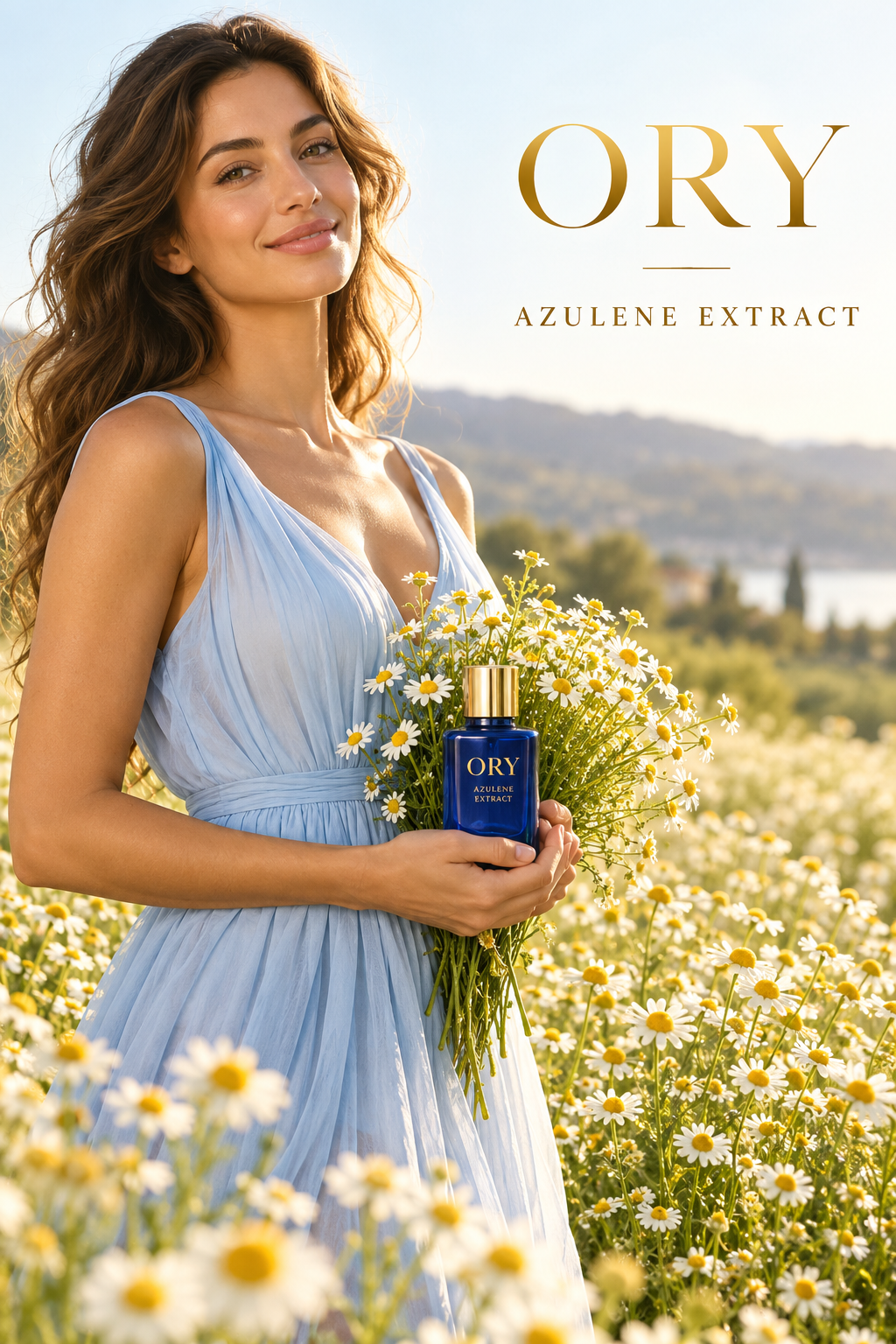

ORY® product lines:
☑ Skincare
☑ Haircare
☑ Handmade Soap (color fades)
☑ Cosmetics (skin-calming color-correctors) — full dual-use ingredient
Azulene is the deep-blue hydrocarbon that forms when the plant precursor matricin is heated during steam distillation of German chamomile, blue tansy, or yarrow. Chamazulene (the natural form) and guaiazulene (its more stable relative from guaiac wood) are potent anti-inflammatories: chamazulene inhibits leukotriene B4 formation [1], and its carboxylic-acid precursor behaves as a natural non-steroidal anti-inflammatory [2]. Azulene’s soothing reputation in dermatology and post-waxing care is matched by its striking color, which lets ORY® create naturally blue calming products. It is oil-soluble, gentle, and usable in all four ORY® lines — with the caveat that its blue color fades with light and in cold-process soap.
What is Azulene Extract made of?
Azulene extract is obtained by steam distillation of chamomile, blue tansy, or yarrow flowers (heat converts matricin to chamazulene), or by isolating guaiazulene from guaiac wood or synthesizing it. Components:
- Chamazulene: The anti-inflammatory blue sesquiterpene from chamomile (2–18% of German chamomile oil) [3].
- Guaiazulene: A more light-stable azulene used as a soothing agent and blue colorant; sensitive to oxidation.
- Alpha-bisabolol and bisabolol oxides: Companion soothers in chamomile-derived azulene oils.
- Sabinene, camphor (blue tansy): Present in Tanacetum annuum oil; ORY® prefers chamomile or guaiazulene grades for camphor-free products.
- Carrier: Supplied in oil or as a water-dispersible complex (e.g., sodium guaiazulene sulfonate for water-based products).
What skin type is best suited for Azulene Extract?
Azulene is a specialist for reactive, inflamed, and post-treatment skin:
- Sensitive: The primary use — reduces redness, stinging, and reactivity.
- Acne-prone: Calms inflammatory lesions and reduces post-acne redness.
- Dry: Oil-based azulene soothes chapped, wind-burned skin.
- Combination: Calming serums for reactive zones.
- Mature: Anti-inflammatory support against inflammaging.
- Normal: After-sun and post-waxing care.
- Oily: Use water-dispersible guaiazulene at low levels.
What hair type is best suited for Azulene Extract?
Azulene calms the scalp and gives naturally blue-tinted products:
- Sensitive scalp: Reduces itch and irritation after coloring or from surfactants.
- Dandruff-prone scalp: Anti-inflammatory support alongside antifungal actives.
- Color-treated or chemically processed: Soothes post-service scalp burn; azulene’s blue can also help offset brassiness in blonde formulas.
- Dry or damaged: Oil-phase conditioning with soothing benefit.
- Mature or thinning, oily scalp, straight, wavy, curly, coily: Scalp-comfort ingredient for all.
What are the benefits of Azulene Extract?
Azulene’s benefits center on inflammation control [1–3]:
- Anti-inflammatory: Chamazulene inhibits leukotriene B4 synthesis, a key inflammatory pathway [1].
- Natural NSAID-like action: Chamazulene carboxylic acid acts like a profen-class anti-inflammatory [2].
- Soothing after hair removal: Classic post-wax and post-shave ingredient to reduce redness and bumps.
- Antioxidant: Scavenges free radicals; supports photo-protection.
- Antimicrobial support: Chamomile-derived oils show mild antibacterial activity [3].
- Wound-healing support: Chamomile terpenes promote re-epithelialization.
- Natural color: Provides blue to blue-green tint without synthetic dyes (color-correcting cosmetics, spa-look products).
Dual use across ORY® product lines
Azulene is oil-soluble and gentle enough for every line; its main limitation is color instability in light and in high-pH soap.
Pros and cons of Azulene Extract
Pros
Cons
- Potent soother: Effective at very low levels.
- Natural blue color: Distinctive, dye-free visual cue for calming products.
- Oil-soluble and mild: Suits balms, oils, and emulsions.
- Post-hair-removal heritage: Long professional spa use.
- Four-line utility: Skin, scalp, soap, and cosmetics.
- Color instability: Fades with light and oxygen; can shift to green or brown in soap.
- Cost: Chamomile-derived azulene is expensive.
- Asteraceae allergy: Chamomile/yarrow/tansy family; patch test.
- Camphor in blue tansy: Avoid blue tansy grades for pregnancy-conscious or child products.
- Limited human trials: Strong mechanistic data; fewer controlled clinical studies than allantoin or niacinamide.
What is the best application of Azulene Extract?
Azulene belongs in calming and post-treatment products:
- Post-wax or post-shave balm: Apply immediately after hair removal to reduce redness and bumps.
- Calming serum: Daily for redness-prone and rosacea-prone skin.
- After-sun oil or lotion: With aloe and bisabolol.
- Eye gel: Water-dispersible guaiazulene for puffiness and redness.
- Mask: Weekly blue calming mask.
- Scalp treatment: After coloring or for itchy scalps.
- Soap: Sensitive-skin bar; add at trace.
- Cosmetics: Color-correcting primer to neutralize redness.
Peer-reviewed references
- Safayhi H, Sabieraj J, Sailer ER, Ammon HP. Chamazulene: an antioxidant-type inhibitor of leukotriene B4 formation. Planta Medica. 1994;60(5):410–413.
- Ramadan M, Goeters S, Watzer B, et al. Chamazulene carboxylic acid and matricin: a natural profen and its natural prodrug, identified through similarity to synthetic drug substances. Journal of Natural Products. 2006;69(7):1041–1045.
- Srivastava JK, Shankar E, Gupta S. Chamomile: a herbal medicine of the past with a bright future. Molecular Medicine Reports. 2010;3(6):895–901.
- McKay DL, Blumberg JB. A review of the bioactivity and potential health benefits of chamomile tea (Matricaria recutita L.). Phytotherapy Research. 2006;20(7):519–530.
Disclaimer:
The information on this page is provided by ORY International, LC for educational purposes only. It summarizes published research about azulene extract as an ingredient, including laboratory and animal studies and clinical studies of formulas that may differ from ORY® products. Results from these studies may not apply to every person or to ORY® products. This page is not medical advice and does not replace advice from a dermatologist, physician, or other qualified healthcare provider.
ORY® Skincare, Haircare, Handmade Soap, and Cosmetics products are cosmetics. They are not intended to diagnose, treat, cure, mitigate, or prevent any disease or condition, including rosacea, acne, eczema, dermatitis, dandruff, burns, wounds, or razor bumps. References to FDA or Cosmetic Ingredient Review (CIR) findings describe the ingredient, not ORY® products, and do not mean FDA has reviewed or approved any ORY® product.
Results vary by skin and scalp type, formulation, and use. Azulene-rich oils come from plants in the daisy (Asteraceae) family, so people with ragweed or chamomile allergy may react, and any cosmetic can cause irritation, sometimes from other ingredients. Always patch test, follow label directions, and stop use if irritation occurs. If you are pregnant, nursing, have a medical condition, or are buying for a child, consult a healthcare provider before use.
ORY International, LC works to keep this page accurate and current but makes no warranty as to its completeness. To the fullest extent permitted by law, ORY International, LC is not liable for any loss or injury arising from reliance on this information or from use of any product contrary to its label directions. To report a reaction, contact us at [insert contact email / phone].